
Today · Market review
US yields ease as German exports weaken
On 8 October, the US 10-year Treasury yield fell to 5.22%, but central-bank Governor Christopher Waller did not rule out further rate rises. German August exports meanwhile showed a decline in the value of exported goods. This offers some relief for bonds, not confirmation of cheaper loans or better company sales.
Period covered: 2026-10-09Information as of 10 min read
US 2-, 10- and 30-year Treasury yields fell on 8 October. New German export data showed a decline, while the ECB meeting account and Waller’s speech announced no new rate decision.
The US target range remains 3.75–4.00%, and the euro area deposit rate is 2.50%. A one-day decline in bond yields does not change payments on existing fixed-rate loans.
Today
What happened
Waller leaves further rate rises open despite few layoffs
On 8 October, Governor Christopher Waller of the US central bank, the Federal Reserve (Fed), assessed the latest labour market information: in his view, the labour market remains stable while inflation is too high. He expects further rate increases if economic data develop as he anticipates, but increases need not come at consecutive meetings. This is his assessment, not a new Fed decision.
? Fed rate projections: what do they show?
In September, 16 of the 18 meeting participants envisaged at least one further rate increase at the year’s two remaining meetings; four of those 16 envisaged two. These are individual projections conditional on economic developments, not probabilities or a promise. The target range in force since 17 September is 3.75–4.00%.
On 8 October, the US Department of Labor reported 197,000 initial unemployment benefit claims for the week ending 3 October, compared with a revised 199,000 the previous week. Low claims indicate few layoffs but do not establish rapid job creation. The September employment report, released earlier on 2 October, showed a net increase of only 29,000 non-farm jobs. These different measures explain how the labour market can be slow yet, in Waller’s assessment, still stable.
? Unemployment benefit claims: what do they measure?
This is a weekly, seasonally adjusted count of claims under state unemployment insurance programmes, not a count of everyone losing a job or of new jobs created. In this release, the previous week’s figure was revised from 197,000 to 199,000; the comparison uses that revised base.
Daily yields fell, but new long-term government borrowing cost more than in September
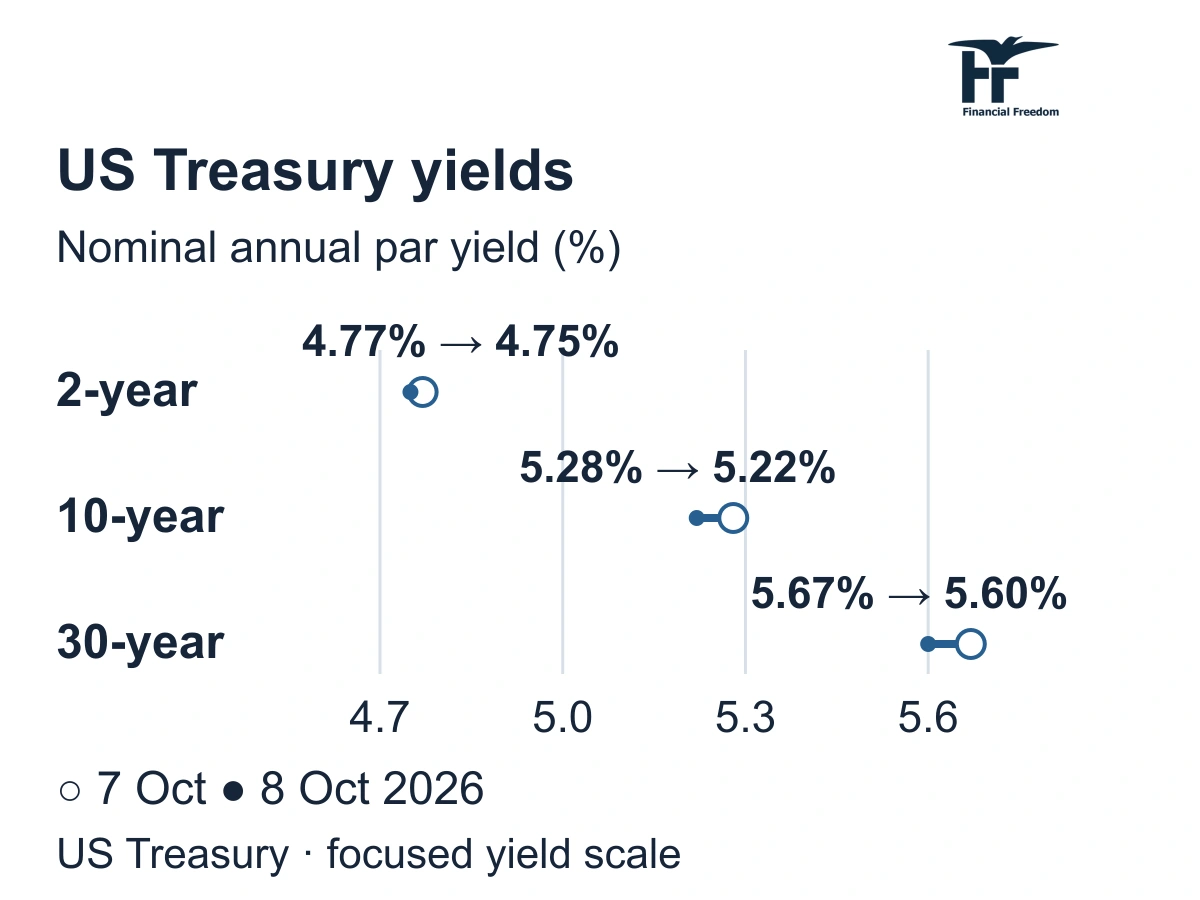
On 8 October, annual US Treasury yields fell at all three maturities being tracked. The two-year yield was 4.75%, the 10-year yield 5.22%, and the 30-year yield 5.60%. Compared with 7 October, they declined by 2, 6 and 7 basis points respectively. Longer-term yields fell more than shorter-term yields that day, but a one-day move does not establish the longer-term direction of interest rates.
Also on 8 October, the US Treasury reopened an existing 30-year bond, offering $22 billion. The highest accepted annual yield was 5.618%, compared with 5.308% at the 10 September reopening of the same issue. Thus, although daily market yields fell, the government borrowed at this auction at a yield 0.31 percentage points higher than a month earlier.
? Yields and auctions: why are they not the same measure?
Daily yields are derived from indicative quotations around 15:30 New York time, while the auction took place earlier and sold a specific bond issue. One basis point is 0.01 percentage points; yield is not an investment return already earned. The auction’s public bid-to-cover ratio declined from 2.61 in September to 2.54 in October: it does not count unique buyers or guarantee subsequent price direction.
The ECB explained September’s rate increase without promising the next step
On 8 October, the European Central Bank published its account of the 9–10 September meeting. All Council members supported the increase of 0.25 percentage points at that meeting. The deposit facility rate has been 2.50% since 16 September. There was no new rate decision on 8 October: the new information is the Council’s reasoning and the qualifications it discussed.
The Council was concerned about energy becoming more expensive for longer. However, September’s discussion had not yet found broad transmission to wages and other prices. The distinction matters: dearer fuel raises costs but does not itself establish that all prices will accelerate at the same pace. The ECB neither promised another increase nor declared September’s step the last.
Fuel delivery remains relevant following the International Energy Agency’s 7 October statement on faster fulfilment of March reserve commitments. That day, the US Energy Information Administration reported distillate stocks of about 105.1 million barrels in the week ending 2 October, 12% below the corresponding five-year seasonal average. These are earlier weekly inventories, not today’s oil price or a new reserve volume already delivered.
? Distillate stocks: what do they measure?
Distillates include diesel and heating oil. US stocks are compared with the five-year average for the corresponding season; this does not describe worldwide inventories or determine the fuel price.
German exports fell, but sales to different destinations diverged
For your investments
Let’s discuss your portfolio
 FINANCIAL FREEDOM01 / 04
Investment results since 1999
Are you beating
global equities?

at the end of the period
Jan 1999–Jun 2026 · EUR · Cumulative return, %
Linear scale · * MSCI World → MSCI ACWI.
Past performance does not guarantee future returns.
FINANCIAL FREEDOM02 / 04Historical comparison
How far did it fall?
How long to recover?
Decline from the previous high

Longest recovery to the previous high

Jan 1999–Jun 2026 · EUR · Monthly data
* MSCI World → MSCI ACWI.
Past performance does not guarantee future returns.
FINANCIAL FREEDOM03 / 04Personal investment consultation
Already investing?
Let’s review your portfolio.
Yet to start
investing?
Let’s build your first
investment plan.
FINANCIAL FREEDOM04 / 04
Personal investment
consultation
Martynas
Juška
Investment manager
Managing a portfolio
of more than€100 million
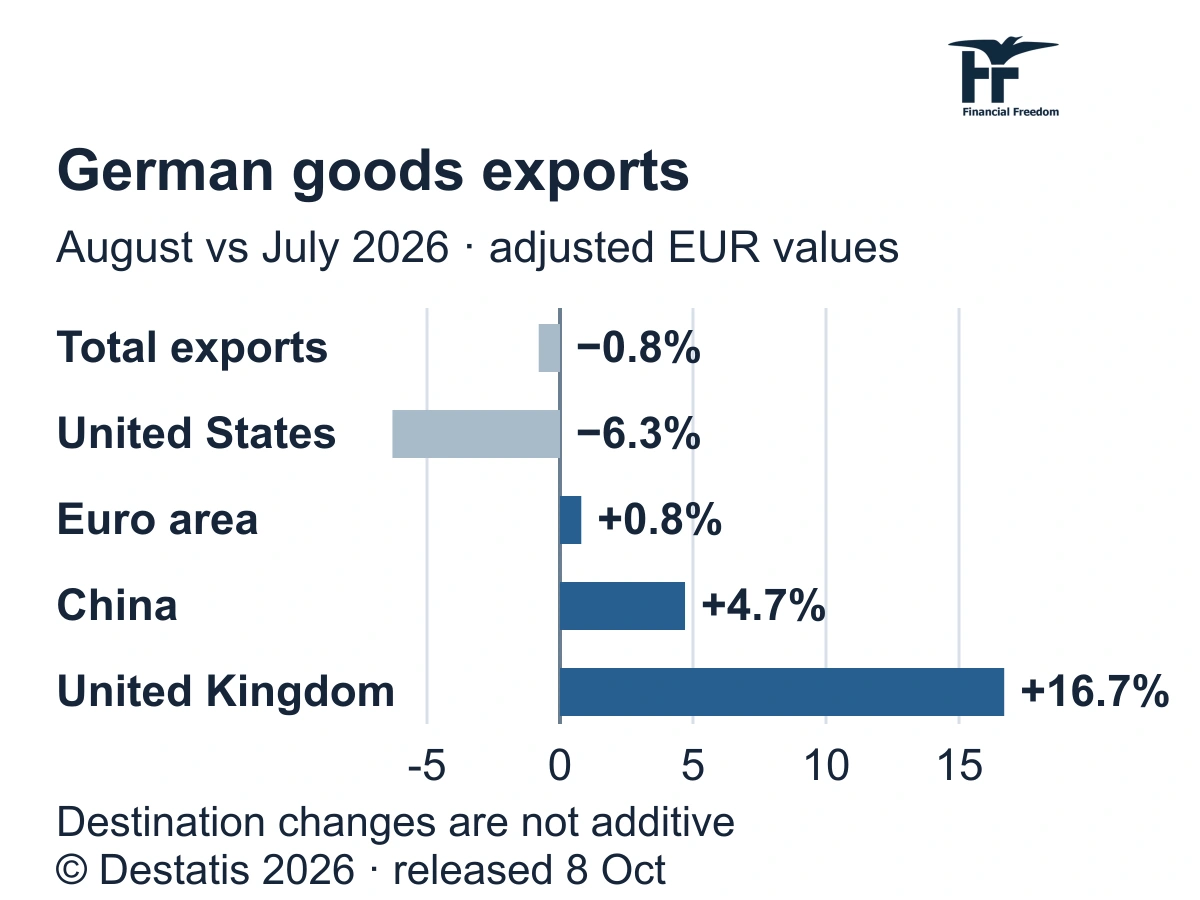
The clearest new difference is between destination markets. Exports to the United States fell 6.3%, while shipments to the euro area rose 0.8%, China 4.7% and the United Kingdom 16.7%. Exporters did not experience a uniform decline. Moreover, sales to the US remained 22.6% above August 2025: the monthly fall did not erase the earlier year-on-year increase.
These figures do not yet explain which goods or causes produced the differences. The decline in exports to the US therefore cannot simply be attributed to tariffs: a more detailed goods breakdown and companies’ own sales may still change the assessment.
? Export change: what is being compared?
August and July goods values in euros are calendar and seasonally adjusted. They measure nominal value, not physical quantities alone. Destination changes are not additive contributions to the total; the annual comparison uses a different denominator.
Europe’s risk assessment linked technology borrowing and profit expectations
On 8 October, the European Systemic Risk Board published the assessment from its 1 October meeting: EU financial-stability risks had increased during the preceding quarter. The Board highlighted technology companies borrowing to expand artificial intelligence and the risk that future profit expectations may be too optimistic. This is a warning about a possible scenario, not a report of those companies already defaulting.
The risk extends beyond technology shares. More expensive government debt servicing reduces fiscal room, while funds investing with borrowed money can amplify bond-market swings. Conversely, the Board noted European banks’ strong capital, liquidity and profitability. Technology-financing concentration is smaller in the EU than in the US, so the two regions should not be treated as carrying identical risks.

More time for what matters to you
Who looks after your portfolio?
Portfolio management covers investment selection, risk monitoring and rebalancing. Let’s discuss whether this approach would suit you.
The first conversation is free, with no obligation.
Today
What matters now
A daily decline in yields can benefit holders of long-maturity fixed-rate US bonds, whose market prices generally move in the opposite direction. However, Waller’s conditional outlook for further rate increases remains a risk if new data show persistent inflation. An investor buying a new bond sees a lower daily yield than a day earlier; that is different from a change in the price of a bond already owned.
Property and infrastructure companies need to consider the terms on which they can refinance debt. A lower government bond yield may help, but a company’s borrowing cost also depends on its risk and contract; a daily move does not change the payment on an existing fixed-rate loan. For consumer goods companies, few layoffs support continuity of household income, while slow job creation limits the scope for demand growth. Bond holdings and consumer equities therefore receive different signals.
The rate outlook depends on costs spreading, not on oil alone
The prices of longer-dated fixed-rate euro bonds and heavily indebted property companies could face pressure if future data encourage further rate increases. Shorter-dated euro bonds are less sensitive to that price change. Less inflation transmission would improve the prospect of longer bonds recovering, but a reserve commitment alone is not enough.
Freight and industrial companies need actual fuel deliveries, while refiners’ profits depend on the gap between product selling prices and crude purchase costs. Restored supply could lower the former’s expenses but weaken refiners’ benefit from product scarcity. The same supply improvement affects different portfolio holdings differently.
The ECB reference rate was $1.1186 per euro on 8 October, compared with $1.1177 on 7 October. The small euro appreciation reduces the euros needed for an unchanged dollar-priced import and reduces the euro value of unhedged dollar assets if their dollar price is unchanged. This describes the currency effect, not the entire investment result.
? ECB reference rate: how should it be read?
The number is US dollars per euro. It is an informational daily rate, not an execution price, and its timing differs from the US market close. Asset-price changes and a currency hedge can alter the overall result.
An exporter’s sales geography matters more than the national headline
For German exporters of machinery, equipment and other industrial goods, weaker sales in a particular market can reduce capacity utilisation and profits. Companies selling into other expanding markets have a potential offset, but national trade data do not establish their results. Within European equity funds, geographic revenue exposure should be distinguished from a company’s country of registration.
Logistics and distribution companies depend on both flows: more imports can provide work even while exports fall. However, nominal goods values are not cargo quantities. The opportunity is demand in different markets providing an offset; the risk would be broader order weakness combined with higher fuel and borrowing costs.
Technology shares and corporate bonds can share the same underlying risk
A technology equity fund and a corporate-bond fund are not entirely independent if both depend on the same companies investing heavily in artificial intelligence. Shares depend on future profits; bonds depend on the ability to pay interest and repay debt. If substantial investment produces less revenue, both valuations could weaken. This is a conditional risk, not a forecast of unavoidable losses.
Bank-share valuations depend on whether customers’ ability to repay loans is deteriorating, not simply on financing becoming dearer. A fund spanning different borrowers and regions can be less dependent on one group of technology companies, but its name alone does not establish that diversification. Upcoming business-distress data will help test whether higher expenses are translating into actual payment difficulties.
Today
What comes next
9 October. Germany’s statistical office is scheduled to publish July business-insolvency data. Are financial difficulties increasing, and what will this add to the industrial and credit-risk assessment? July is the measurement period, not today’s insolvency count.
At 17:00 Lithuania time on 9 October, the University of Michigan is scheduled to release its preliminary October consumer survey. Are consumers’ inflation expectations and assessments of their finances changing? This will inform the consumption outlook, but expectations are not price changes that have already occurred.
At 15:30 on 14 October, the US Bureau of Labor Statistics will release September’s consumer price index. It will show whether actual price pressure is easing and help assess how the latest data compare with Waller’s view.
14 October. The International Energy Agency is scheduled to publish its Oil Market Report, informing the supply, refining and demand outlook.
15 October, 19:00 Lithuania time. The US Energy Information Administration will release data for the week ending 9 October: will distillate stocks begin to recover?
At 20:00 on 28 October, the Fed is scheduled to announce its meeting decision. Data released before then will inform whether rates are held or raised again; Waller’s 8 October remarks do not replace that decision.
29 October. The European Central Bank will take its next monetary-policy decision. The central question is whether new inflation and wage data justify further rate increases or whether transmission from dearer energy to other prices remains limited.
Important. This is general market analysis, not a personal recommendation to buy or sell. Historical data and company results do not guarantee future returns. Forecasts and conditional scenarios may not materialise.
How is the history preserved and updated?
All five periods in this edition share one information date. Week means the latest 7 days, quarter means 90 days, and year means the trailing 12 months. The next dated edition will have a separate URL. This text keeps its date and assessment; later events are not silently inserted into an older edition. Longer periods assess new evidence alongside earlier developments without repeating every headline.