
Today · Market review
Nasdaq fell another 0.74%; US retail sales growth slowed
Nasdaq Composite fell another 0.74% on 17 November, while US October retail sales growth slowed from 0.8% to 0.2% month on month. After the US market close, NVIDIA reported quarterly revenue up 103%, providing a fresh counterweight to weaker demand signals. The index close does not yet reflect that later announcement. Information cutoff: 18 November 2026, 08:20 Lithuanian time.
Period covered: 2026-11-18Information as of 6 min read
NVIDIA’s results, released after the US market close, showed rapidly growing equipment-supplier sales. Earlier that day, US retail sales and production showed uneven demand, while German expectations improved.
Slower sales do not automatically mean lower interest rates: prices and quantities affect monetary turnover, and a monthly estimate can be revised.
Today
What happened
Nasdaq fell for a second consecutive session
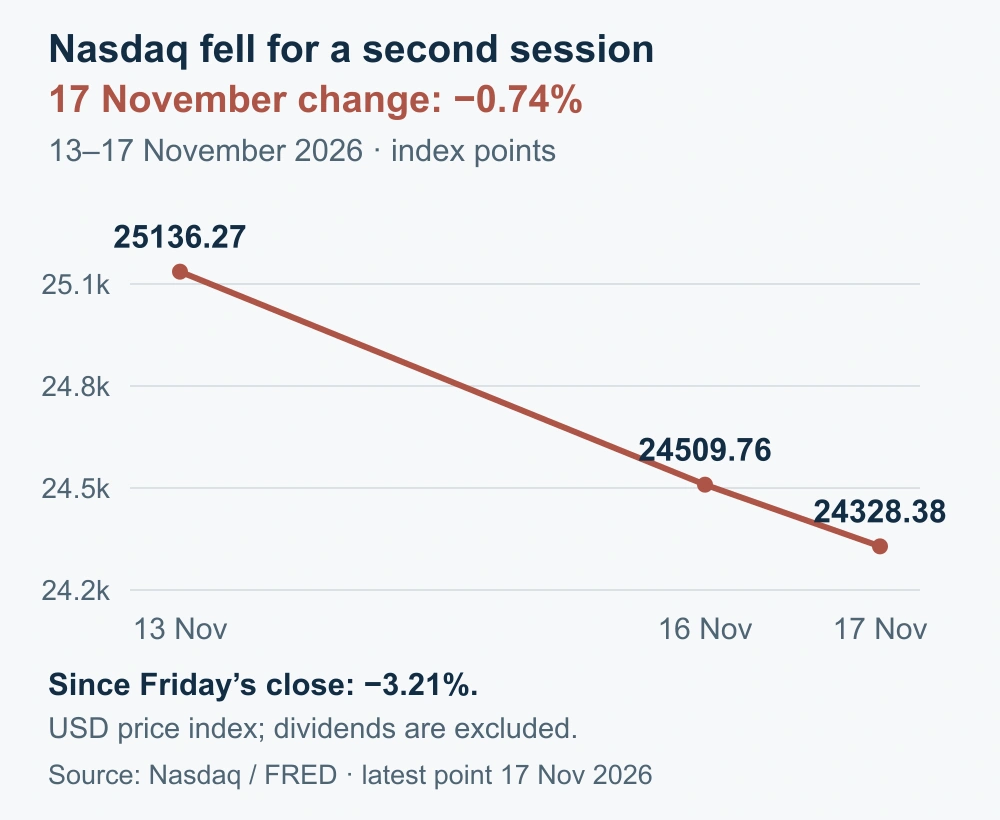
Nasdaq Composite closed on 17 November at 24,328.38 points, 0.74% below Monday’s 24,509.76 points. Over the two sessions since Friday, 13 November, the index lost 3.21%. These are price changes in US dollars, excluding dividends. This morning’s edition considers completed US sessions; trading on 18 November had not yet begun.
After the market close, NVIDIA reported more than doubled revenue
At 23:20 Lithuanian time on 17 November, after the regular US trading session, NVIDIA reported US$115.8 billion of revenue for the quarter ended 25 October. Revenue was 103% higher than a year earlier. The announcement came after the Nasdaq close cited above, so that session’s index change does not yet reflect a reaction to it.
For the next fiscal quarter, which will include an additional week, the company forecasts revenue of US$130 billion, plus or minus 3%. This is management guidance, not revenue already earned. The new report shows strong equipment-supplier sales, while its customers still need to earn returns from using the infrastructure they have purchased.
US retail sales growth slowed
The US Census Bureau reported on 17 November that October retail and food services sales totalled US$748.2 billion. Monthly growth slowed from September’s 0.8% to 0.2%. These are seasonally adjusted nominal sales: they do not by themselves show how many more goods customers actually bought.
The 0.2% figure is also an advance estimate with a margin of error that includes a decline. The clearer message is therefore a slower estimated growth rate, rather than certainty that customers spent more. This matters to a retailer planning inventory: slower revenue growth leaves less room to absorb rising costs.
Goods sales do not cover all household consumption. Much spending on services falls outside this report. It therefore cannot simply be relabelled as a measure of total US consumption or overall economic growth.
For your investments
Let’s discuss your portfolio
 FINANCIAL FREEDOM01 / 04
Investment results since 1999
Are you beating
global equities?

at the end of the period
Jan 1999–Jun 2026 · EUR · Cumulative return, %
Linear scale · * MSCI World → MSCI ACWI.
Past performance does not guarantee future returns.
FINANCIAL FREEDOM02 / 04Historical comparison
How far did it fall?
How long to recover?
Decline from the previous high

Longest recovery to the previous high

Jan 1999–Jun 2026 · EUR · Monthly data
* MSCI World → MSCI ACWI.
Past performance does not guarantee future returns.
FINANCIAL FREEDOM03 / 04Personal investment consultation
Already investing?
Let’s review your portfolio.
Yet to start
investing?
Let’s build your first
investment plan.
FINANCIAL FREEDOM04 / 04
Personal investment
consultation
Martynas
Juška
Investment manager
Managing a portfolio
of more than€100 million
Energy output pulled industry down while manufacturing grew
On the same day, the Federal Reserve reported that October industrial production fell 0.4% from September. Its components moved in different directions: manufacturing output rose 0.3%, mining fell 0.8%, and electricity and gas utilities output declined 4.3%. The overall fall therefore does not mean that every US factory experienced the same drop in orders.
The sales and production reports answer different questions. One measures monetary turnover, the other output volume. A business can produce more and still earn less profit if selling prices do not cover wages, energy and financing costs.
Bond yields fell, but shares did not rebound
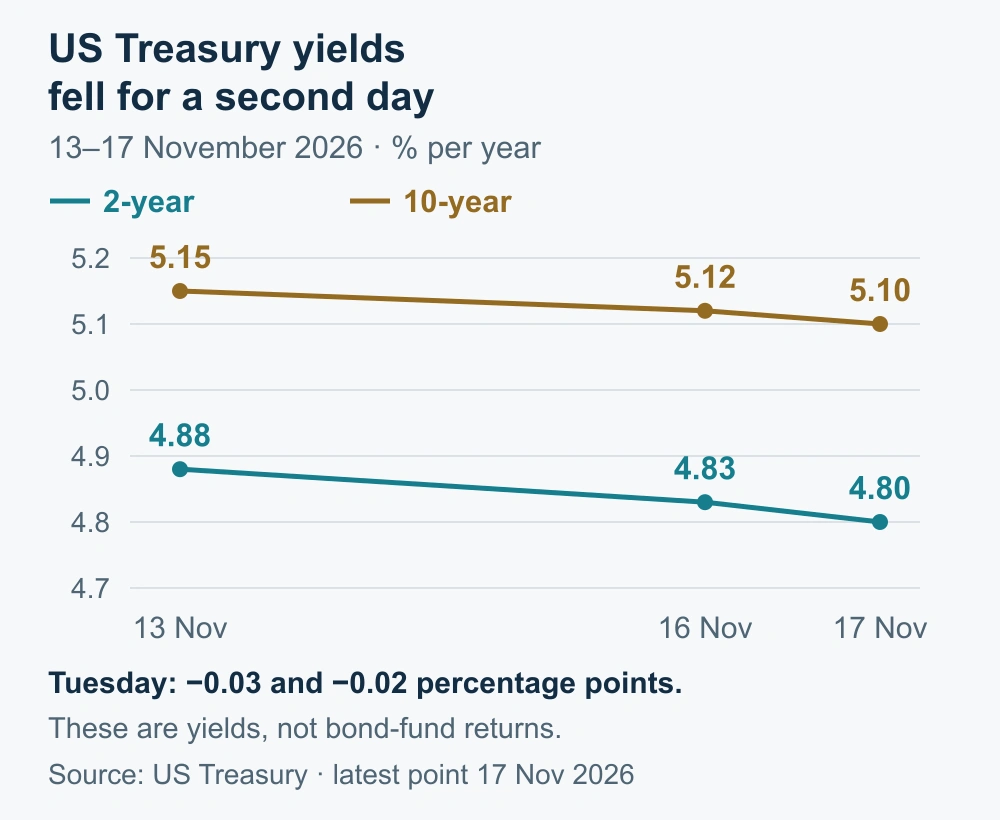
The US ten-year Treasury yield fell from 5.12% to 5.10% on 17 November, while the two-year yield declined from 4.83% to 4.80%. This was a second session of declines from the 13 November levels. Lower yields generally support the prices of existing fixed-rate bonds, but shares also depend on company earnings and the price paid for them.
German expectations improved, but current conditions remained weak
Germany’s ZEW expectations indicator, released on 17 November, rose 7.5 points to 35.6. The current economic situation indicator improved by 2.7 points but remained negative at −33.2. Experts are more positive about the outlook than about present conditions. This is a possible turning-point signal that actual orders and production still need to confirm.
Today
What matters now
Weaker demand and cheaper financing affect different parts of profit
Lower market yields can make new borrowing easier. But they do not solve a retailer’s problem if inventory grows faster than sales. Discounts help sell goods but can also reduce the profit left from each sale. Falling shares alongside lower Treasury yields are therefore not inherently contradictory.
Technology companies also need customers to pay for services from their own revenue. Investment in new equipment creates sales for suppliers today, while the buyer still needs to earn enough to pay for electricity, loans and equipment replacement. Easier financing alone is insufficient if demand for the final services takes longer to arrive.
Regional signals do not add up to one global conclusion
Improved German expectations could favour companies whose orders would benefit from economic recovery. But an expectations survey is not an actual sales invoice. Slower US retail sales, in turn, matter most directly to businesses selling goods to American customers. A company’s sources of revenue reveal more than its country of registration alone.
The dollar exchange rate also matters to a euro investor
The ECB reference rate changed from US$1.1014 to US$1.0989 per euro between 16 and 17 November. The same dollars could therefore be translated into more euros. This can offset part of a decline in a dollar asset’s price, although fees, dividends and currency hedging affect the result of an individual fund. The ECB reference rate is not a fund’s transaction price.
Today
What comes next
18 November morning: UK consumer prices
October consumer-price data are scheduled for release at 09:00 Lithuanian time. The result is not yet available at this review’s 08:20 cutoff. The question is whether price growth helps explain why the Bank of England still faces a difficult balance between limiting inflation and supporting demand.
18 November evening: the reasoning behind the earlier US rate decision
At 21:00 Lithuanian time, minutes of the Federal Reserve’s 27–28 October meeting will be released. They will show the inflation and growth arguments made then, but will not be a new interest-rate decision. The sales and industrial-production data released on 17 November appeared after that meeting.
Important. This is general market analysis, not a personal recommendation to buy or sell. Historical data and company results do not guarantee future returns. Forecasts and conditional scenarios may not materialise.
How is the history preserved and updated?
All five periods in this edition share one information date. Week means the latest 7 days, quarter means 90 days, and year means the trailing 12 months. The next dated edition will have a separate URL. This text keeps its date and assessment; later events are not silently inserted into an older edition. Longer periods assess new evidence alongside earlier developments without repeating every headline.