
Quarter · Market review
Ninety days: Nasdaq lost 6.67% and financing remained expensive
Nasdaq Composite fell 6.67% from the 20 August close to the latest known close on 17 November. The calculation is in US dollars, excluding dividends; its starting value is the last completed session before this review period. September rate increases and the financing needed by data centres widened the difference between orders and final profit. NVIDIA’s report, released after the US market close on 17 November, added to the picture of supplier growth. Information cutoff: 18 November 2026, 08:20 Lithuanian time.
Period covered: 2026-08-21 – 2026-11-18Information as of 8 min read
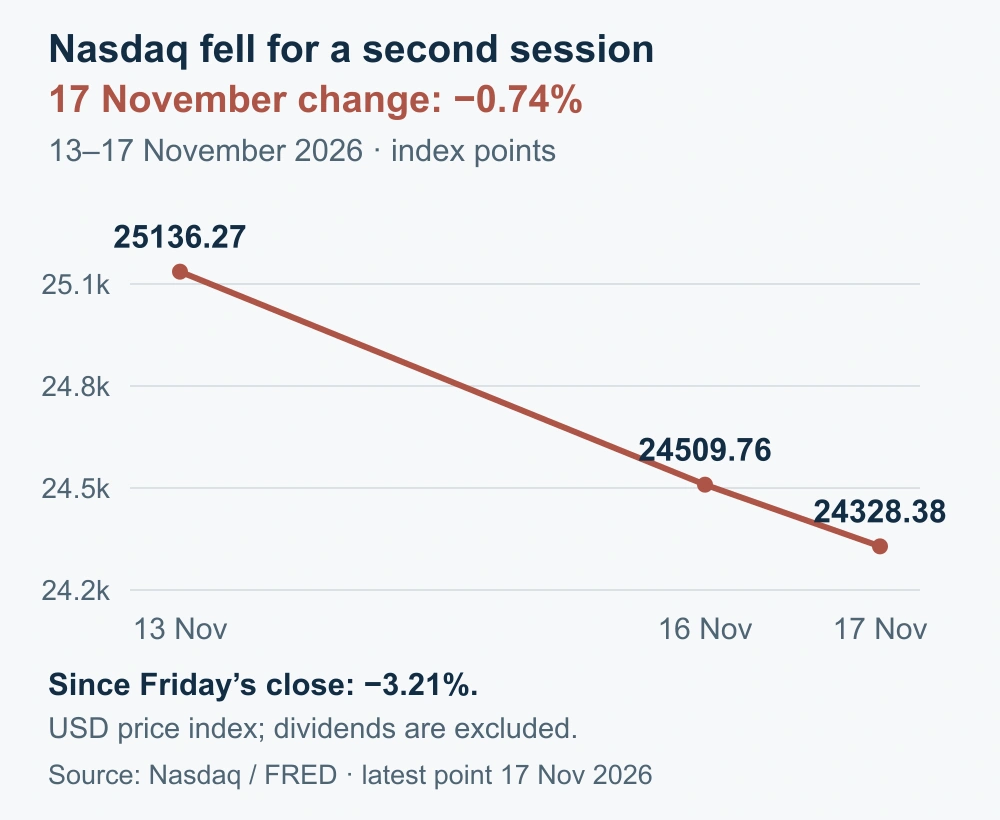
After the US market close on 17 November, NVIDIA reported quarterly revenue up 103%. Earlier that day, Nasdaq fell 0.74%, US retail sales growth slowed, and German experts’ expectations improved.
US and euro-area central banks have not reversed September’s rate increases. The cost of new borrowing and the ability to repay it on time remain important for companies needing additional loans.
Quarter
What happened
September rate increases changed the conditions for investment
On 10 September, the European Central Bank decided to raise its deposit rate from 2.25% to 2.50%, effective on 16 September. On that same day, the Federal Reserve raised its target range from 3.50–3.75% to 3.75–4.00%. The Bank of Japan announced an increase from 1.00% to 1.25% on 18 September, applying from 24 September.
On 28–30 October, those three institutions retained their new levels. Increases continued elsewhere: Canada raised its rate from 2.25% to 2.50% on 28 October, Australia from 4.60% to 4.85% on 3 November, and the United Kingdom from 3.75% to 4.00% on 5 November. This matters for new loans and refinancing, but does not change the instalment on an existing fixed-rate loan that same day.
Minutes of Australia’s 3 November meeting, released on 17 November, explained the decision rather than raising rates again. Six members voted for the increase and three opposed it. The majority were more concerned about inflation; the minority preferred to wait for the effect of earlier increases. The disagreement shows why even a weaker monthly reading does not by itself determine the next decision.
Chip sales grew, but some buyers lacked enough operating profit to cover interest
On 26 August, US chip designer NVIDIA reported revenue growth of 106% from a year earlier and operating-profit growth of 124% for its quarter ending on 26 July. On 15 October, Taiwanese chip manufacturer TSMC reported third-quarter revenue of US$46.72 billion. These results confirmed actual equipment sales. But a data-centre owner pays for equipment before receiving all the revenue expected from future customers.
Results released by US cloud-infrastructure company CoreWeave on 10 November illustrated this difference. It generated US$207 million of third-quarter operating income, but net interest expense reached US$846 million. Operating income was insufficient to cover interest. Equipment, electricity and debt payments have their own deadlines, even if customer numbers are expected to grow later.
On 16 November, Federal Reserve governor Michael Barr discussed a broader financing picture. His speech cited an expectation that the balance-sheet debt of the seven largest artificial-intelligence companies would exceed US$800 billion by year-end. That is a forecast. Separately, he described more than US$3 trillion in potential maximum gross nominal off-balance-sheet commitments, including long-term contracts, leases and guarantees. These amounts cannot be added into one current-debt figure.
Barr also described more than US$100 billion of cumulative investment by major cloud and chip suppliers in model developers and cloud start-ups. Recipients spend some of that funding on services from their investors. This arrangement helps businesses get started, but long-term payback requires revenue from independent paying customers. According to Barr, banks’ capital and still-limited leverage reduce the risk of direct credit losses.
NVIDIA’s results added to the story of growing equipment sales
At 23:20 Lithuanian time on 17 November, after the US market close, NVIDIA reported revenue of US$115.8 billion for the quarter ended 25 October, 103% more than a year earlier. This is new confirmation that technology-infrastructure expansion is turning into supplier sales; the return on its customers’ investment remains a separate question.
More oil supply did not yet mean lower costs
Oil supply recovered unevenly during autumn. The International Energy Agency’s 14 October report put September global supply at 102.3 million barrels a day, 2.5 million more than in August. Renewed attacks in the Gulf showed the fragility of that improvement. Crude production, refined fuel and its delivery are different things: a transport company’s expenses depend on the fuel it actually buys and when it buys it.
For your investments
Let’s discuss your portfolio
 FINANCIAL FREEDOM01 / 04
Investment results since 1999
Are you beating
global equities?

at the end of the period
Jan 1999–Jun 2026 · EUR · Cumulative return, %
Linear scale · * MSCI World → MSCI ACWI.
Past performance does not guarantee future returns.
FINANCIAL FREEDOM02 / 04Historical comparison
How far did it fall?
How long to recover?
Decline from the previous high

Longest recovery to the previous high

Jan 1999–Jun 2026 · EUR · Monthly data
* MSCI World → MSCI ACWI.
Past performance does not guarantee future returns.
FINANCIAL FREEDOM03 / 04Personal investment consultation
Already investing?
Let’s review your portfolio.
Yet to start
investing?
Let’s build your first
investment plan.
FINANCIAL FREEDOM04 / 04
Personal investment
consultation
Martynas
Juška
Investment manager
Managing a portfolio
of more than€100 million
On 10 November, the US Energy Information Administration estimated that Middle Eastern production shut-ins averaged about 2.5 million barrels a day in October, compared with the May peak of 10.9 million. Nevertheless, Brent averaged US$124 a barrel in October against US$114 in September. These are historical monthly averages, not today’s oil price.
The latest Eurostat trade report, published on 13 November, showed the connection between energy and European spending. In September, the euro area imported €283.0 billion of goods and exported €272.7 billion. Its energy trade deficit increased from €20.7 billion to €33.0 billion over a year. Import values rose faster even though exports also increased; a deficit is not itself evidence of falling exports.
Waiting for tariff relief does not reduce costs yet. On 25–27 September, the US and China presented product groups recommended for tariff relief with a 2024 trade value of roughly US$30 billion in each direction. These included US agricultural goods and medical equipment, and Chinese household appliances and toys. That recommendation is different from a lower duty already applying to a particular product.
November figures separated investment from consumer demand
US October consumer-price data, published on 10 November, showed a monthly increase of 0.4%, following September’s 0.6%. But prices excluding food and energy rose 0.3% for a third consecutive month. The headline slowdown was therefore not uniform across the consumer basket. These seasonally adjusted monthly changes are not annual inflation rates.
On 16 November, China reported October value-added growth at industrial enterprises above the official size threshold of 4.8% from a year earlier, while retail sales of consumer goods rose only 0.4%. These percentages are not directly comparable: the industrial measure removes the effect of price changes, while the retail-sales measure does not. Nonetheless, the industrial and consumer measures underline that expanding production does not guarantee equally fast growth in end-buyers’ spending.
Japan’s first third-quarter estimate, published that same day, showed almost no change in real economic output from the second quarter. Private consumption fell 0.3%, while private non-residential investment rose 1.6%. Investment supported activity where households were spending less. These percentages cannot be added together: consumption and investment account for different shares of the economy.
Demand signals diverged on 17 November
US October retail sales rose 0.2% from September, following the previous month’s 0.8% increase. These are nominal, seasonally adjusted sales; the small advance monthly change is not statistically different from zero. Industrial production fell 0.4%, although manufacturing grew 0.3%. Germany’s ZEW expectations indicator rose 7.5 points to 35.6. Weaker US data were therefore accompanied by improved German expert sentiment, rather than the same economic direction everywhere.
The latest session also reduced the return over this period
On 17 November, Nasdaq Composite fell 0.74% to 24,328.38 points. Compared with the 20 August close of 26,067.17 points, the index fell 6.67%. This is the price change in US dollars, excluding dividends, through the 17 November close; the 18 November session had not yet begun. The starting value is the last close before the first day of this review period.
Quarter
What matters now
A lower bond yield does not remove earnings risk
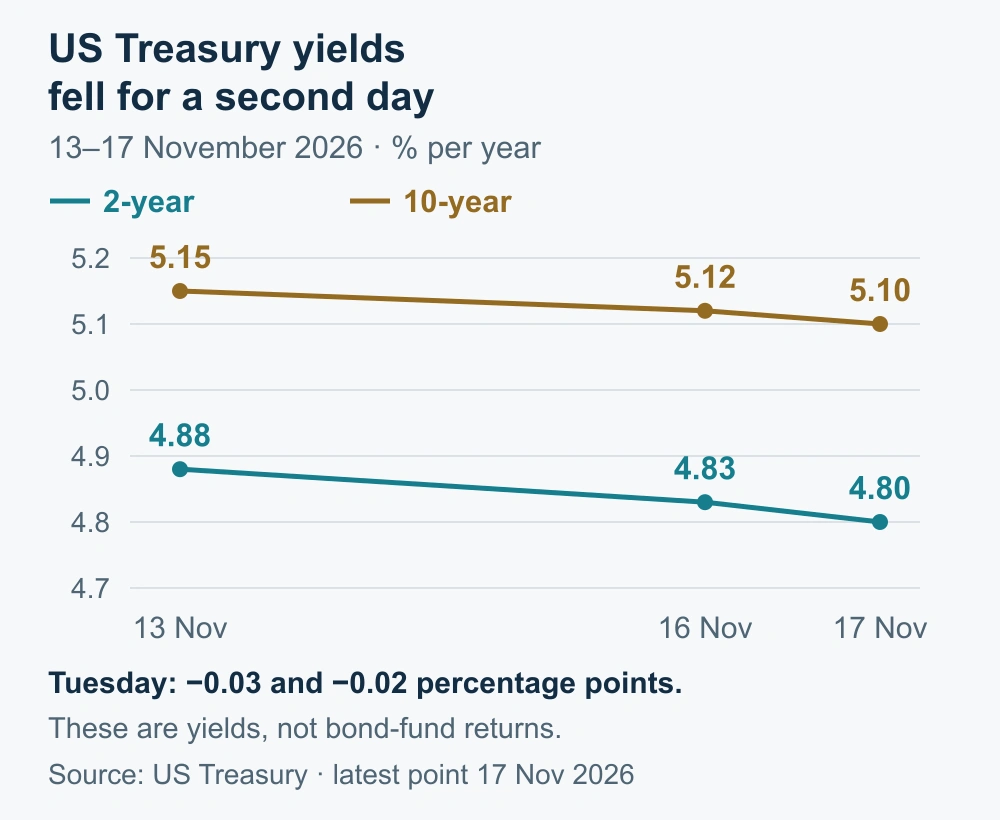
On 17 November, the US ten-year Treasury bond yield declined to 5.10% from 5.12% on 16 November; it had been 5.15% on 13 November. Falling bond yields do not by themselves guarantee rising share prices: the profits companies will earn in future also affect their value.
If investors began expecting lower inflation and interest rates, prices of longer-dated, high-quality government bonds could rise. Technology shares depend on future company earnings. Data-centre lenders need borrowers to pay interest and repay their debt on time. Chipmakers’ shares and their customers’ debt can therefore share the same risk: whether data-centre services generate enough revenue.
Weaker demand would eventually reach equipment suppliers too
If consumer or business demand takes longer to arrive, servicing debt may require further financing or reduced new investment. Slower orders would then eventually affect even suppliers that are profitable today.
European industry and transport would benefit from reliable, cheaper energy deliveries. Lower selling prices would work in the opposite direction for oil producers, although greater volumes could offset part of the effect. When assessing these positions, it helps to separate a one-off price change from a long-term supply contract: their effects on profit emerge at different times.
The dollar exchange rate also matters to a euro investor
The ECB reference rate changed from US$1.1014 to US$1.0989 per euro between 16 and 17 November. The same dollars could therefore be translated into more euros. This can offset part of a decline in a dollar asset’s price, although fees, dividends and currency hedging affect the result of an individual fund. The ECB reference rate is not a fund’s transaction price.
Quarter
What comes next
18 November morning: UK consumer prices
October consumer-price data are scheduled for release at 09:00 Lithuanian time. The result is not yet available at this review’s 08:20 cutoff. The question is whether price growth helps explain why the Bank of England still faces a difficult balance between limiting inflation and supporting demand.
18 November evening: the reasoning behind the earlier US rate decision
At 21:00 Lithuanian time, minutes of the Federal Reserve’s 27–28 October meeting will be released. They will show the inflation and growth arguments made then, but will not be a new interest-rate decision. The sales and industrial-production data released on 17 November appeared after that meeting.
8 December: a revised picture of Japanese demand
Japan’s second estimate of third-quarter GDP is scheduled for 01:50 Lithuanian time. It will test whether the gap between weaker consumption and growing business investment remains. Equipment suppliers need the capacity being purchased to attract enough paying customers later.
Important. This is general market analysis, not a personal recommendation to buy or sell. Historical data and company results do not guarantee future returns. Forecasts and conditional scenarios may not materialise.
How is the history preserved and updated?
All five periods in this edition share one information date. Week means the latest 7 days, quarter means 90 days, and year means the trailing 12 months. The next dated edition will have a separate URL. This text keeps its date and assessment; later events are not silently inserted into an older edition. Longer periods assess new evidence alongside earlier developments without repeating every headline.