
Today · Market review
US inflation picked up as Asian chip shares fell
On 25 November, Asian chip shares fell and the Korea Exchange paused some automated sell orders. Later, the US Bureau of Economic Analysis reported that annual consumer spending inflation had risen to 3.8%. US Treasury yields fell that day. Data cut-off: 23:59 Vilnius time.
Period covered: 2026-11-25Information as of 4 min read
The Korea Exchange paused automated buying on Tuesday and selling on Wednesday. The US third-quarter growth estimate was revised higher, but October spending was virtually flat after adjusting for prices.
The rate decision is still ahead. The Federal Reserve’s target range remains 3.75–4.00%; for companies the cost depends in part on when they need to refinance.
Today
What happened
Asia’s rebound reversed before the US data
At 02:08 Vilnius time on 25 November, the Korea Exchange paused automated sell orders on its main market for five minutes after KOSPI 200 futures fell 5.12% from the exchange’s reference level. The exchange did not halt trading across the market. The same market had paused automated buying the day before. Monday’s US chip-share rebound did not turn into a steady rise for the sector.
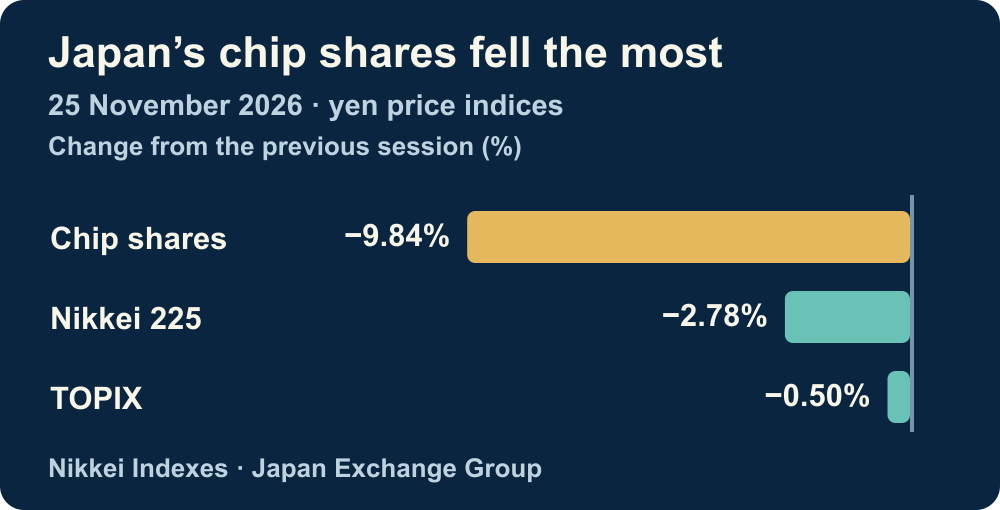
Taiwan’s benchmark TAIEX fell 4.80%, from 40,122.35 to 38,195.43 points. It gave back more than half the index points gained on Tuesday. In Japan, the Nikkei 225 fell 2.78%, Japan’s semiconductor share index lost 9.84%, and the broader TOPIX fell 0.50%. These are price indices in local currencies. The gap shows that selling was far heavier in technology than across the Japanese market as a whole.
Annual inflation picked up, but monthly price growth did not accelerate
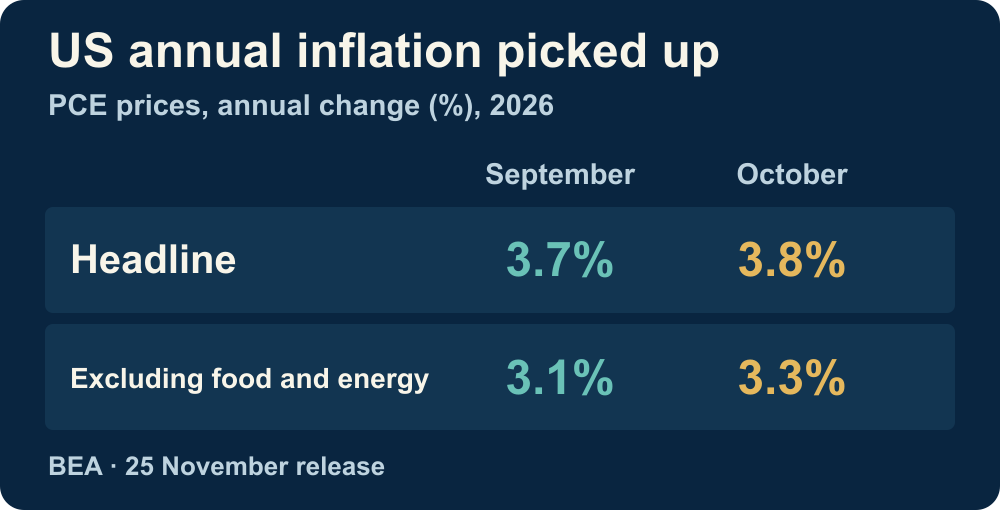
At 15:30 Vilnius time, the US Bureau of Economic Analysis published the personal consumption expenditures price index (PCE). Prices rose 3.8% from a year earlier in October, after a revised 3.7% in September in the same release. Excluding food and energy, annual inflation went from 3.1% to 3.3%. Both price indices rose 0.3% from September to October.
Americans spent 0.3% more in dollars in October than in September, but spending fell by less than 0.1% after adjusting for prices. Shoppers paid more at the till without buying a greater volume of goods and services overall. That is why an increase in spending measured in dollars is not necessarily good news for retailers and leisure businesses.
For your investments
Let’s discuss your portfolio
 FINANCIAL FREEDOM01 / 04
Investment results since 1999
Are you beating
global equities?

at the end of the period
Jan 1999–Jun 2026 · EUR · Cumulative return, %
Linear scale · * MSCI World → MSCI ACWI.
Past performance does not guarantee future returns.
FINANCIAL FREEDOM02 / 04Historical comparison
How far did it fall?
How long to recover?
Decline from the previous high

Longest recovery to the previous high

Jan 1999–Jun 2026 · EUR · Monthly data
* MSCI World → MSCI ACWI.
Past performance does not guarantee future returns.
FINANCIAL FREEDOM03 / 04Personal investment consultation
Already investing?
Let’s review your portfolio.
Yet to start
investing?
Let’s build your first
investment plan.
FINANCIAL FREEDOM04 / 04
Personal investment
consultation
Martynas
Juška
Investment manager
Managing a portfolio
of more than€100 million
At the same time, the estimate of US economic growth for July to September was raised from 3.4% to 4.3% at an annualised rate. It was about 1.1% from the second quarter, not 4.3% in three months. Higher estimates of investment and consumption drove most of the revision. Quarterly growth and an almost flat October spending figure describe different periods.
The US proposed tariffs but had not imposed them
On 25 November the Office of the US Trade Representative announced proposed measures after investigating manufacturing overcapacity in 14 economies. The proposed 15% rate for the European Union is net of ordinary and applicable additional duties, with exemptions. It is not an extra 15 percentage points on all goods. For Japan, South Korea and Taiwan, proposed rates are up to 15%, also accounting for duties already in place.
On 25 November the broad STOXX Europe 600 closed 1.06% below Tuesday’s level. The US Nasdaq Composite traded 4.64% below Tuesday’s close at its low but finished down 0.62%. The ten-year US Treasury yield fell from 4.91% to 4.85%. The moves took place on the same date, but timing alone does not establish which announcement drove the entire move.
Today
What matters now
Funds in different countries can share the same technology risk
If the same data-centre orders drive revenue for Japanese equipment suppliers and Taiwanese chipmakers, a cut to investment by those customers can affect both funds. A broader fund may rely less on that part of the market, as the gap between the two Japanese benchmarks shows. Bonds respond through a different mechanism: falling yields usually raise prices of existing fixed-rate bonds, but weaker companies’ borrowing costs also depend on their ability to repay.
In the tariff scenario the important details are the specific product exported to the US, where it was made and the duty already applicable, rather than the location of the company’s headquarters. An importer may try to pass costs on to buyers; if demand is weak it may have to absorb part of the increase and make less profit.
Today
What comes next
26 November: Bank of Korea decision and European Central Bank meeting account
The Bank of Korea will decide on interest rates. The European Central Bank’s account of its October meeting will show how members weighed energy prices against weaker demand. US stock exchanges are closed for Thanksgiving, with Friday 27 November’s main session ending at 20:00 Vilnius time.
8–9 December: US Federal Reserve meeting
The decision and fresh economic projections will show whether tighter borrowing conditions are likely to persist while annual inflation remains above the central bank’s target.
Important. This is general market analysis, not a personal recommendation to buy or sell. Historical data and company results do not guarantee future returns. Forecasts and conditional scenarios may not materialise.
How is the history preserved and updated?
All five periods in this edition share one information date. Week means the latest 7 days, quarter means 90 days, and year means the trailing 12 months. The next dated edition will have a separate URL. This text keeps its date and assessment; later events are not silently inserted into an older edition. Longer periods assess new evidence alongside earlier developments without repeating every headline.