
Week · Market review
The chip-share rebound had faded by Wednesday
Between 19 and 25 November, the rebound in US chip shares did not turn into a steady rise. On 25 November, Asian technology shares fell and the subsequent US release showed faster annual inflation. Data cut-off: 25 November, 23:59 Vilnius time.
Period covered: 2026-11-19 – 2026-11-25Information as of 4 min read
The Korea Exchange restricted automated sell orders on Wednesday after curbing buys on Tuesday. US trade officials issued a fresh tariff proposal, but it has not yet changed import costs.
Shares in different sectors and countries can depend on the same big data-centre customers. A large equity offering or a strong day for share prices does not show how much those customers will earn.
Week
What happened
19–20 November: raising cash is not the same as making a profit
Shares in US artificial intelligence company Anthropic began trading on 19 November. On 20 November, the company confirmed an offering worth US$93.5 billion, of which about US$91.6 billion went to the company before expenses. This is money for expansion, not revenue from sales. Investors need to know whether payments from end customers will cover equipment, electricity and financing costs over time.
On Friday 20 November, the Nasdaq Composite closed at 22,617.73 points. The US semiconductor share index lost 10.73% in its session, and Japan’s Nikkei 225 fell 5.06% in its own. The ten-year US Treasury yield fell to 4.92% from Thursday’s 5.04%. Bonds moved in the opposite direction from shares that day, but the relationship depends on whether investors are more concerned about growth or prices.
23–24 November: the US rebound reached Asia
Before the US market opened on 23 November, US chipmaker Nvidia announced that its cofounder Jensen Huang was returning as chief executive. The US semiconductor share index rose 14.03% and the Nasdaq Composite gained 6.51%. The ten-year Treasury yield held at Friday’s level. The clearest change was in share prices, not in the cost of long-term debt.
On 24 November, Taiwan’s TAIEX gained 8.99% and Japan’s Nikkei 225 rose 3.91% in its first session after a holiday. The Korea Exchange paused automated buying. The Nasdaq Composite finished the same date at 23,733.54 points, below Monday’s 24,089.56. Regional sessions ended at different times and did not all point in the same direction.
25 November: technology shares gave back more of the rebound
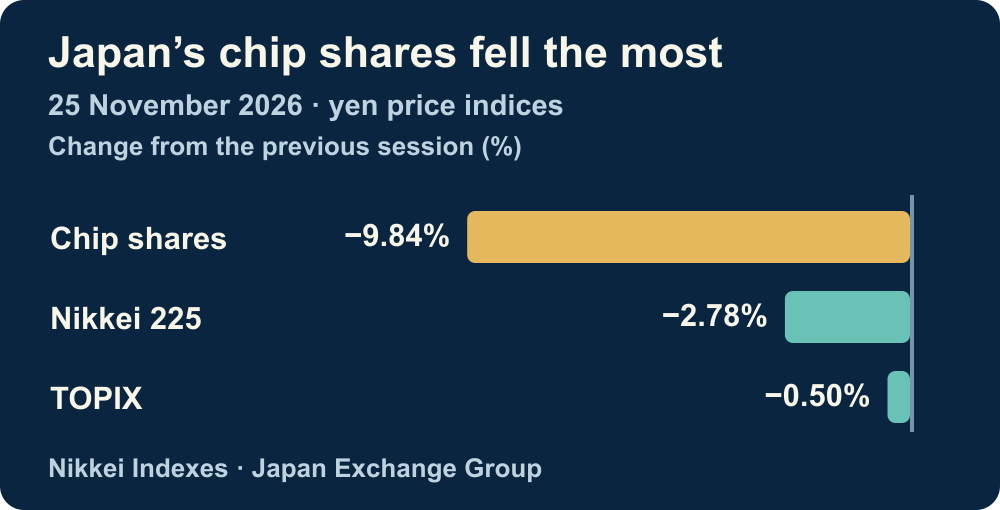
Taiwan’s share index fell 4.80% and Japanese chip shares dropped 9.84%, against a 0.50% decline for the broader TOPIX. The Korea Exchange paused automated sell orders for five minutes on its main market; ordinary share trading continued. The US Nasdaq Composite finished at 23,585.80 points. It was still 4.28% above the previous Friday even after giving back part of Monday’s bounce.
For your investments
Let’s discuss your portfolio
 FINANCIAL FREEDOM01 / 04
Investment results since 1999
Are you beating
global equities?

at the end of the period
Jan 1999–Jun 2026 · EUR · Cumulative return, %
Linear scale · * MSCI World → MSCI ACWI.
Past performance does not guarantee future returns.
FINANCIAL FREEDOM02 / 04Historical comparison
How far did it fall?
How long to recover?
Decline from the previous high

Longest recovery to the previous high

Jan 1999–Jun 2026 · EUR · Monthly data
* MSCI World → MSCI ACWI.
Past performance does not guarantee future returns.
FINANCIAL FREEDOM03 / 04Personal investment consultation
Already investing?
Let’s review your portfolio.
Yet to start
investing?
Let’s build your first
investment plan.
FINANCIAL FREEDOM04 / 04
Personal investment
consultation
Martynas
Juška
Investment manager
Managing a portfolio
of more than€100 million
US releases distinguished a stronger quarter from October spending
On 25 November, the US statistics agency reported that the October personal consumption expenditures price index (PCE) showed annual inflation of 3.8%, compared with a revised 3.7% in September. Real consumer spending in October was nearly unchanged from September. July–September economic growth was revised to a 4.3% annualised rate. These figures measure different periods: a better third quarter does not mean spending was still rising in October.
That day the US Trade Representative proposed new measures for 14 economies. The proposal for European Union goods sets a 15% rate net of specified existing tariffs and with exemptions. It is a proposal, not a new duty already in force. Public comments are due on 5 January and a hearing is scheduled for 25 January 2027.
Week
What matters now
Share prices, spending and rates told different stories
If buyers of chip equipment slow their expansion, the revenue impact will not stop at US chipmakers. Asian factories, electrical-equipment companies and data-centre suppliers can feel the same pressure. In a global equity fund, the degree of exposure reflects who actually buys the companies’ products, not just the number of countries in the portfolio.
Falling US government bond yields could help longer-dated fixed-rate bonds if demand for safer assets persists. But if tariffs or energy put more pressure on prices, central banks could maintain higher rates for longer. For importers’ shares, the immediate question is whether they can pass the increase on to customers.
July–September investment was stronger than first estimated, supporting equipment and software suppliers’ revenues as orders are fulfilled. Nearly flat real spending in October raises a different question for retailers: do higher bills mean higher profits if volumes do not rise? The answer depends on costs and whether customers chose more expensive goods or merely paid more for the same basket.
Week
What comes next
26 November: Bank of Korea decision and European Central Bank meeting account
The Bank of Korea will decide on interest rates. The European Central Bank’s account of its October meeting will show how members weighed energy prices against weaker demand. US stock exchanges are closed for Thanksgiving, with Friday 27 November’s main session ending at 20:00 Vilnius time.
8–9 December: US Federal Reserve meeting
The decision and fresh economic projections will show whether tighter borrowing conditions are likely to persist while annual inflation remains above the central bank’s target.
Important. This is general market analysis, not a personal recommendation to buy or sell. Historical data and company results do not guarantee future returns. Forecasts and conditional scenarios may not materialise.
How is the history preserved and updated?
All five periods in this edition share one information date. Week means the latest 7 days, quarter means 90 days, and year means the trailing 12 months. The next dated edition will have a separate URL. This text keeps its date and assessment; later events are not silently inserted into an older edition. Longer periods assess new evidence alongside earlier developments without repeating every headline.