
Today · Market review
Bonds hit 5%. Can company earnings keep up?
US government bonds now offer a higher yield, so shares need a stronger argument than a promise of growth. Yet the business picture is not all bad: Microsoft is increasing its dividend, European exports have improved and Lithuania’s growth forecast for next year has risen. The question is how much of that growth will remain for companies and households after paying bigger bills.
Period covered: 2026-09-16Information as of 8 min read
Several signals emerged yesterday: the US ten-year Treasury yield reached 5%, new European trade data and Lithuanian forecasts were published, and Microsoft increased its dividend. Today, last week’s euro-area interest rate increase takes effect. The US decision is still ahead this evening.
The week’s question remains whether energy and other costs will prevent interest rates from coming down. Growing sales provide a counterweight to pessimism, but do not show how much cash remains after wages, investment and debt payments. The cost of growth matters alongside growth itself.
Today
What happened
US bond yields reached 5%, leaving shares with more to prove
Five percent is a useful reference point, not a sudden market turning point. In Tuesday’s US Treasury table, dated 15 September, the ten-year annual yield reached 5.00%. It was 4.97% on Monday and 4.78% on 4 September. The single-session change was small; the accumulated increase in borrowing costs is more significant. The two-year yield stood at 4.67% yesterday.
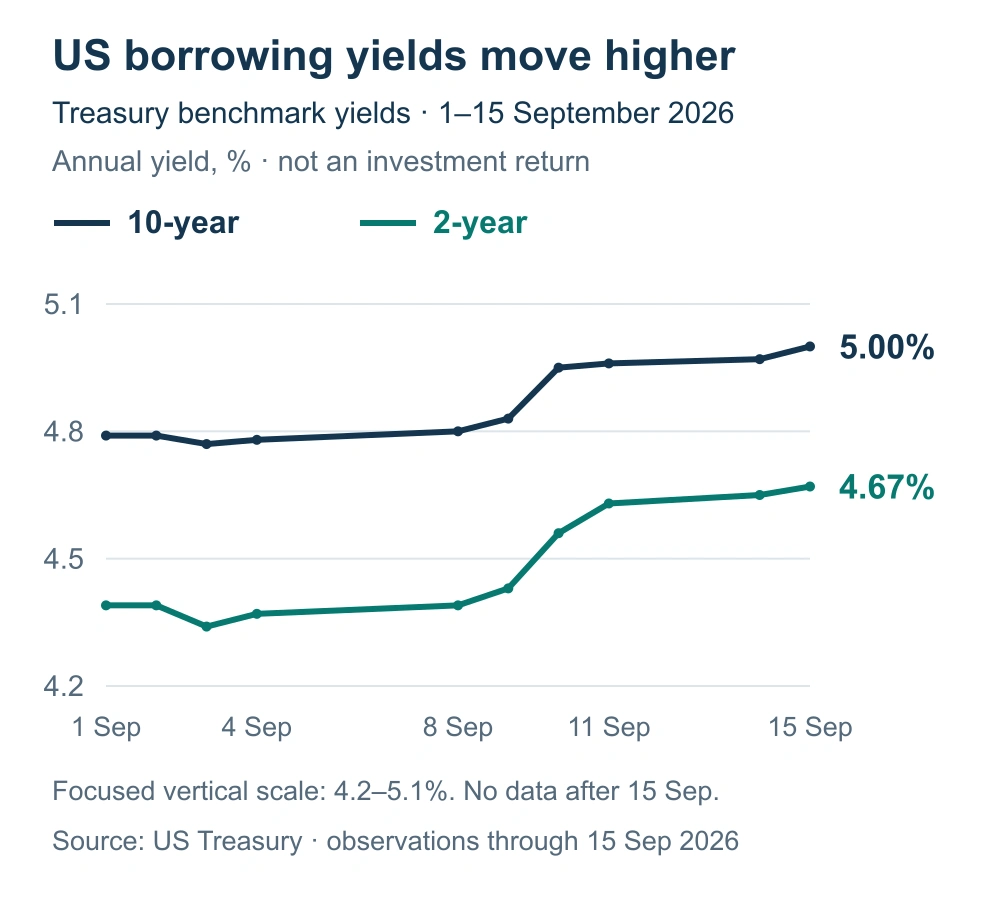
In the same US session, the large-company S&P 500 price index fell 0.45%, while the more technology-heavy Nasdaq Composite declined 0.78%. Higher interest rates are a plausible source of pressure, but their coinciding does not establish the cause of the entire decline. When bonds offer more, a high share price becomes harder to justify solely through distant future profits. A business taking out a new loan also faces a very tangible interest bill.
? Bond yield: does it guarantee a 5% return?
A bond’s yield connects its price with interest and redemption payments. These US Treasury figures are estimates for standard maturities, not a particular investor’s transaction. They are annual rates, not one-day returns or central bank policy rates. Selling before maturity exposes the investor to changes in market price. For someone investing from Lithuania, the dollar exchange rate and currency-hedging costs also matter.
Yesterday’s New York manufacturing survey added another tension: its activity index fell from 20.6 to 7.6 points, while the prices-paid index rose from 58.6 to 63.1. Activity was expanding more slowly, yet many businesses still faced higher input prices. This is a regional survey, not a result for the entire US economy. Industrial and transport companies need to know whether customers will accept higher prices; savers buying bonds may welcome higher yields.
? What do the New York manufacturing survey’s points mean?
The Empire State Manufacturing Survey asks businesses whether conditions and prices increased, stayed unchanged or decreased. Its indices subtract the share reporting a decrease from the share reporting an increase. Above zero, increases predominate; below zero, decreases do. A reading of 63.1 points does not mean prices rose 63.1%. The 50-point threshold used by some other surveys does not apply here.
A softer Federal Reserve assessment could support existing bond prices and highly valued shares. The opposite risk is persistent price pressure and less scope for interest rate cuts. The decision is due today at 21:00 Lithuanian time. Until then, the US policy rate target remains 3.50–3.75%.
European exports improve, but expensive financing remains a concern
A better trade report does not mean every aspect of European business has become easier. The European Central Bank’s higher deposit rate of 2.50% takes effect today. The decision was made on 10 September; this is not an unexpected new increase today. Meanwhile, July data released yesterday showed euro-area goods export values 9.0% higher than a year earlier.
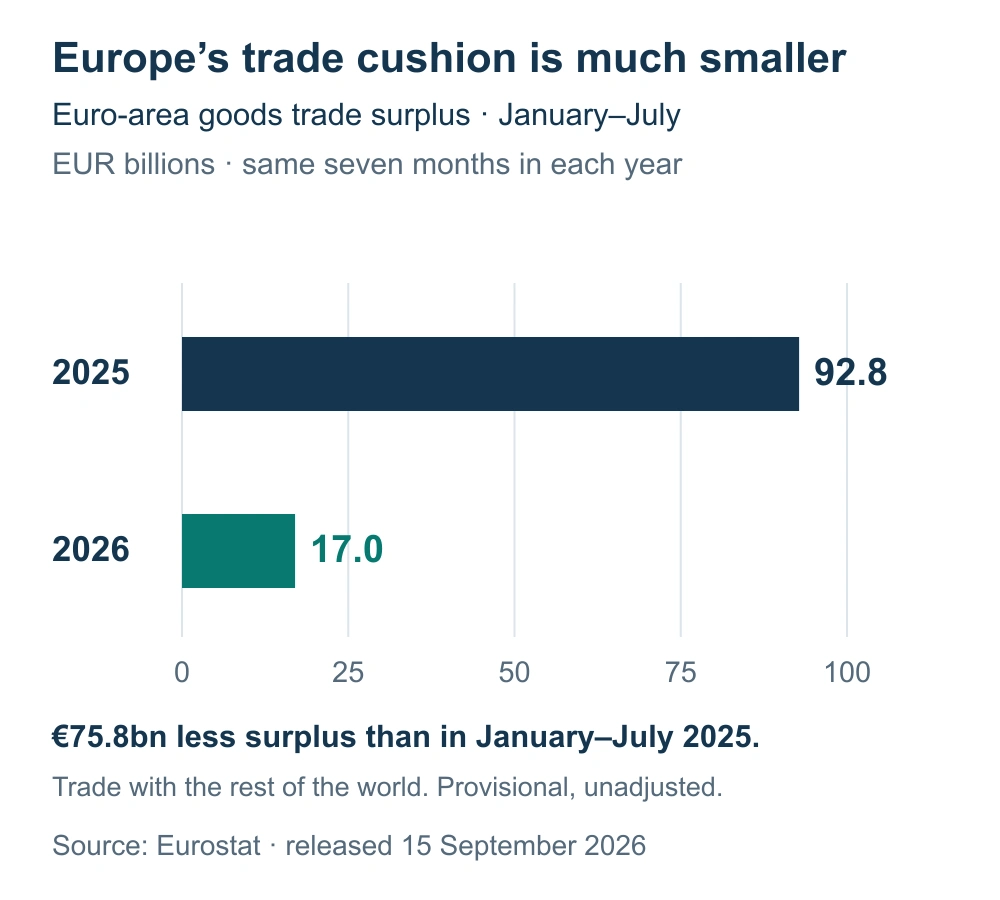
July’s export–import gap improved to €14.2 billion from €10.7 billion a year earlier. However, the January–July trade surplus was only €17.0 billion, compared with €92.8 billion a year earlier. One better month has not repaired the weaker seven-month picture. These are trade values at current prices: they do not establish an equivalent increase in the quantity of goods sold or in company profits.
Higher sales support exporting manufacturers. For energy-intensive businesses and hauliers, the other side matters: raw materials, electricity and delivery costs. New euro bonds or deposits may become more attractive to savers, while refinancing businesses face higher interest bills. A mortgage payment does not automatically change today: its contractual reference rate and reset date determine that.
? Is a trade surplus a country’s profit?
The trade balance in goods is the value of exports minus imports. A positive balance is a surplus. It does not include all services and is not the sum of company profits. These comparisons cover periods of equal length and are not seasonally adjusted. A larger import bill can reflect either higher prices or more goods purchased.
The opportunity is a broader recovery in orders that allows sales to grow faster than costs. The risks are prolonged energy-delivery problems and further increases in financing costs. Upcoming industrial production and order data will help distinguish a price-driven rise in trade values from stronger underlying activity.

Investment consultation
Do your investments work together?
Review where your money is invested, how much depends on a single market and whether your plan fits your goals. Leave with clearer next steps.
See the consultation process and terms on the registration page.
Today
What matters now
Mini-analysis: Microsoft raises its dividend, but investment absorbs more cash
A rising dividend and less cash left after investment can be part of the same company’s story. On 15 September, software and cloud-services company Microsoft raised its quarterly dividend from $0.91 to $0.98 per share, about 8%. Payment is scheduled for 10 December. That is a future distribution, not money investors have already received.
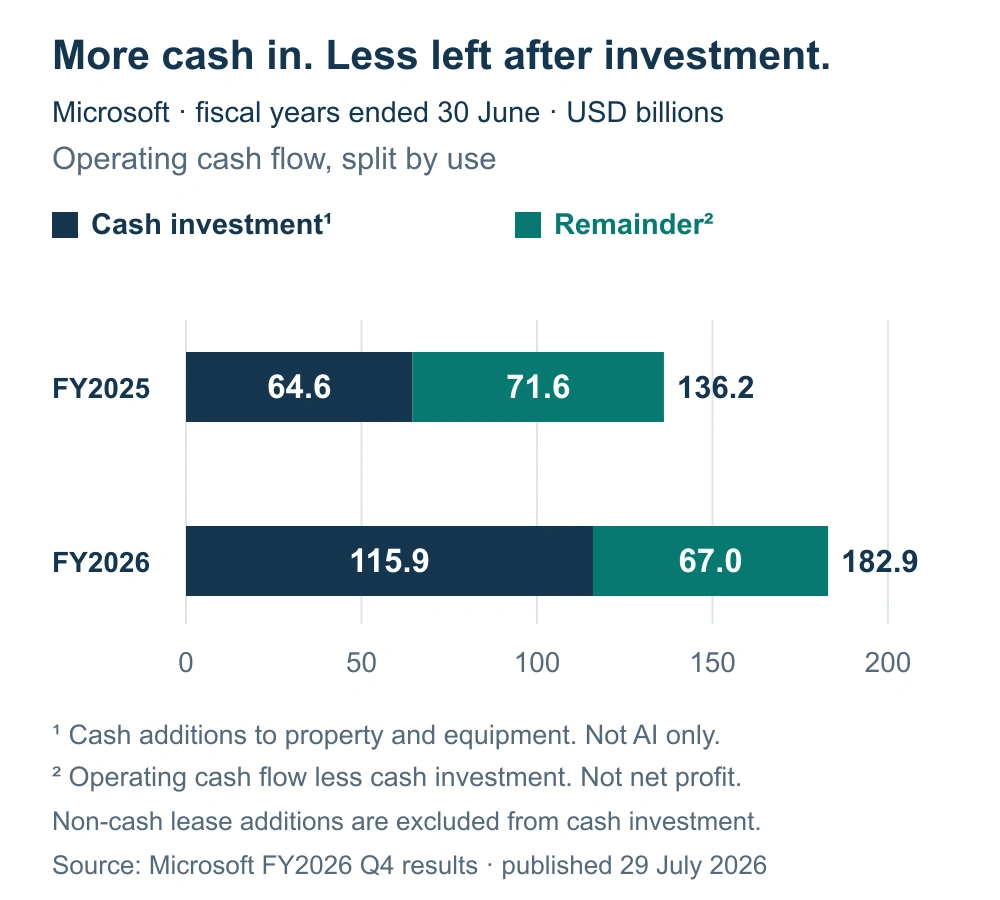
The latest annual cash-flow statement explains why this news alone is not enough. In the financial year ended June, operations generated $182.9 billion, while cash purchases of property and equipment used $115.9 billion. Those investments absorbed 63.4% of operating cash, compared with 47.4% a year earlier. Subtracting these purchases left $67.0 billion, versus $71.6 billion previously. These annual figures were published on 29 July, not released as new September operating results.
? How does cash flow differ from profit?
Operating cash flow records cash generated and spent through business operations. Accounting profit can be recognised at a different time. The chart subtracts cash additions to property and equipment from operating cash. The remainder is not net income or a bank-account balance. These investments are not all exclusively for artificial intelligence, and the chart excludes non-cash finance-lease additions.
Shareholders need new capacity to earn enough to justify today’s spending. For suppliers of servers, electrical equipment and construction services, that investment can become revenue. For investors in the cloud business itself, the return on that spending is crucial. Sustained demand and cash generation provide an opportunity; slower use of new capacity is a risk. The next results will test operating cash, investment payments and lease commitments. A dividend increase alone does not answer those questions.
Lithuania’s growth forecast improves for next year, but purchasing power remains under pressure
A smaller short-term consumption surge can also mean a smaller reversal later. Yesterday, the Bank of Lithuania forecast 2.7% real economic growth this year and 2.4% next year. The latter was revised up from 2.0%. One reason is that money withdrawn from the second pension pillar is being spent more slowly, reducing the expected drop after the one-off spending boost.
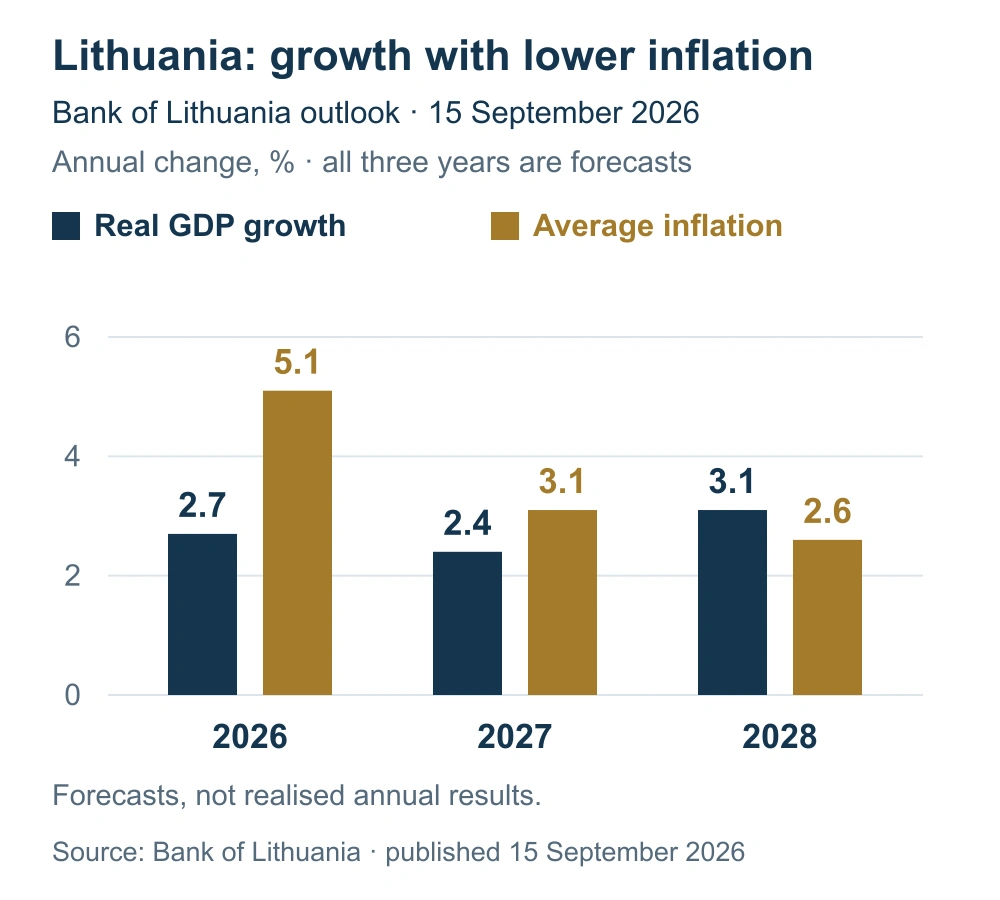
Higher incomes do not necessarily produce an equivalent improvement in living standards. The central bank forecasts average annual inflation of 5.1% this year, 3.1% next year and 2.6% in 2028. Real economic growth in 2028 is projected at 3.1%. These are forecasts, not completed annual results. Rising consumer prices reduce the purchasing power of uninvested cash and absorb part of nominal wage increases.
? What do real growth and average inflation measure?
Real gross domestic product growth measures the change in economic output after removing price effects. Average annual inflation compares the year’s average price level with the previous year’s average. It is not September’s inflation rate or the year-end rate. The forecast chart describes a conditional outlook, not a guaranteed path.
Local retailers need money to reach shops; exporters depend more on orders abroad. Households must consider interest on savings alongside inflation and borrowing costs. The opportunity is steadier growth without an abrupt consumption reversal. The risks are more expensive energy and weaker export demand. Upcoming consumption, export and price data will test this outlook.
The portfolio takeaway: look at what remains, not just what grows
US interest rates, Europe’s import bill and technology investment raise the same question: how much cash remains after costs? The two main risks are more expensive financing and persistent energy-price pressure. Growing sales, cash-generating businesses and a better Lithuanian growth forecast provide a counterweight. Technology shares, domestic consumer businesses and bonds should therefore not be judged through a single headline. For euro-based owners of US assets, the dollar can add to or offset changes in the security’s own price.
Today
What comes next
Three checkpoints today that could change the assessment
- 15:30 Lithuanian time: US consumption and import prices. Retail sales will show the direction of spending; import prices will add to the cost picture. Stronger sales support businesses, but a rise in money spent does not always mean more goods purchased.
- 17:30: US oil inventories. The weekly energy report will help assess physical supply. One week of inventories cannot prove that international disruptions have ended; imports, refinery activity and product stocks also matter.
- 21:00: Federal Reserve decision; 21:30: press conference. Its assessment of inflation and growth matters alongside the interest rate itself. A tougher message could support yields and the dollar; a softer one could ease pressure on longer-term bonds and equity valuations.
All times are for Lithuania. These decisions and releases were still ahead when the morning review was prepared. Scenarios are not promises: a more favourable interest rate signal does not automatically make energy cheaper or every major investment profitable.
Important. This is general market analysis, not a personal recommendation to buy or sell. Historical data and company results do not guarantee future returns. Forecasts and conditional scenarios may not materialise.
How is the history preserved and updated?
All five periods in this edition share one information date. Week means the latest 7 days, quarter means 90 days, and year means the trailing 12 months. The next dated edition will have a separate URL. This text keeps its date and assessment; later events are not silently inserted into an older edition. Longer periods assess new evidence alongside earlier developments without repeating every headline.