
30 days · Market review
30 days: growth held up, but costs did not fall
Company sales and production grew over this month, but success was not shared equally across the economy. Demand helped technology suppliers, costs rose for energy-buying companies, and interest rates kept financing from being cheap. The latest China data add to this story: producing more does not mean households are buying more.
Period covered: 2026-08-18 – 2026-09-16Information as of 13 min read
On 15 September, the US ten-year Treasury yield reached 5.00%. A new New York survey showed slower activity growth and greater price pressure. Microsoft raised its future dividend, while Europe’s rate increase takes effect on 16 September.
Energy delivery, borrowing costs and cash left after investment remain the common question. Higher sales do not automatically mean higher profits. The US central bank’s decision is still due this evening; its outcome is unknown in this morning’s review.
30 days
What happened
Late August: the economy grew, but consumers chose more cautiously
At the start of this month-long period, there was no basis for calling the whole economy weak. The second estimate of US second-quarter gross domestic product, released on 26 August, showed annualised growth of 1.5%. That is about 0.4% above the previous quarter, not 1.5% growth in three months. Private domestic demand grew faster than the headline measure, so a single figure did not describe conditions for every business.
Consumption data also showed that more dollars spent do not necessarily mean more goods bought. July’s Personal Consumption Expenditures Price Index, released on 26 August, showed annual price growth of 3.7%. Real consumption expenditure, which removes the effect of prices, increased by less than 0.1% over the month. This distinction is worth remembering when reading companies’ reports of rising revenue.
Technology suppliers showed earned profits, not promises
Technology results provided the strongest counterweight to cost concerns. On 26 August, chip designer NVIDIA reported quarterly revenue of 96.221 billion US dollars, up 106% year on year. Operating profit under US accounting standards grew even faster, by 124%. These are results for the quarter ended 26 July, although the company calls it the second quarter of fiscal 2027.
Semiconductor and infrastructure software company Broadcom also confirmed revenue growth on 2 September. Its quarterly revenue reached 29.6 billion dollars, up 86% year on year. Two companies do not represent the whole sector, but their results show that some demand for artificial intelligence infrastructure has already turned into sales. How much the customers buying that equipment will earn remains a separate question.
Early September: growth and more expensive energy appeared in the same picture
European statistics did not allow a simple choice between good growth and bad inflation. The preliminary euro-area estimate for August, released on 1 September, showed annual consumer price inflation of 3.3%, compared with 2.9% in July. Energy prices rose 14.3% year on year, while services inflation slowed. Prices were moving unevenly, rather than the entire consumer basket getting more expensive at one uniform pace.
On 7 September, euro-area second-quarter growth was revised to 0.6% quarter on quarter. That was a better estimate of an earlier period, not extra growth that suddenly appeared in September. The US increase of 162,000 jobs in August, announced on 4 September, also showed resilience. June and July gains had been much smaller. Businesses still had customers, but that did not make it easier to promise rapid interest rate cuts.
The oil problem was delivery as well as price
Unreliable supply complicated the energy story. On 5 and 8 September, US Central Command reported strikes on Iranian tankers. These are statements from a party to the conflict, not an independent measurement of all oil flows. Even so, they were a reminder that June’s diplomatic agreement did not yet mean shipping had been reliably restored.
The US Energy Information Administration’s 9 September forecast projected an average Brent price of about 90 US dollars per barrel in the second half of the year. That was an increase of 8 dollars, or roughly a tenth, from the previous forecast of 82 dollars. Model inputs were finalised on 3 September, so this revision cannot be attributed to later military statements. It is a forecast, not today’s exchange price. For hauliers and energy-importing industry, what matters is whether actual improvements in supply bring lower bills.
10 September: Europe chose higher interest rates
The European Central Bank decided to raise all three key interest rates by 0.25 percentage points. The deposit facility rate rose from 2.25% to 2.50% on 16 September. The decision has been made, but its effective date is not its announcement date.
In the bank’s forecasts, the energy shock remains an obstacle to returning inflation to its 2% target. That complicates conditions for companies facing higher fuel and borrowing costs at the same time. Banks’ interest income may rise, but weaker customers increase the risk of loan defaults. A central bank rate increase is therefore not equally good news for the entire financial sector.
11 September: annual inflation did not rise, but the monthly message was not reassuring
The US Consumer Price Index, or CPI, rose 3.4% year on year in August, the same as in July. The monthly change, adjusted for normal seasonal patterns, nevertheless accelerated from 0.1% to 0.4%. These data were already released on 11 September; this is not a future event.
The picture excluding food and energy is also mixed. Annual growth slowed from 2.5% to 2.4%, but monthly growth rose from 0.2% to 0.3%. It is therefore inaccurate to say that all price pressure intensified by the same amount. The central bank will have to consider both the pace in recent months and the broader trend.
How can annual inflation stay unchanged while monthly inflation rises?
The annual change compares the price level with the same month a year earlier. The monthly change compares two adjacent months. A new price increase can replace a similar older month, leaving the annual figure unchanged. The measure excluding food and energy helps show the direction of other prices, but does not capture a household’s whole bill.
? How should we read GDP and price indices?
Gross domestic product measures the value of final goods and services produced in an economy. Real growth removes the effect of prices. US quarterly growth is often reported at an annualised rate, as if the same change continued for four quarters. The Consumer Price Index measures a basket of prices weighted by consumption. Its annual and monthly changes have different comparison bases. The Personal Consumption Expenditures Price Index also includes spending made on consumers’ behalf, uses different weights and accounts for changes in the composition of consumption; these two price indices should not be treated as interchangeable.
11 September: the wait for an energy supply recovery grew longer
The International Energy Agency’s 11 September forecast projected a larger fall in oil supply than in demand this year. This is a forecast, not the final annual result.
France’s example: money is available, but it costs more
France’s ten-year government bond yield benchmark was 4.48% on 14 September, compared with 4.19% on 1 September. The move over these sessions is 0.29 percentage points; it is not a monthly investment return. The higher cost of new debt can increase the budget’s interest expense over time, but coupons on existing fixed-rate debt do not automatically change.

Investment consultation
Do your investments work together?
Review where your money is invested, how much depends on a single market and whether your plan fits your goals. Leave with clearer next steps.
See the consultation process and terms on the registration page.
30 days
What matters now
15 September: the ten-year US Treasury yield reached 5%
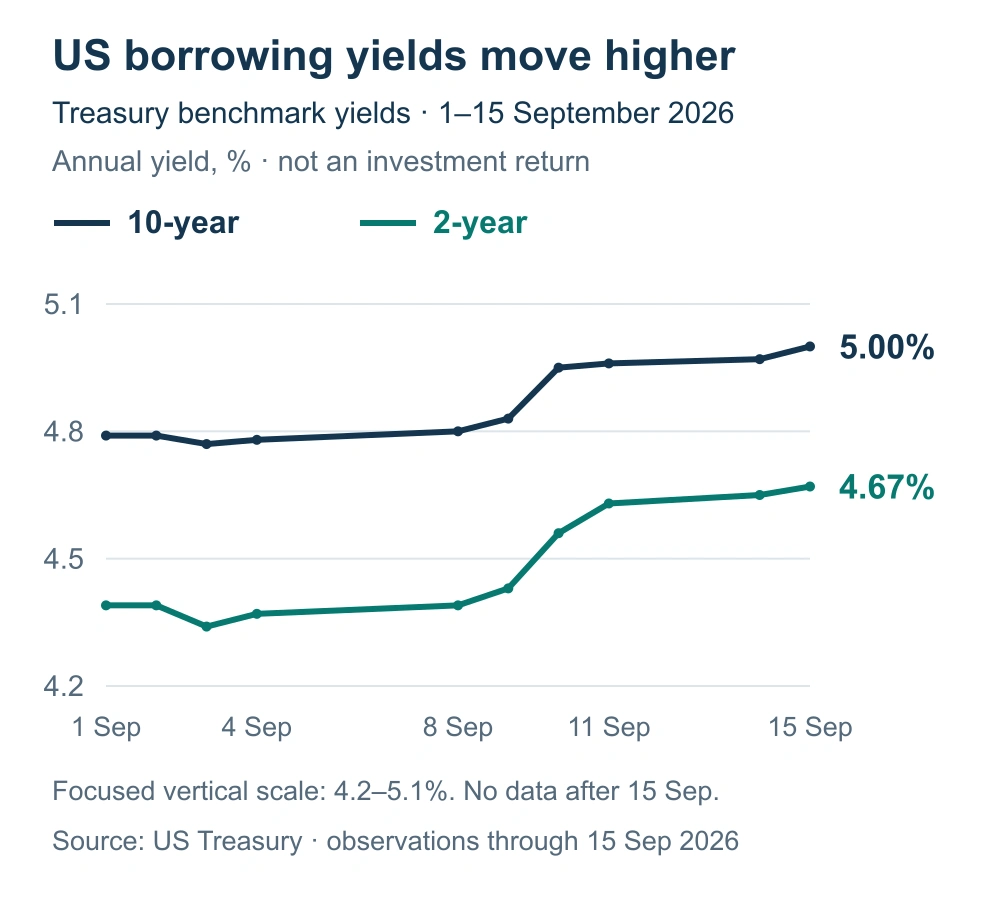
Before the US central bank’s decision on the evening of 16 September, the bond market was already signalling more expensive long-term financing. The ten-year Treasury yield reached 5.00% on 15 September, compared with 4.97% on 14 September and 4.78% on 4 September. The last session’s rise was small, but part of a larger move over several sessions. The two-year yield was 4.67% on 15 September and the thirty-year yield was 5.36%.
A new bond buyer sees a higher yield, while the holder of an older fixed-rate bond may see a lower market price. A company refinancing debt now may face a higher interest bill. For technology and property projects, what matters is not just future revenue, but the cost of waiting for it. These market moves cannot be attributed to a decision that has not yet been announced.
? What does a 5% bond yield mean?
A bond yield relates its price to future payments. These are annual yields for standard maturities calculated by the US Treasury from market quotations. They are not that day’s earnings, the US central bank’s policy rate or a return guaranteed to every investor. A euro-based investor’s result may also change with the dollar exchange rate.
Factories report slower growth in orders, while inputs keep getting dearer
In the New York State manufacturing survey released on 15 September, the general business conditions index fell from 20.6 points in August to 7.6 in September. The prices paid index rose from 58.6 to 63.1. This is a regional warning, not evidence of a contraction across all US manufacturing: activity was still growing, but cost pressure was not easing.
A factory finds it harder to protect profits if material bills rise faster than its ability to raise selling prices. Orders can still help equipment suppliers, while buyers exposed to energy costs and debt face the other side of the trade. The next broader production and sales figures will show whether this regional signal is repeated.
? How should the New York manufacturing survey be read?
The Empire State Manufacturing Survey compares the shares of companies reporting an increase and a decrease in each measure. Zero separates a balance towards growth from a balance towards decline. A prices index of 63.1 points does not mean that prices rose 63.1%. This is not a purchasing managers’ index, for which the usual threshold is 50 points.
A higher dividend does not tell us how much cash remains after expansion
Software and cloud company Microsoft announced on 15 September that its quarterly dividend would rise from $0.91 to $0.98 per share, or about 7.7%. Payment is scheduled for 10 December. This is a future distribution, not income already received. The decision shows that heavy expansion and returning cash to shareholders can coexist, but a dividend alone cannot establish whether investment is paying off.
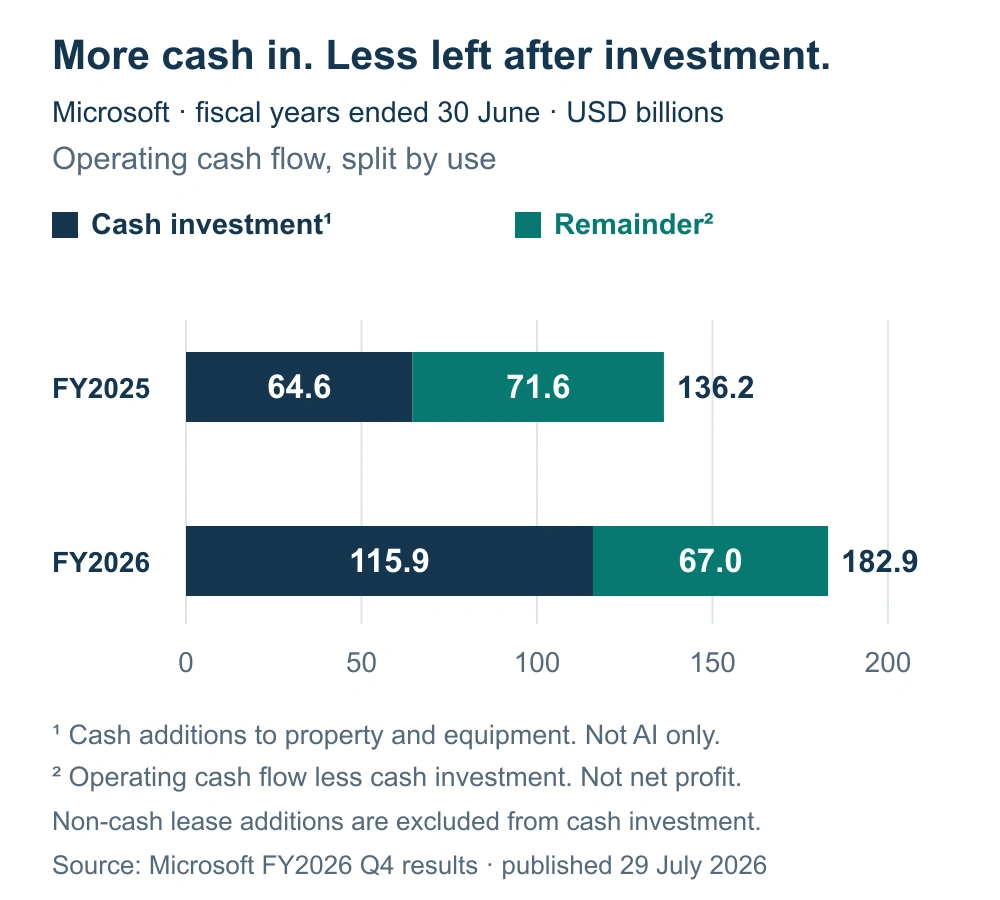
In the latest annual cash-flow statement, released on 29 July for the year ended 30 June, operating cash flow increased from $136.2 billion to $182.9 billion. Cash additions to property and equipment rose from $64.6 billion to $115.9 billion. They absorbed about 63% of operating cash, compared with 47% a year earlier. The calculated remainder after those outlays fell from $71.6 billion to $67.0 billion.
These investments are not all artificial-intelligence spending and exclude non-cash finance-lease additions. The remainder is not net income or cash reserved exclusively for dividends. The opportunity for investors is new capacity turning into profitable services; the risk is revenue arriving slowly when equipment and electricity already have to be paid for. Operating cash, actual investment payments and lease commitments matter next, not revenue growth alone.
Europe's rate decision is now in force, while the trade recovery remains uneven
The European Central Bank’s decision of 10 September takes effect on 16 September. The rate paid on banks’ overnight deposits is now 2.50%, up from 2.25%. This implements an earlier decision rather than delivering a fresh surprise this morning. A loan payment depends on its contract and reset date, so not every borrower’s bill changes today.
Euro-area trade figures for July, released on 15 September, provided a counterweight: nominal goods exports rose 9.0% year on year and imports 7.9%. July’s surplus was €14.2 billion, but the January–July surplus totalled only €17.0 billion, compared with €92.8 billion a year earlier. These are non-seasonally adjusted goods values. One better month has not offset the earlier weakness, and higher sales values alone do not prove larger volumes or profits.
Lithuania is expected to grow, but purchasing power still matters
The Bank of Lithuania’s forecast published on 15 September projects real economic growth of 2.7% in 2026, 2.4% in 2027 and 3.1% in 2028. Average annual inflation is forecast at 5.1%, 3.1% and 2.6%, respectively. These are forecasts, not completed annual results. A smaller one-off consumption boost from withdrawals from the second-pillar pension system would also mean a smaller subsequent reversal.
Domestic retailers depend on household purchases; Baltic exporters also depend on orders from abroad. Their prospects need not move together. Inflation erodes the purchasing power of money held for a long time without interest, but a forecast alone does not justify hastily taking more risk. What matters most is when the money will be needed and how much fluctuation in value can be tolerated.
15 September: China’s factories strengthened, but consumers were slow to spend
August year-on-year changes released on 15 September: China’s industrial output grew 5.2% in real terms, while retail sales increased 0.4% in nominal terms.
The unevenness itself matters to investors. An equipment or technology supplier can receive more orders while a business dependent on household spending experiences sluggish demand. China’s headline growth rate alone therefore cannot tell us how a European exporter or a commodity company will perform. We need to know who its customers are and what they use its products for.
? What are we actually comparing in China’s data?
Industrial value added measures the value created in production, and its real growth rate removes the effect of prices. Retail sales here measure the monetary value of sales at current prices. They do not cover all household spending, because many services fall outside this measure. Both percentages compare with August of the previous year, but their coverage and price adjustments differ.
The technology buyer’s bill: what did the 10 September results show?
The distinction between technology sellers and buyers became clearer over the month. Software and cloud company Oracle generated 23.103 billion dollars in operating cash flow for the quarter ended in August, while capital expenditure was 28.499 billion dollars. Investment spending was about 23% higher than operating cash flow. Subtracting it left a negative difference of 5.396 billion dollars.
Operating cash flow also included 11.363 billion dollars of customer prepayments. These can help finance expansion, but they are not the same as recurring profit from services already delivered. The opportunity is that new data centres may later operate profitably. Risk increases if revenue is delayed while equipment, electricity and debt must be paid for sooner.
Higher market yields generally put pressure on the prices of previously issued fixed-rate bonds. For equity investors, they raise the bar for future profits: a safer alternative pays more, while a company’s debt may also become more expensive. The most exposed businesses are those that need to borrow now while still waiting for higher revenue.
The portfolio question: who receives the cash, and who is still funding expansion?
Higher oil prices can help suppliers while increasing costs for hauliers and the chemicals industry. A technology equipment supplier may earn money before its customer starts receiving a return on the assets it bought. Longer-term bonds react more sensitively to changing rate expectations than shorter-term bonds. These are not three unrelated stories: they illustrate different timings of cash coming in and going out.
For a euro-based investor, the dollar’s effect also remains. A US share’s change in dollar value will not necessarily match the return in euros. A higher US yield alone is not enough to predict the currency’s direction, because growth, trade and investors’ choices also affect it.
30 days
What comes next
The evening of 16 September: the US decision is still ahead
The Federal Reserve, the US central bank, is already holding its 15–16 September meeting. The decision is scheduled for today at 21:00 Lithuanian time and the press conference at 21:30. At this morning’s information cutoff, the outcome is unknown and the federal funds target range maintained on 29 July remains 3.50–3.75%. The outcome must not be presented as something that has already happened.
Before that, US August retail sales and import-price data are scheduled for 15:30 Lithuanian time. They will help show whether demand is withstanding higher prices. A more restrictive central bank signal than markets expect could support yields and put pressure on highly valued shares; a softer signal could ease that tension. These are conditional scenarios, not guaranteed price directions. US industrial production on 18 September will provide a broader check than one regional survey.
Next, look beyond the revenue growth percentage
In new company results, it is worth tracking the cost of equipment, electricity and interest, and the cash left after those expenses. The positive opportunity is expansion turning into profitable services. The main risk is a timing mismatch: bills are paid now, while expected revenue arrives late. Commodity and currency fluctuations can widen or narrow that gap, so a sales forecast alone does not provide the full picture.
Important. This is general market analysis, not a personal recommendation to buy or sell. Historical data and company results do not guarantee future returns. Forecasts and conditional scenarios may not materialise.
How is the history preserved and updated?
All five periods in this edition share one information date. Week means the latest 7 days, quarter means 90 days, and year means the trailing 12 months. The next dated edition will have a separate URL. This text keeps its date and assessment; later events are not silently inserted into an older edition. Longer periods assess new evidence alongside earlier developments without repeating every headline.