
Today · Market review
US ten-year bond yield at 5.24%: who faces costlier borrowing?
Companies borrowing to expand may face more expensive new loans after US bond yields rose yesterday, 28 September. The European Central Bank discussed whether costlier energy would push up other prices. NVIDIA increased the amount it can spend on its own shares, but the announcement does not confirm completed purchases. The proposed US–China reductions in some import tariffs are also not yet in force. US job-openings data are due on 29 September.
Period covered: 2026-09-29Information as of 9 min read
Important news followed the morning of 28 September: Monday’s US ten-year yield rose to 5.24%, the ECB president discussed energy-related inflation risks, and NVIDIA announced an additional $150 billion share-repurchase authorisation. These are developments from 28 September, not new decisions this morning. US job-openings data are due later on 29 September.
The proposed US–China import tariff reductions are not yet in force. NVIDIA’s authorisation does not mean the shares have already been repurchased. Energy inventories measure stored quantities, not current prices. Companies need to be assessed by their orders, cash generation and borrowing costs. Even rising profit does not guarantee a good investment if too much is paid for the shares.
Today
What happened
The US ten-year bond yield reached 5.24%: companies may face higher borrowing costs
Companies borrowing to expand may have to pay higher interest rates. On 28 September, the US ten-year Treasury yield rose from Friday’s 5.17% to 5.24%. The two-year measure increased from 4.81% to 4.92%, and the thirty-year from 5.49% to 5.56%. Yields rose on both shorter- and longer-term bonds. These figures do not establish which particular news item contributed most to the rise.
? Bond yields and basis points: what does the change mean?
A yield relates a bond’s market price to its future payments; these are the US Treasury’s standardised measures for the respective maturities. A rise from 5.17% to 5.24% is 0.07 percentage points, or 7 basis points, not a 7% investment return. When yields rise, prices of existing fixed-rate bonds generally fall.
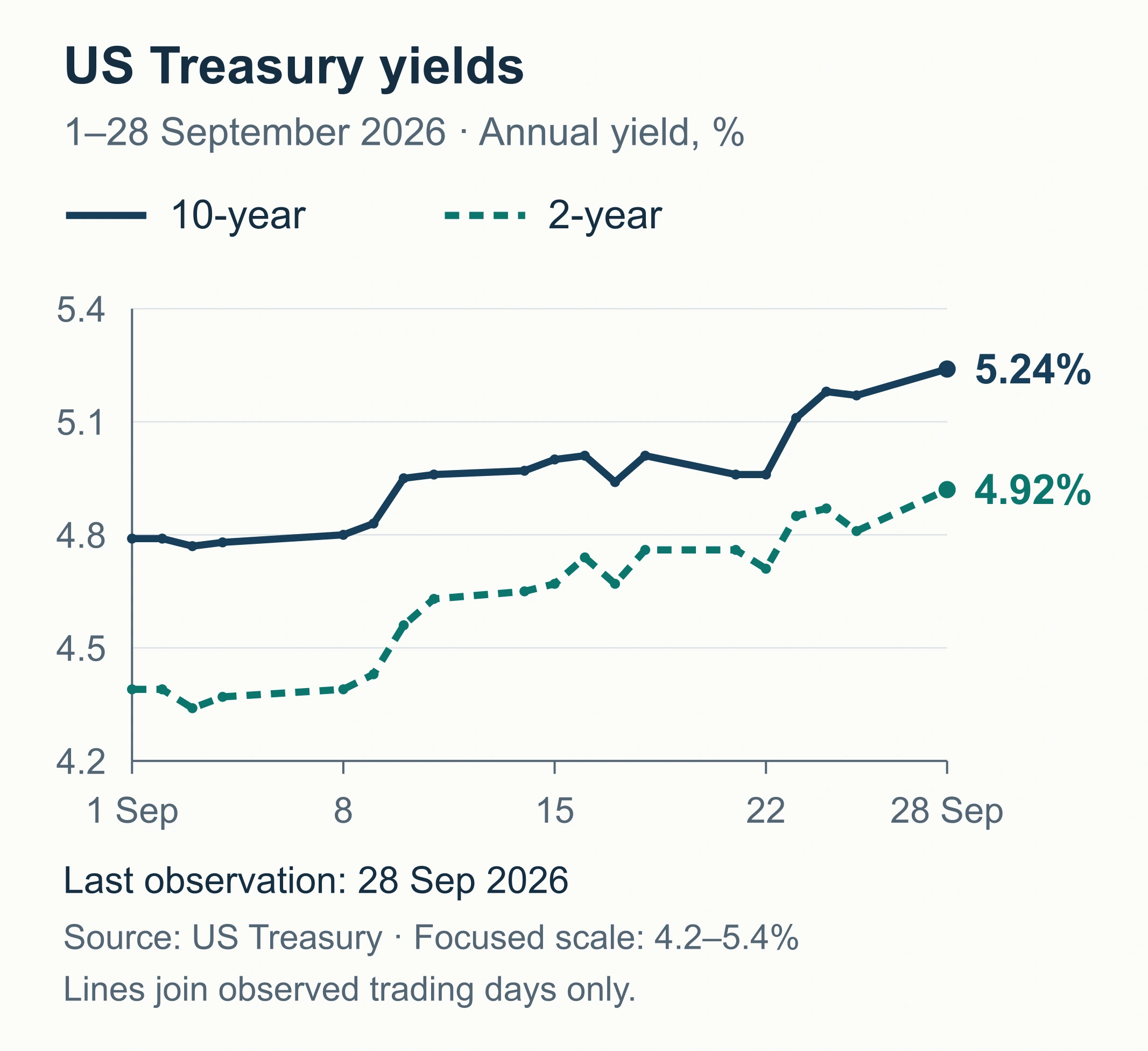
A company’s borrowing rate is not identical to this measure, but government borrowing costs provide an important reference point. When that reference rises, new loans or bond issues can become more expensive for a company, unless lenders reduce the additional interest they charge for that company’s risk. This matters for property companies, utility companies and data centres financed with borrowing. Existing fixed-rate loans do not automatically become more expensive after a single market session.
The same change affects new bond buyers and existing holders differently. New bond buyers see a higher yield, while the value of an existing longer-maturity portfolio may fall. Higher interest rates may affect a technology company with little debt less than a customer borrowing to build new data centres. The next US labour-market and consumer-price releases will help test whether household spending and business demand are supporting the economy, or prices are still rising too quickly.
The ECB is watching whether costlier energy will push up other prices and wages
For Europe, the issue is not only how much energy has become more expensive, but whether the increase spreads to other prices. On 28 September, European Central Bank President Christine Lagarde noted that there were not yet clear signs that rising energy costs have already led to a lasting increase in wage growth. This is the ECB’s assessment, not a guarantee or a new interest-rate decision. Compensation per employee grew 3.3% year on year in the second quarter, compared with 3.6% in the first; these figures should not be confused with inflation.
? Second-round inflation effects: what is the central bank looking for?
The first effect is the direct increase in energy prices. A second round occurs when higher costs spread more widely into wages and other goods and services prices. An energy-price jump alone does not prove that such a more persistent price-setting process has become established.
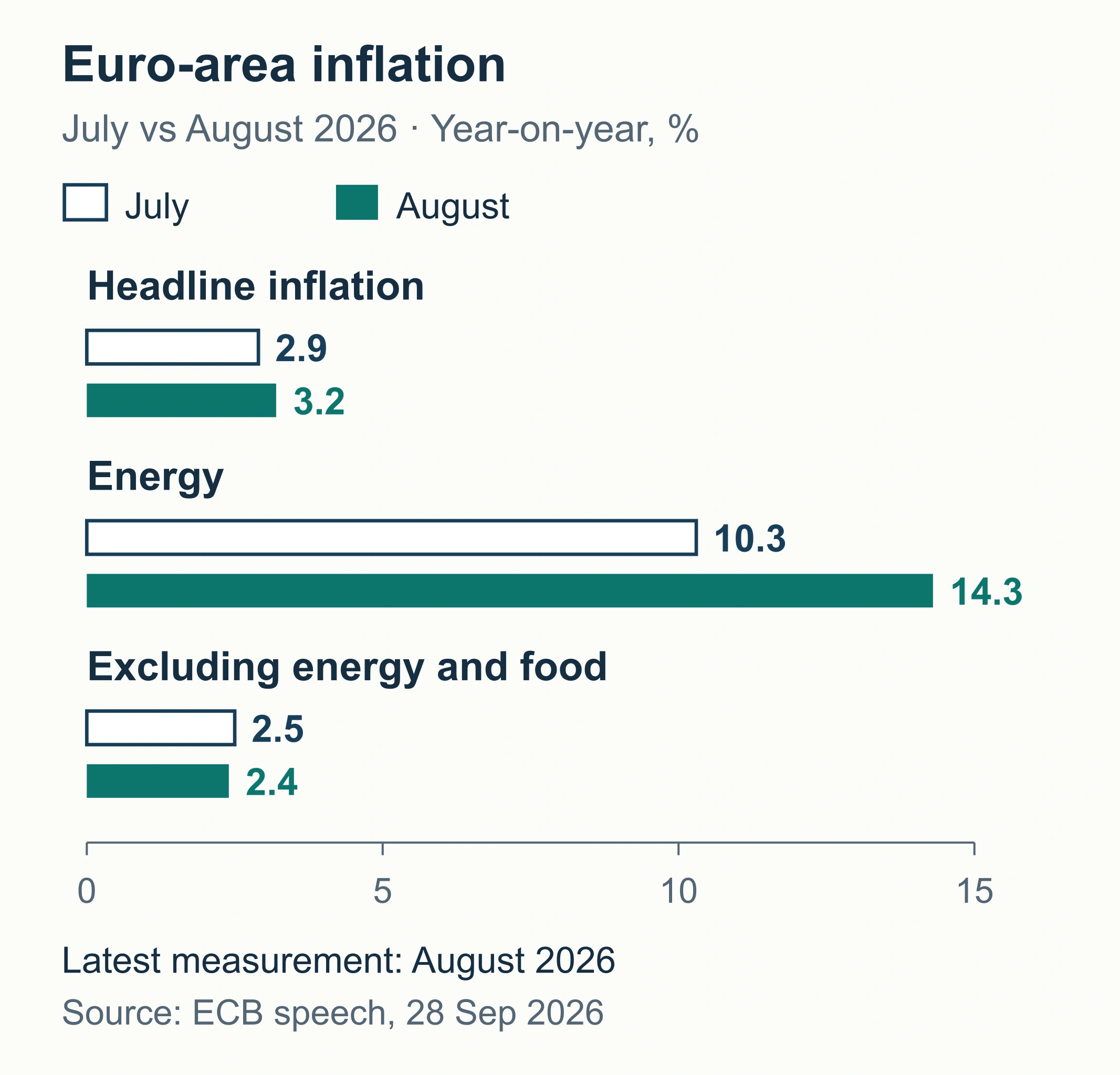
Energy prices rose faster in August, but other prices did not all accelerate with them. Annual headline euro-area inflation rose from July’s 2.9% to 3.2%, and energy inflation from 10.3% to 14.3%. Inflation excluding energy and food nevertheless slowed from 2.5% to 2.4%. Faster energy inflation therefore does not mean that all goods and services prices are accelerating equally. The ECB is also assessing whether higher long-term rates will slow the economy and reduce companies’ ability to raise selling prices.
US inventory data show that supplies of crude oil and finished fuels differ. The latest US weekly release was published on 23 September for the week ending 18 September. Commercial crude stocks excluding the strategic reserve were 426.4 million barrels, around 2% above their five-year seasonal average. Petrol stocks were 6% below their own average and distillates 12% below theirs. This compares inventories; it is not today’s oil price or an equivalent change in fuel prices.
? Distillates and seasonal averages: what is being compared?
Distillates include diesel and heating-oil products. Each product’s stocks are compared with its own average for that time of year over five years. More crude in storage does not always mean sufficient finished fuel has reached buyers.
More expensive fuel and electricity can reduce transport and chemical companies’ profits. Households spending more on energy also have less money left for other goods. Higher fuel inventories and slower price increases would help these businesses and their shareholders. New supply disruptions, by contrast, could raise costs and selling prices. The US inventory report on 30 September needs to be read for fuel stocks and refining activity, while European wage and services-price trends remain important.
For your investments
Let’s discuss your portfolio
 FINANCIAL FREEDOM01 / 04
Investment results since 1999
Are you beating
global equities?

at the end of the period
Jan 1999–Jun 2026 · EUR · Cumulative return, %
Linear scale · * MSCI World → MSCI ACWI.
Past performance does not guarantee future returns.
FINANCIAL FREEDOM02 / 04Historical comparison
How far did it fall?
How long to recover?
Decline from the previous high

Longest recovery to the previous high

Jan 1999–Jun 2026 · EUR · Monthly data
* MSCI World → MSCI ACWI.
Past performance does not guarantee future returns.
FINANCIAL FREEDOM03 / 04Personal investment consultation
Already investing?
Let’s review your portfolio.
Yet to start
investing?
Let’s build your first
investment plan.
FINANCIAL FREEDOM04 / 04
Personal investment
consultation
Martynas
Juška
Investment manager
Managing a portfolio
of more than€100 million
NVIDIA’s $150 billion authorisation is not a completed share buyback
NVIDIA announced a plan to buy more of its own shares, not new sales results. On 28 September, chip designer NVIDIA announced an additional $150 billion share-repurchase authorisation. After the increase, the company can spend a total of $235 billion on further repurchases under the programme. The company expects to use that balance through the end of its fiscal 2028. This is a plan, not completed purchases, a guaranteed payment on a specific date or newly earned profit.
? Share-repurchase authorisation: what changes for a shareholder?
Authorisation allows a company to buy its own shares, but does not itself spend cash or reduce the share count. If actual repurchases reduce the number of shares, the same total profit is divided among fewer shares. New share issuance and the purchase price also affect the outcome; authorisation is not a promised investment return.
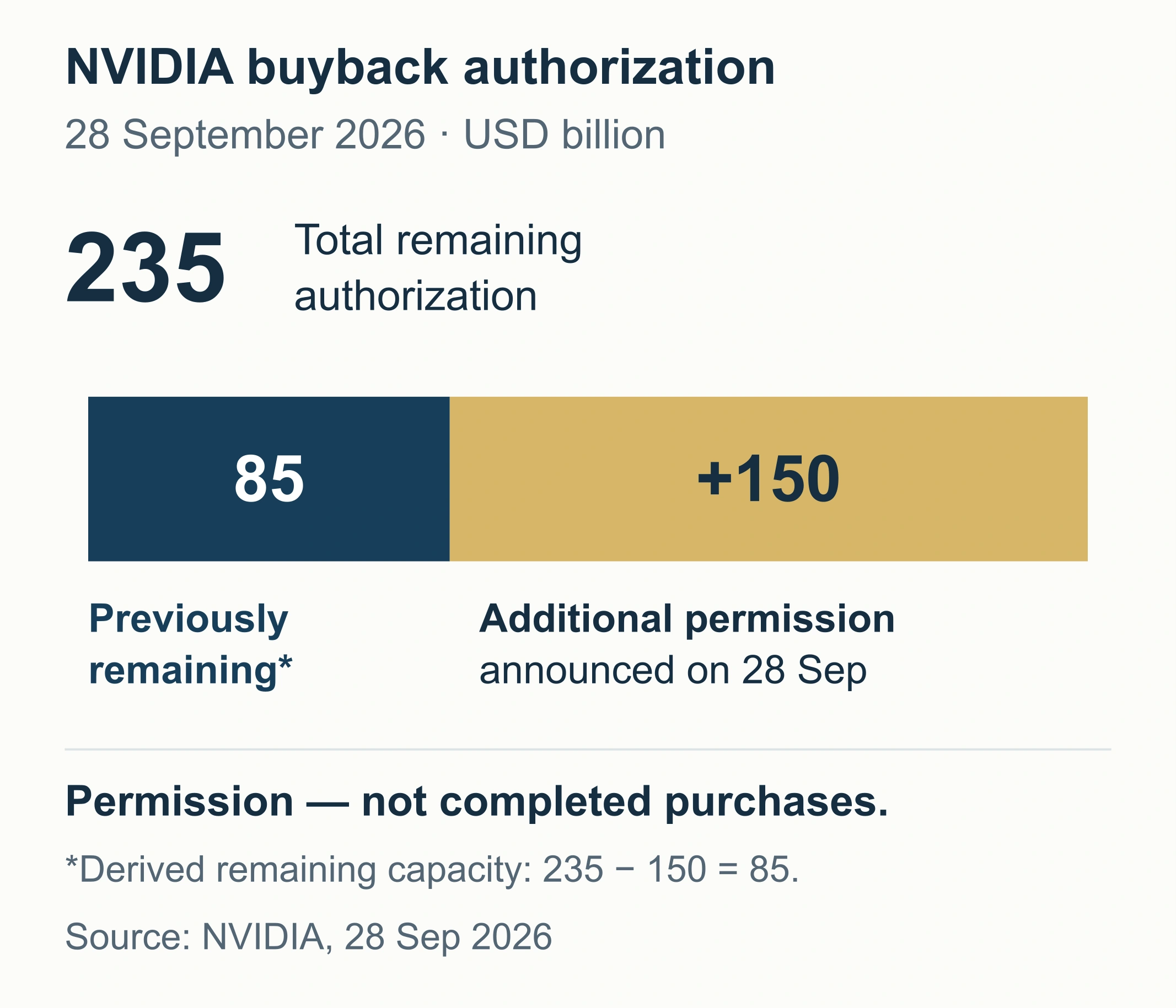
The scale needs careful reading: the additional $150 billion is part of the total $235 billion remaining balance, not another amount to add to it. NVIDIA’s ability to repurchase shares may differ from its customers’ ability to finance data centres. This matters to holders of broad US equity funds as well as individual technology shares. One company’s buyback programme does not prove that artificial-intelligence infrastructure has already paid off for all its customers.
Repurchases could benefit shareholders if the company generates enough cash both to buy shares and to fund worthwhile projects. But it could pay too much for its shares. If repurchases merely offset newly issued shares, the total share count would not fall. Chip suppliers and their customers therefore need separate financial assessments. Later NVIDIA reports will show how much cash was actually spent on repurchases and how the share count changed.
US–China tariff reductions are not yet in force, while Chinese industrial profit growth has slowed
The proposed reduction in US–China import tariffs has not yet changed the duties companies pay. On 27 September, the White House published US and Chinese product lists proposed for lower import tariffs worth about $30 billion in each direction. Lower tariffs are not yet in force. An importer would save money only if lower duties were approved and applied to its goods. Product codes, tariff rates, exemptions and delivery conditions all matter.
? Scope of the proposed tariff reductions: what does a product list’s value mean?
The $30 billion in each direction describes the scope of that product list. It is not additional exports or corporate profit of that amount, nor a 30% tariff. Final terms and actual orders determine the economic effect.
Data published on 28 September showed slower profit growth at Chinese industrial companies. August profit at larger industrial enterprises was 4.2% higher than a year earlier, compared with growth of 11.2% in July. That is slower annual growth, not a fall in profit from July. Slower growth in customers’ earnings can restrain orders for European equipment and metals suppliers even if some trade costs subsequently decline.
? Chinese industrial profit: what is the comparison base?
The measure covers industrial enterprises with annual principal-activity revenue of at least 20 million yuan, calculating growth on a comparable sample. August is compared with August a year earlier. Profit growth is neither a stock return nor the result for every company in the country.
Lower US–China import tariffs could reduce importers’ costs and help suppliers win orders. But decisions may be delayed. If demand weakens, sellers may still need to cut prices. Retailers need to know how much less they will pay for goods, while industrial suppliers need to know whether customers will order more equipment and materials. Final tariff rules therefore need to be assessed alongside companies’ orders and profit reports.

More time for what matters to you
Who looks after your portfolio?
Portfolio management covers investment selection, risk monitoring and rebalancing. Let’s discuss whether this approach would suit you.
The first conversation is free, with no obligation.
Today
What matters now
The week’s question: would lower US–China tariffs increase company profits?
What changed since yesterday? The US–China proposal to reduce some import tariffs is still under consideration. But Monday’s rise in bond yields could make new business borrowing more expensive. The ECB discussed whether rising energy costs would push up other prices, while NVIDIA increased the amount authorised for share repurchases. Companies face different needs: some need more buyers, some cheaper loans, and others need to decide how to use cash they have earned.
Lower tariffs would help if they took effect and allowed companies to cut costs or increase profitable sales. But more expensive loans, weaker demand or higher energy costs could offset part of that benefit. The next labour-market and consumption releases will help distinguish these scenarios. No precise equity-index or exchange-rate moves are given here because prices for the full comparison period have not been verified. Dollar movements also affect the value of a euro investor’s US holdings if the currency risk is unhedged.
Higher interest rates do not necessarily worsen every company’s prospects equally. If stronger real growth drives them higher, more sales may offset part of companies’ financing costs. If prices rise without companies selling more, extra sales do not offset the higher costs. The yield table alone cannot distinguish these scenarios. Household spending adjusted for price changes, company orders and the profit retained from sales therefore need to be assessed together, rather than assuming that higher rates are equally bad for every equity.
Today
What comes next
What comes next: labour demand, consumption and plans put into practice
- US job-openings data on 29 September. August’s Job Openings and Labor Turnover Survey is due at 17:00 Lithuanian time. It has not been released at the morning cutoff; the question is whether companies still need as many new workers.
- US prices and consumption on 30 September. August personal spending and its price index, plus the third estimate of second-quarter economic growth, are due at 15:30 Lithuanian time. These are upcoming releases, not known results.
- Will announced decisions be put into practice? The US energy report on 30 September will test fuel inventories. US–China trade needs final terms for applying lower tariffs, while NVIDIA needs later reports of completed repurchases, not just the size of its authorisation.
? Job openings and consumption prices: what are we monitoring?
The Job Openings and Labor Turnover Survey measures vacancies and movements of workers, not simply the number of newly created jobs. The Personal Consumption Expenditures Price Index measures price changes in goods and services consumed. Real consumption expenditure removes the effect of price changes and should not be confused with the price index.
Important. This is general market analysis, not a personal recommendation to buy or sell. Historical data and company results do not guarantee future returns. Forecasts and conditional scenarios may not materialise.
How is the history preserved and updated?
All five periods in this edition share one information date. Week means the latest 7 days, quarter means 90 days, and year means the trailing 12 months. The next dated edition will have a separate URL. This text keeps its date and assessment; later events are not silently inserted into an older edition. Longer periods assess new evidence alongside earlier developments without repeating every headline.