
Year · Market review
Year: how rates, tariffs and energy affected companies
Over twelve months, central banks changed interest rates, import tariffs changed, and geopolitical events disrupted energy supply. Technology companies grew revenue, but their customers needed substantial funding for equipment and infrastructure. NVIDIA’s new share-repurchase authorisation does not remove these differences. Investors need to assess how much a company earns, what its borrowing costs and whether its share price is justified by expected profits.
Period covered: 2025-09-30 – 2026-09-29Information as of 18 min read
Important news followed the morning of 28 September: Monday’s US ten-year yield rose to 5.24%, the ECB president discussed energy-related inflation risks, and NVIDIA announced an additional $150 billion share-repurchase authorisation. These are developments from 28 September, not new decisions this morning. US job-openings data are due later on 29 September.
The proposed US–China import tariff reductions are not yet in force. NVIDIA’s authorisation does not mean the shares have already been repurchased. Energy inventories measure stored quantities, not current prices. Companies need to be assessed by their orders, cash generation and borrowing costs. Even rising profit does not guarantee a good investment if too much is paid for the shares.
Year
What happened
Autumn 2025: US interest rates fell while Europe opted for a pause
Before this rolling period began, on 17 September 2025, the Federal Reserve cut its target range from 4.25–4.50% to 4.00–4.25%. That is the starting background, not an event after 30 September. It cut the range by another quarter point on both 29 October and 10 December, reaching 3.50–3.75%. Each decision took effect the following day.
Lower interest rates helped some borrowers, but their benefits cannot be separated from the reason for the cuts. If a central bank cuts rates because it sees weaker demand, a company’s cheaper loan may be offset by poorer sales. That is why the simple rule that “rates were cut, so that is good for shares” does not explain the market’s entire reaction.
During the autumn, the European Central Bank kept the rate paid on banks’ overnight deposits at 2.00%. Its 11 September decision was announced before this rolling twelve-month period began, but established its starting backdrop. The rate remained unchanged at the October and December meetings. The US and the euro area were therefore already following different paths.
November: the US and China agreed to ease some tariffs and export restrictions
On 1 November, the US announced the terms of an agreement with China providing for reductions in some tariffs and a suspension of rare-earth export restrictions from 10 November. This was an important signal of relief for supply chains. Rare earths are used in a range of industrial and technological equipment, so the availability of these materials matters to more than just their producers.
However, temporary relief is not a permanent, unchanging rule. A factory needs to know when a component will arrive and what its final cost will be. Uncertainty encourages companies to hold larger inventories or seek a more expensive alternative supplier. The November decision therefore cannot automatically be presented as the tariff applying to all goods today: subsequent measures have their own legal bases and conditions.
January 2026: switching energy suppliers became a concrete plan
On 26 January, the Council of the European Union approved a gradual phase-out of Russian gas imports. A full ban on liquefied natural gas is scheduled from the beginning of 2027, and on pipeline gas from autumn 2027. These are future deadlines with transition periods, not a halt to all imports on that January date.
Replacing Russian gas required new supply contracts and infrastructure. Other suppliers, ships, terminals and reserves were needed. Over time, a wider choice of suppliers may reduce dependence, but the transition itself also costs money. Investors need to distinguish the long-term benefits of resilience from the near-term bills for energy and infrastructure.
Meanwhile, the US central bank was in no hurry to continue the autumn cuts. The 3.50–3.75% range remained unchanged at its January, March and April meetings. Europe’s February, March and April decisions also maintained the 2.00% deposit facility rate. Earlier cuts were not a promise that every subsequent meeting would follow the same pattern.
February: the legal basis for tariffs changed
On 20 February, the US Supreme Court ruled that the International Emergency Economic Powers Act does not authorise the president to impose tariffs. The decision restricted a specific legal basis. It did not mean that all US import tariffs disappeared, because other measures relied on different laws.
On the same day, the administration announced a temporary 10% import surcharge, with exemptions, under a different section of the Trade Act. The proclamation specified a start on 24 February and a 150-day period until 24 July. This is a historical measure, not a tariff automatically applying to all imports today.
For businesses, changes like these mean having to recheck a product’s origin, classification code, delivery date and exemptions. An importer uncertain of the final cost may delay an order or hold more inventory. Even a politically favourable headline therefore does not always immediately reduce a company’s costs or increase its sales.
February's results showed that technology demand was more than a promise
On 25 February, chip designer NVIDIA reported results for its financial year ended 25 January. Revenue reached $215.938 billion, while net income under US accounting standards was $120.067 billion. Both figures were 65% higher than in the company’s previous financial year. These are results for a completed period, not a forecast for calendar year 2026.
This matters to the longer story: technology suppliers were generating visible, actual earnings well before the summer results season. But profit does not answer the question of an investment’s price. Even a successful company may be valued on very high expectations for the future that subsequently prove harder to meet.
Spring: geopolitical risk became an oil delivery problem
The war in the Middle East that began on 28 February disrupted oil shipments through the Strait of Hormuz. On 11 March, International Energy Agency member countries agreed to make 400 million barrels of emergency oil reserves available to the market. This was the largest coordinated release amount in the agency’s history. The decision was a commitment to release reserves, not the release of the entire volume in one day.
Reserves can buy time, but cannot replace commercial supply indefinitely. When reliable deliveries are lacking, the effects spread from the oil market to fuel, transport, chemicals and household purchasing power. More expensive energy can simultaneously raise inflation and weaken growth. A central bank faces an uncomfortable choice: raising interest rates does not produce additional oil, but cutting them may stimulate demand at a time when supply is constrained.
May: the EU–Mercosur agreement reduced some tariffs
On 1 May, provisional application of the trade agreement between the European Union and the South American Mercosur countries began. Tariffs on some goods were reduced or removed. This marked a move from negotiations to applicable trade preferences, but was not yet the full, finally ratified partnership agreement.
European exporters gained opportunities to reach buyers on more favourable terms. For importers, a wider choice may help reduce dependence on a single supplier. At the same time, greater competition puts pressure on more vulnerable sectors. Actual orders and the use of trade preferences ultimately reveal the investment significance, not just the headline on the day an agreement is signed or takes effect.
June and July: Europe's interest rate direction reversed
On 11 June, the European Central Bank announced a 0.25 percentage point rate increase. The deposit facility rate rose to 2.25% from 17 June. It was left unchanged on 23 July. The US maintained its 3.50–3.75% target range at the 17 June and 29 July meetings. US cuts had therefore given way to a pause, while Europe had already turned towards higher rates.
The 18 June memorandum between the US and Iran raised hopes of normalising supply. But the International Energy Agency’s 10 July report already described ceasefire breaches on 7–8 July. Its August edition showed weaker oil export flows in July. An agreement and its implementation proved to be two separate stages that matter to investors.
On 23 July, the European Union expanded its energy and financial sanctions against Russia. The Office of the US Trade Representative announced a decision concerning 60 economies under Section 301 of the Trade Act on the same day. Tariffs depended on the product and applicable conditions; this was not an automatic extension of the temporary surcharge announced in February. Over the year, both supply routes and the rules governing what buyers pay for goods changed.
Summer: NVIDIA’s profits grew while its customers invested heavily in infrastructure
On 26 August, NVIDIA reported revenue of $96.221 billion for the quarter ended 26 July. Revenue was 106% higher and operating profit 124% higher than a year earlier. This result confirmed that demand for the supplier remained real. Its customers, however, pay for equipment, data centres and electricity infrastructure before receiving all their expected revenue.
In late July, Microsoft reported that it generated $55.4 billion in operating cash flow during the quarter ended 30 June and spent $35.8 billion in cash on purchases of long-term assets. In Oracle’s quarterly results released in September, capital expenditure already exceeded operating cash flow. These are not identical businesses, but the comparison shows why the technology story requires monitoring more than revenue growth.
Early September: prices brought attention back to interest rates
On 9 September, the US Energy Information Administration raised its forecast for the average Brent price in the second half of the year to around $90 per barrel. The publication used model inputs finalised by 3 September. It therefore does not measure the impact of later military reports in September and is not the latest exchange price.
On 10 September, the European Central Bank announced another 0.25 percentage point rate increase. On 11 September, the US Consumer Price Index showed annual price growth of 3.4% in August, unchanged from July. Seasonally adjusted monthly growth increased from 0.1% to 0.4%. However, annual growth in the basket excluding food and energy slowed from 2.5% to 2.4%. Monthly growth in this basket nevertheless increased from 0.2% to 0.3%. Prices therefore rose faster over the month even though annual inflation slowed for some goods and services.
For your investments
Let’s discuss your portfolio
 FINANCIAL FREEDOM01 / 04
Investment results since 1999
Are you beating
global equities?

at the end of the period
Jan 1999–Jun 2026 · EUR · Cumulative return, %
Linear scale · * MSCI World → MSCI ACWI.
Past performance does not guarantee future returns.
FINANCIAL FREEDOM02 / 04Historical comparison
How far did it fall?
How long to recover?
Decline from the previous high

Longest recovery to the previous high

Jan 1999–Jun 2026 · EUR · Monthly data
* MSCI World → MSCI ACWI.
Past performance does not guarantee future returns.
FINANCIAL FREEDOM03 / 04Personal investment consultation
Already investing?
Let’s review your portfolio.
Yet to start
investing?
Let’s build your first
investment plan.
FINANCIAL FREEDOM04 / 04
Personal investment
consultation
Martynas
Juška
Investment manager
Managing a portfolio
of more than€100 million
The interest rate path in one place
The table shows changes to key US and euro area interest rates announced within this twelve-month period through 17 September, the July decisions to leave them unchanged, and an earlier US decision establishing the starting backdrop. It is not a list of every meeting. Europe’s decision announced on 10 September took effect on 16 September.
| Decision date | Region | Before | After | When it applies |
|---|---|---|---|---|
| 2025-09-17 | US | 4.25–4.50% | 4.00–4.25% | From 18 September |
| 2025-10-29 | US | 4.00–4.25% | 3.75–4.00% | From 30 October |
| 2025-12-10 | US | 3.75–4.00% | 3.50–3.75% | From 11 December |
| 2026-06-11 | Euro area | 2.00% | 2.25% | From 17 June |
| 2026-07-23 | Euro area | 2.25% | 2.25% | Left unchanged |
| 2026-07-29 | US | 3.50–3.75% | 3.50–3.75% | Range left unchanged |
| 2026-09-10 | Euro area | 2.25% | 2.50% | In effect from 16 September |
| 2026-09-16 | US | 3.50–3.75% | 3.75–4.00% | From 17 September |
For the US, the table shows the federal funds target range; for the euro area, it shows the specific deposit facility rate. Europe’s 2.50% rate took effect on 16 September. On 17 September, the US range was 0.25 percentage points lower than after the decision of 17 September 2025 that established the starting backdrop. The European deposit rate rose 0.50 percentage points. The US increase of 16 September is included in the table.
? Consumer Price Index: why does the monthly change matter too?
The Consumer Price Index is compiled using the prices of goods and services and their weights in consumption. The annual change compares prices with the same month of the previous year. The seasonally adjusted monthly change helps show the latest pace. The annual figure can therefore remain unchanged even when prices rise faster in the latest month.
Mid-September: oil supply was forecast to fall more than demand
The International Energy Agency’s 11 September forecast projects a larger decline in oil supply than in demand this year. This is a forecast, not a final annual result.
16–24 September: US bond yields rose again after a brief decline
On 16 September the Federal Reserve raised its target range to 3.75–4.00%. An earlier European decision lifting the deposit rate to 2.50% took effect on the same day. The US ten-year yield fell to 4.96% on 21–22 September, but reached 5.18% on 24 September. The fall in US bond yields was therefore short-lived.
The preliminary US Purchasing Managers’ Index, or PMI, reached 58.4 in the release of 23 September, compared with 56.0 in August. Initial unemployment benefit claims of 197,000 for the week ending 19 September, released on 24 September, added to the evidence that the economy was not weakening sharply. These are signals from 23–24 September, but neither a survey nor one week of claims is a final measure of an entire quarter’s growth.
? Purchasing Managers’ Index: what does the threshold mean?
The company survey compares activity with the previous month. Above 50 generally indicates expansion and below 50 contraction. A reading of 58.4 does not mean growth of 58.4%; the preliminary measure may be revised.
September’s decisions extended beyond the US and euro area. On 18 September the Bank of Japan set an overnight interest-rate target of 1.25%, effective from 24 September. On 17 September the Bank of England left Bank Rate at 3.75%. These different paths matter for Japanese bonds and yen-funded investments, as well as British companies’ borrowing costs.
25–28 September: uneven demand and trade relief not yet in force
US August durable-goods orders, reported on 25 September, reached $338.6 billion and were virtually unchanged from revised July. Orders for non-defence capital goods excluding aircraft nevertheless rose 1.6%, while shipments increased 0.6%. These are monthly changes adjusted for seasonality, but not for prices. On the same day, the University of Michigan’s final September consumer sentiment index stood at 48.1, compared with 51.7 in August. Business-equipment demand and households’ assessments were therefore sending different signals.
On 27 September, the White House published US and Chinese product lists proposed for lower import tariffs worth about $30 billion in each direction. These were published lists, not tariff reductions already in force. On 28 September, China reported that August profit at larger industrial enterprises was 4.2% higher than a year earlier; July’s growth was 11.2%. Slower annual growth was not a month-on-month decline in profit. Companies’ profits would depend not only on lower tariffs, but also on selling more goods at profitable prices.

More time for what matters to you
Who looks after your portfolio?
Portfolio management covers investment selection, risk monitoring and rebalancing. Let’s discuss whether this approach would suit you.
The first conversation is free, with no obligation.
Year
What matters now
The US ten-year bond yield reached 5.24%: companies may face higher borrowing costs
Companies borrowing to expand may have to pay higher interest rates. On 28 September, the US ten-year Treasury yield rose from Friday’s 5.17% to 5.24%. The two-year measure increased from 4.81% to 4.92%, and the thirty-year from 5.49% to 5.56%. Yields rose on both shorter- and longer-term bonds. These figures do not establish which particular news item contributed most to the rise.
? Bond yields and basis points: what does the change mean?
A yield relates a bond’s market price to its future payments; these are the US Treasury’s standardised measures for the respective maturities. A rise from 5.17% to 5.24% is 0.07 percentage points, or 7 basis points, not a 7% investment return. When yields rise, prices of existing fixed-rate bonds generally fall.
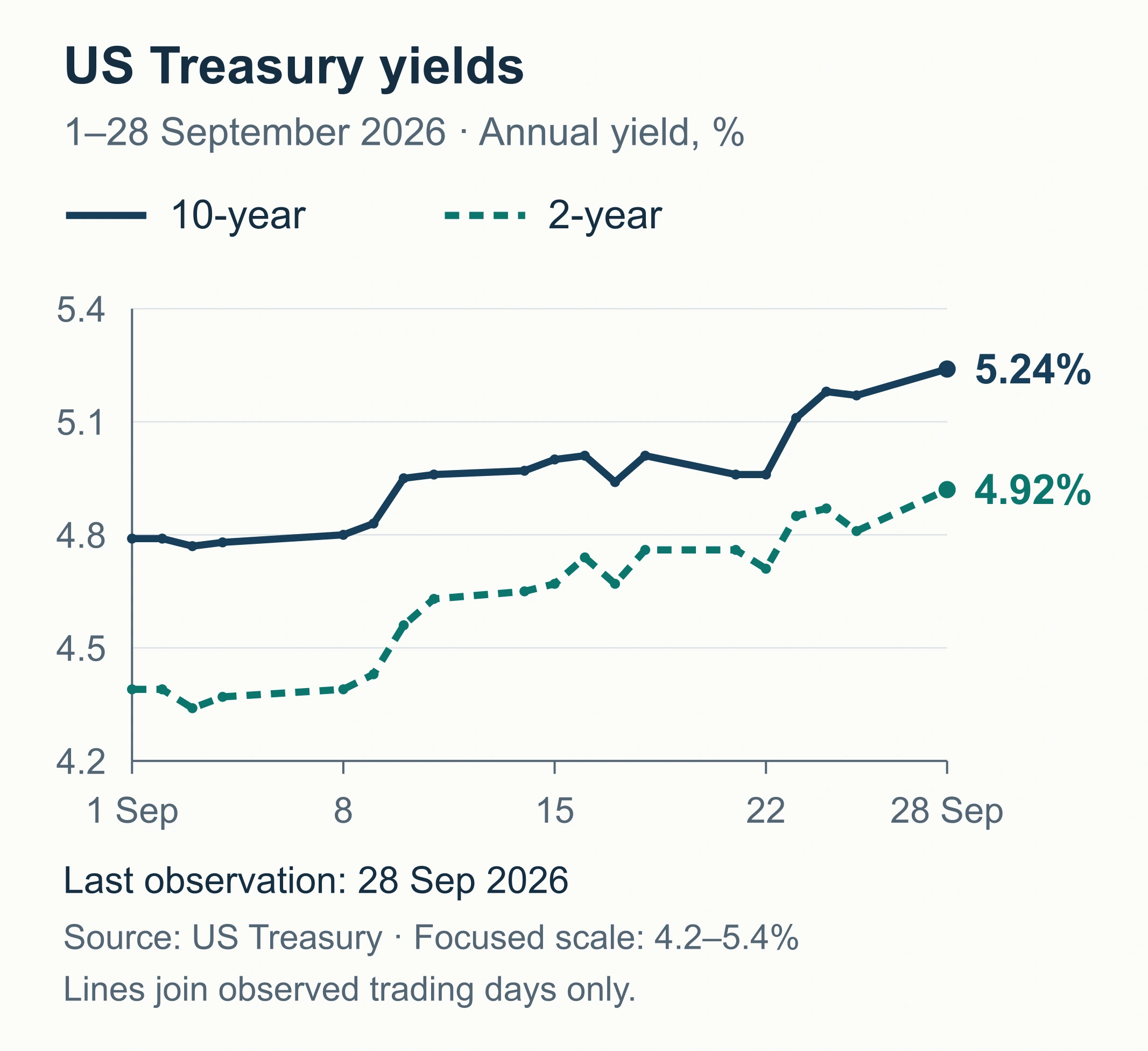
A company’s borrowing rate is not identical to this measure, but government borrowing costs provide an important reference point. When that reference rises, new loans or bond issues can become more expensive for a company, unless lenders reduce the additional interest they charge for that company’s risk. This matters for property companies, utility companies and data centres financed with borrowing. Existing fixed-rate loans do not automatically become more expensive after a single market session.
The same change affects new bond buyers and existing holders differently. New bond buyers see a higher yield, while the value of an existing longer-maturity portfolio may fall. Higher interest rates may affect a technology company with little debt less than a customer borrowing to build new data centres. The next US labour-market and consumer-price releases will help test whether household spending and business demand are supporting the economy, or prices are still rising too quickly.
The ECB is watching whether costlier energy will push up other prices and wages
For Europe, the issue is not only how much energy has become more expensive, but whether the increase spreads to other prices. On 28 September, European Central Bank President Christine Lagarde noted that there were not yet clear signs that rising energy costs have already led to a lasting increase in wage growth. This is the ECB’s assessment, not a guarantee or a new interest-rate decision. Compensation per employee grew 3.3% year on year in the second quarter, compared with 3.6% in the first; these figures should not be confused with inflation.
? Second-round inflation effects: what is the central bank looking for?
The first effect is the direct increase in energy prices. A second round occurs when higher costs spread more widely into wages and other goods and services prices. An energy-price jump alone does not prove that such a more persistent price-setting process has become established.
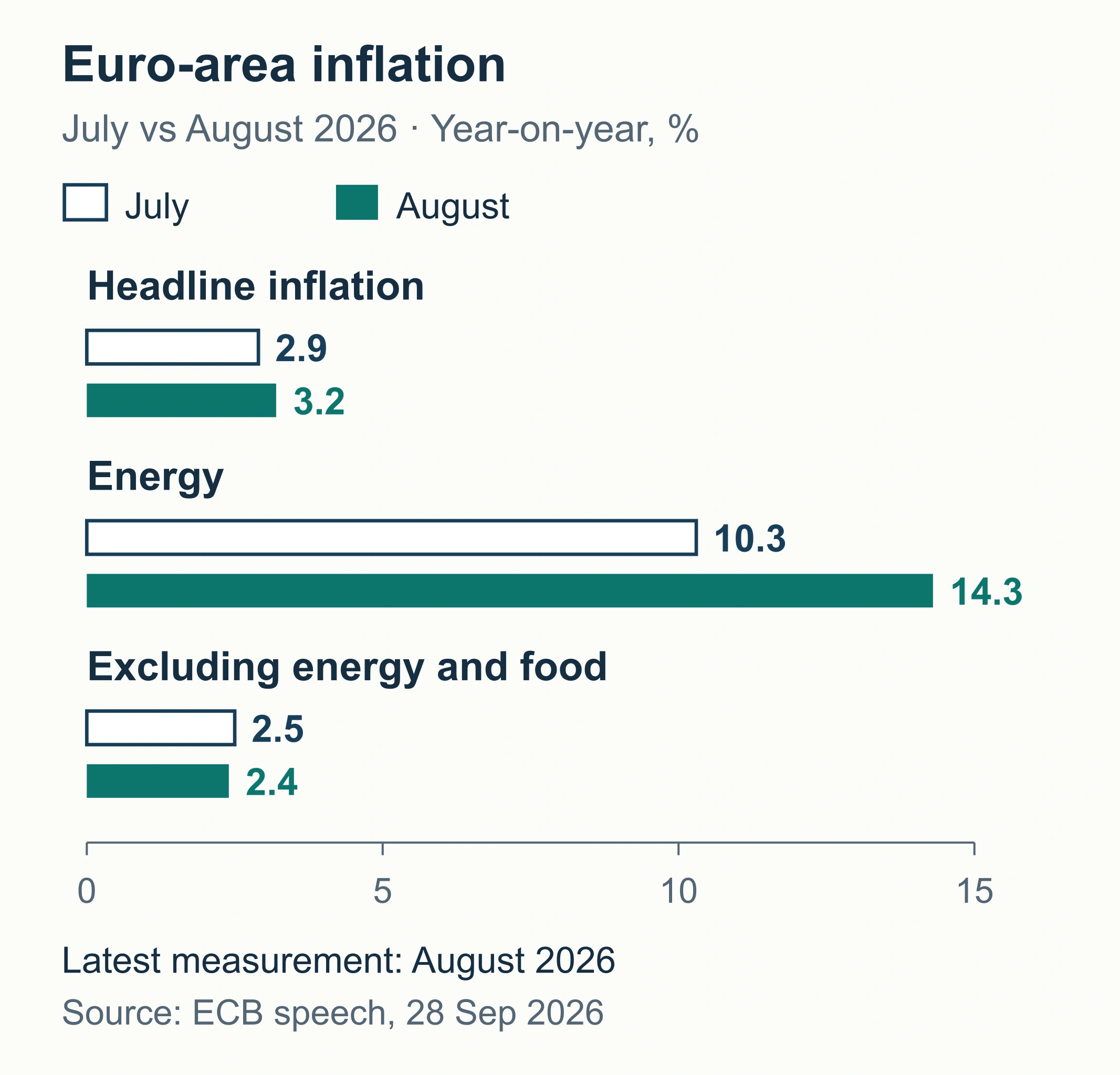
Energy prices rose faster in August, but other prices did not all accelerate with them. Annual headline euro-area inflation rose from July’s 2.9% to 3.2%, and energy inflation from 10.3% to 14.3%. Inflation excluding energy and food nevertheless slowed from 2.5% to 2.4%. Faster energy inflation therefore does not mean that all goods and services prices are accelerating equally. The ECB is also assessing whether higher long-term rates will slow the economy and reduce companies’ ability to raise selling prices.
US inventory data show that supplies of crude oil and finished fuels differ. The latest US weekly release was published on 23 September for the week ending 18 September. Commercial crude stocks excluding the strategic reserve were 426.4 million barrels, around 2% above their five-year seasonal average. Petrol stocks were 6% below their own average and distillates 12% below theirs. This compares inventories; it is not today’s oil price or an equivalent change in fuel prices.
? Distillates and seasonal averages: what is being compared?
Distillates include diesel and heating-oil products. Each product’s stocks are compared with its own average for that time of year over five years. More crude in storage does not always mean sufficient finished fuel has reached buyers.
More expensive fuel and electricity can reduce transport and chemical companies’ profits. Households spending more on energy also have less money left for other goods. Higher fuel inventories and slower price increases would help these businesses and their shareholders. New supply disruptions, by contrast, could raise costs and selling prices. The US inventory report on 30 September needs to be read for fuel stocks and refining activity, while European wage and services-price trends remain important.
NVIDIA’s $150 billion authorisation is not a completed share buyback
NVIDIA announced a plan to buy more of its own shares, not new sales results. On 28 September, chip designer NVIDIA announced an additional $150 billion share-repurchase authorisation. After the increase, the company can spend a total of $235 billion on further repurchases under the programme. The company expects to use that balance through the end of its fiscal 2028. This is a plan, not completed purchases, a guaranteed payment on a specific date or newly earned profit.
? Share-repurchase authorisation: what changes for a shareholder?
Authorisation allows a company to buy its own shares, but does not itself spend cash or reduce the share count. If actual repurchases reduce the number of shares, the same total profit is divided among fewer shares. New share issuance and the purchase price also affect the outcome; authorisation is not a promised investment return.
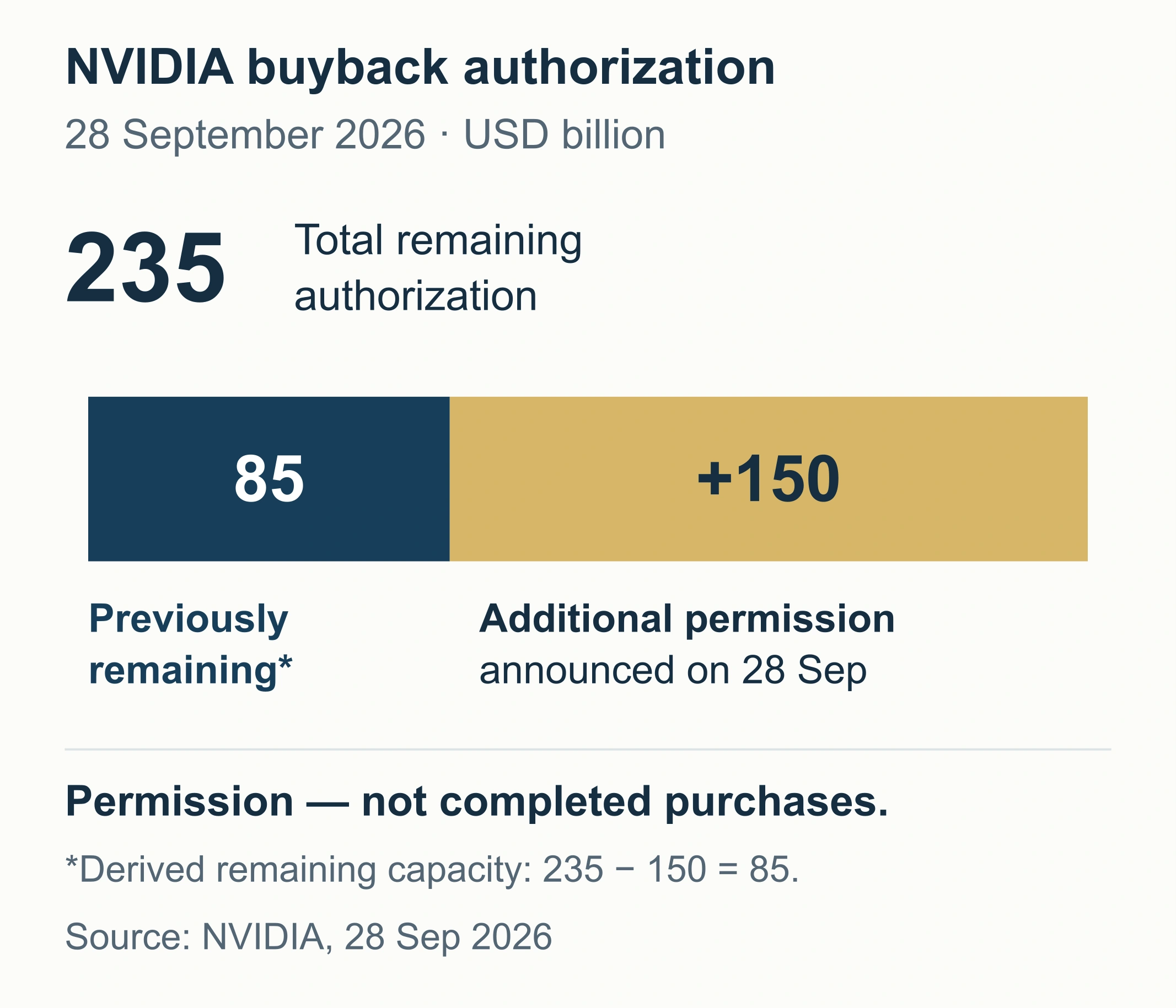
The scale needs careful reading: the additional $150 billion is part of the total $235 billion remaining balance, not another amount to add to it. NVIDIA’s ability to repurchase shares may differ from its customers’ ability to finance data centres. This matters to holders of broad US equity funds as well as individual technology shares. One company’s buyback programme does not prove that artificial-intelligence infrastructure has already paid off for all its customers.
Repurchases could benefit shareholders if the company generates enough cash both to buy shares and to fund worthwhile projects. But it could pay too much for its shares. If repurchases merely offset newly issued shares, the total share count would not fall. Chip suppliers and their customers therefore need separate financial assessments. Later NVIDIA reports will show how much cash was actually spent on repurchases and how the share count changed.
The week’s question: would lower US–China tariffs increase company profits?
What changed since yesterday? The US–China proposal to reduce some import tariffs is still under consideration. But Monday’s rise in bond yields could make new business borrowing more expensive. The ECB discussed whether rising energy costs would push up other prices, while NVIDIA increased the amount authorised for share repurchases. Companies face different needs: some need more buyers, some cheaper loans, and others need to decide how to use cash they have earned.
Lower tariffs would help if they took effect and allowed companies to cut costs or increase profitable sales. But more expensive loans, weaker demand or higher energy costs could offset part of that benefit. The next labour-market and consumption releases will help distinguish these scenarios. No precise equity-index or exchange-rate moves are given here because prices for the full comparison period have not been verified. Dollar movements also affect the value of a euro investor’s US holdings if the currency risk is unhedged.
Higher interest rates do not necessarily worsen every company’s prospects equally. If stronger real growth drives them higher, more sales may offset part of companies’ financing costs. If prices rise without companies selling more, extra sales do not offset the higher costs. The yield table alone cannot distinguish these scenarios. Household spending adjusted for price changes, company orders and the profit retained from sales therefore need to be assessed together, rather than assuming that higher rates are equally bad for every equity.
Year
What comes next
What comes next: labour demand, consumption and plans put into practice
- US job-openings data on 29 September. August’s Job Openings and Labor Turnover Survey is due at 17:00 Lithuanian time. It has not been released at the morning cutoff; the question is whether companies still need as many new workers.
- US prices and consumption on 30 September. August personal spending and its price index, plus the third estimate of second-quarter economic growth, are due at 15:30 Lithuanian time. These are upcoming releases, not known results.
- Will announced decisions be put into practice? The US energy report on 30 September will test fuel inventories. US–China trade needs final terms for applying lower tariffs, while NVIDIA needs later reports of completed repurchases, not just the size of its authorisation.
? Job openings and consumption prices: what are we monitoring?
The Job Openings and Labor Turnover Survey measures vacancies and movements of workers, not simply the number of newly created jobs. The Personal Consumption Expenditures Price Index measures price changes in goods and services consumed. Real consumption expenditure removes the effect of price changes and should not be confused with the price index.
Important. This is general market analysis, not a personal recommendation to buy or sell. Historical data and company results do not guarantee future returns. Forecasts and conditional scenarios may not materialise.
How is the history preserved and updated?
All five periods in this edition share one information date. Week means the latest 7 days, quarter means 90 days, and year means the trailing 12 months. The next dated edition will have a separate URL. This text keeps its date and assessment; later events are not silently inserted into an older edition. Longer periods assess new evidence alongside earlier developments without repeating every headline.