
Today · Market review
Fed minutes and German output: growth remains uneven
The US central bank’s September meeting minutes, released on 7 October, showed that most participants had then envisaged another rate rise. Construction provided the main support for German output in August, while faster reserve releases are not yet delivered diesel. Investors need to distinguish orders that lead to profit growth from orders whose gains are absorbed by borrowing and fuel costs.
Period covered: 2026-10-08Information as of 8 min read
On 7 October, the Fed released its September minutes, Destatis showed an uneven German production rebound and the IEA clarified releases already pledged. Short- and long-maturity US yields moved in different directions.
The Fed target range remains 3.75–4.00%. September participants’ discussions are not a new decision, and reserve pledges will not reduce costs until the required fuel is delivered.
Today
What happened
Fed minutes: most September participants envisaged another rate rise
On 7 October, the US central bank, the Federal Reserve (Fed), released the minutes of its 15–16 September meeting. Most participants had then considered another rate increase likely to be appropriate by the end of the year. This was not a new October decision: on 16 September, the target range had been raised by 0.25 percentage points to 3.75–4.00%.
September meeting participants did not yet have the September jobs increase released on 2 October: 29 thousand, compared with a revised 133 thousand in August. The assessment recorded in the minutes therefore cannot be treated as a response to that subsequent slowdown.
The September assessment was not only about expensive oil. Participants also discussed rapidly growing investment in artificial intelligence infrastructure: it supports orders but can increase the costs of materials, transport and other resources. The longer energy remains expensive, the greater the risk that cost increases in individual sectors will spread into broader inflation.
? Fed minutes: what do they show?
The minutes describe the information available and discussions held at the meeting, not an assessment of data published later. A majority view about a future increase is not a vote for that future decision; it will depend on new information.
US yields moved in different directions as the auction cleared at 5.30%
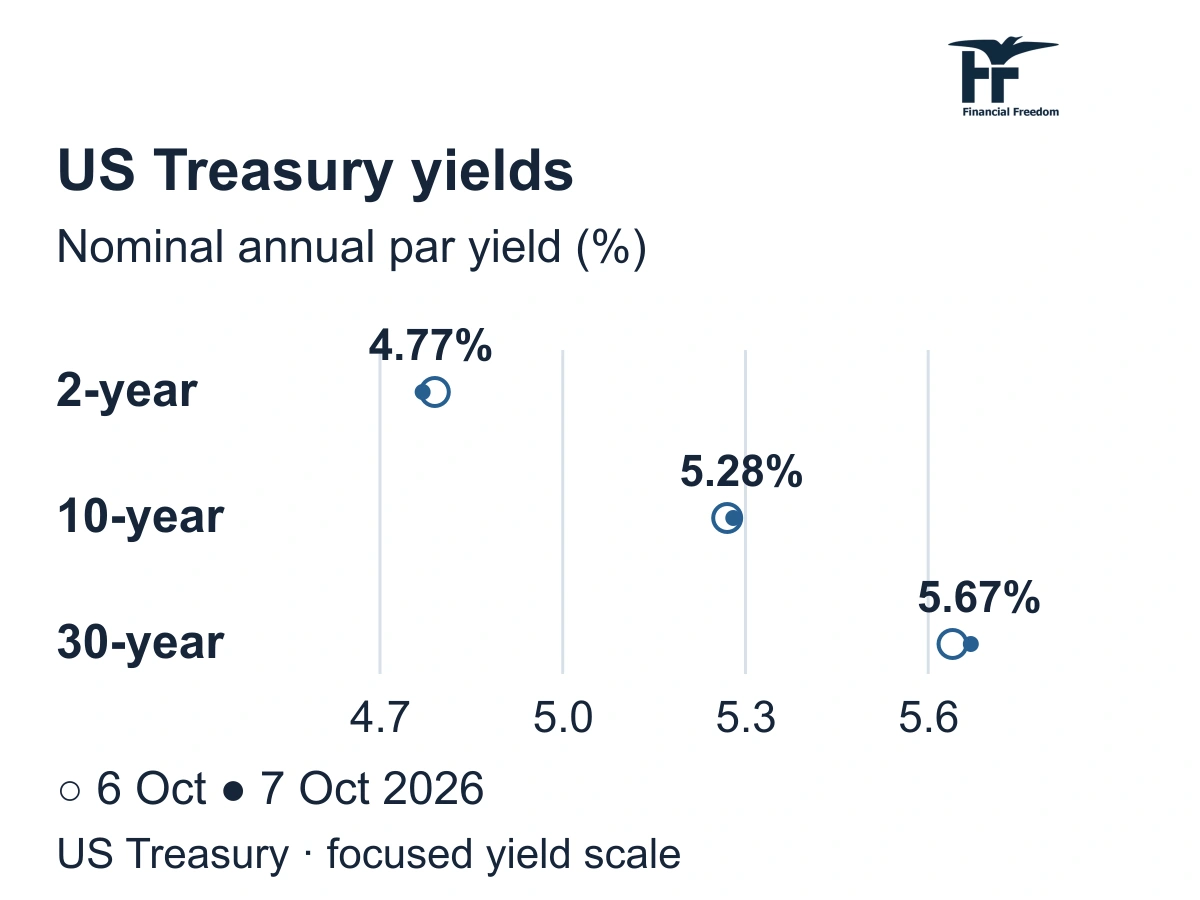
US Treasury yields did not move in one direction on 7 October. The annual two-year yield declined from 4.79% to 4.77%, but the 10-year yield rose from 5.27% to 5.28%, while the 30-year yield increased from 5.64% to 5.67%. Shorter-maturity bonds and longer-term borrowing costs presented different pictures that day.
On the same day, the US Treasury sold a further $39 billion of previously issued 10-year notes. The auction’s highest accepted annual yield was 5.30%, and the bid-to-cover ratio was 2.77. The auction shows the terms on which the government raised fresh money; it is not a return investors have already earned over a year.
? Bond yields and auctions: how should they be read?
Treasury daily yields are derived from indicative market quotations around 15:30 New York time; they are not averages of actual trades. The auction’s highest accepted yield is set at a different time and through a different process. The ratio of 2.77 compares public bids with the amount sold, not the number of unique buyers or future price direction.
German production rebounded, but construction and car factories moved in opposite directions
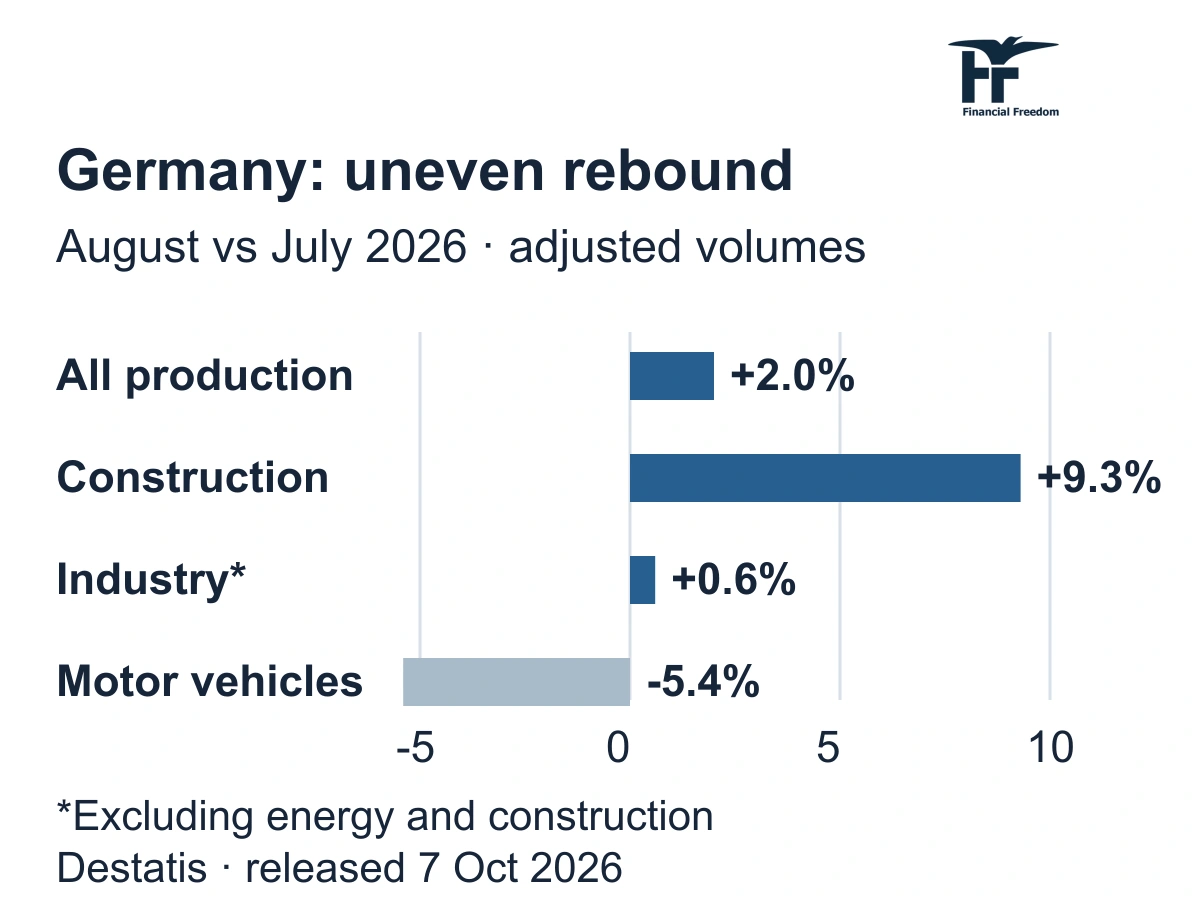
On 7 October, Germany’s statistical office Destatis reported that production rose 2.0% in August from July. Construction, which increased 9.3%, provided the main positive contribution. The headline therefore points more to an increase in construction work than to a uniform recovery across factories. More completed work can support sales of building materials and equipment, but the measure does not itself show suppliers’ profits.
Industry excluding energy and construction grew only 0.6% month on month. Machinery and equipment production rose 5.3%, while automotive production fell 5.4%. Destatis noted that factory holidays being more concentrated in August explained part of the automotive decline. Fewer cars produced do not therefore establish an equivalent decline in orders or sales.
The longer comparison remains modest: total production in June–August was just 0.4% above the preceding three months. July’s decline was revised to 1.2%. Production in energy-intensive branches fell another 0.5% in August. These differences matter for chemical and other materials producers: an increase in Germany’s overall output does not yet mean their sales are recovering.
? Production volume: what does the monthly change measure?
The measure removes price changes, and the monthly comparison is seasonally and calendar adjusted. August figures are provisional. The headline includes construction; it does not measure company revenue, profit or share returns.
For your investments
Let’s discuss your portfolio
 FINANCIAL FREEDOM01 / 04
Investment results since 1999
Are you beating
global equities?

at the end of the period
Jan 1999–Jun 2026 · EUR · Cumulative return, %
Linear scale · * MSCI World → MSCI ACWI.
Past performance does not guarantee future returns.
FINANCIAL FREEDOM02 / 04Historical comparison
How far did it fall?
How long to recover?
Decline from the previous high

Longest recovery to the previous high

Jan 1999–Jun 2026 · EUR · Monthly data
* MSCI World → MSCI ACWI.
Past performance does not guarantee future returns.
FINANCIAL FREEDOM03 / 04Personal investment consultation
Already investing?
Let’s review your portfolio.
Yet to start
investing?
Let’s build your first
investment plan.
FINANCIAL FREEDOM04 / 04
Personal investment
consultation
Martynas
Juška
Investment manager
Managing a portfolio
of more than€100 million
Reserve commitments still need delivery, while the diesel stock shortage persists
On 6 October, the US Energy Information Administration raised its fourth-quarter average Brent oil price forecast from $91 to $105 a barrel. On 7 October, the International Energy Agency (IEA) said member governments support accelerating March reserve commitments and prioritising diesel where possible. Faster fulfilment is not confirmation of additional oil delivered.
About 325 million barrels have been released under the March collective action. The remaining pledges would bring approximately 100 million barrels to market. This remainder must not be counted as a separate new volume added to the earlier plan. The agency gave no precise delivery timetable. Actual cargoes and their product mix matter to fuel buyers, not just the announcement.
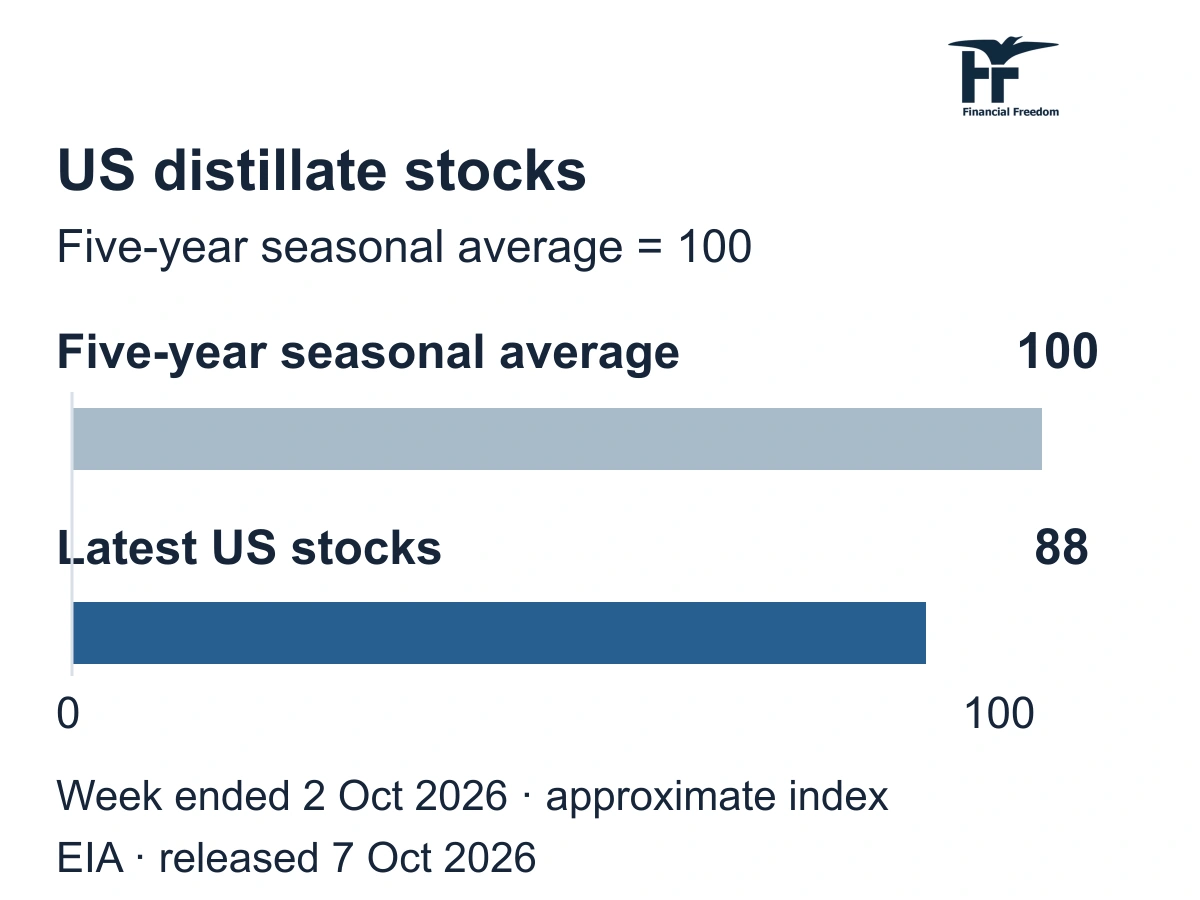
The EIA’s US weekly report, released on 7 October, showed distillate stocks broadly unchanged at about 105.1 million barrels in the week ending 2 October. They remained 12% below the five-year average. Additional crude pledges need not quickly lower diesel prices: crude must still be refined and products delivered.
? Distillate stocks: what is included?
Distillates include diesel and heating oil, not diesel alone. This compares US stocks with the five-year average for the corresponding season. A US weekly measure does not describe all global inventories.

Financial independence calculator
How much would you need to save?
Enter your target monthly income and current savings. See the gap and how changing your saving period affects the result.
Results depend on your assumptions, not guaranteed returns.
Today
What matters now
Growing investment does not remove borrowing-cost risks
Artificial intelligence infrastructure suppliers can face growth and more expensive borrowing at the same time. Data centre construction supports demand for chips, electrical equipment and engineering services. However, operators financing expansion with debt must consider future refinancing rates. More orders therefore do not necessarily mean an equal increase in profits: company costs and borrowing terms also matter.
Holders of long-maturity fixed-rate bonds face a different risk. If inflation forced the central bank to keep rates high for longer and market yields rose, those bonds could lose value. Weaker demand or easing energy costs would provide a counterweight. In September, participants viewed the labour market as stable but noted that the share of people finding a new job was low even though companies were laying off few workers.
Long-term borrowing depends on the specific debt
Heavily indebted property and infrastructure companies need to consider the rates they will pay when refinancing. However, a small daily yield move does not itself change a payment on an existing fixed-rate loan. The debt’s maturity, contractual terms and need for fresh funding determine the difference.
Germany’s headline recovery has not equalised company prospects
More completed work gives building-material and machinery producers scope to use equipment more fully and cover fixed costs. For automotive and energy-intensive chemical shares, their own sales and expenses matter more. A German equity fund holds different sectors, so higher overall production does not benefit every company equally. Factory holidays can temporarily distort monthly comparisons.
Diesel deliveries matter for freight costs and refiners’ profits
Faster diesel delivery could ease shortages and costs for road freight and agriculture. Product scarcity can help refiners earn a wider gap between product selling prices and crude purchase costs. That advantage could weaken if shortages ease. Reserve releases are temporary: prolonged disruptions also depend on operating refineries and open transport routes.
A weaker euro raises import costs and supports unhedged dollar assets
The European Central Bank reference rate fell to $1.1177 per euro on 7 October from $1.1269 on 6 October. A euro area importer needs more euros for the same dollar-priced fuel purchase. The currency move increases the euro value of a Lithuanian investor’s unhedged US bonds or shares if their dollar price is unchanged. Asset-price changes and any currency hedge also affect the total result.
? ECB reference rate: how should it be read?
This is US dollars per euro: a lower number means a weaker euro. The informational daily rate is not a transaction price. Its timing differs from the US market close, so it cannot precisely convert that session’s investment return into euros.
Today
What comes next
8 October, 11:30 Lithuania time. Fed Governor Christopher Waller is scheduled to speak on the economic outlook. Will the current assessment of inflation and growth differ from the September minutes?
8 October. The European Central Bank is scheduled to publish the account of its 9–10 September monetary-policy meeting. How did the council then assess energy inflation and weaker demand? This discusses an earlier decision; it is not a new rate decision.
8 October, 15:30 Lithuania time. The US will release its weekly number of people applying for unemployment benefits for the first time. Are companies beginning to cut staff more quickly?
8 October, 20:00 Lithuania time. Competitive bidding closes for a $22 billion reopening of 30-year Treasury bonds. The result will help assess demand for very long-term government borrowing.
14 October, 15:30 Lithuania time. The US will release September consumer price data. Is price pressure easing, or are broader increases persisting?
14 October. The International Energy Agency is scheduled to publish its October Oil Market Report. It will help assess changes in oil supply, shortages of refined products and the demand outlook; forecasts are not consumption already realised.
15 October, 19:00 Lithuania time. The US Energy Information Administration is scheduled to publish its weekly petroleum report for the week ending 9 October. Will distillate stocks begin to recover, or will fuel-supply pressure persist? Because of a US holiday, the release is scheduled for Thursday rather than the usual Wednesday.
28 October. The next Fed rate decision is scheduled. Will inflation and labour-market data published subsequently justify the further increase envisaged by September participants?
Important. This is general market analysis, not a personal recommendation to buy or sell. Historical data and company results do not guarantee future returns. Forecasts and conditional scenarios may not materialise.
How is the history preserved and updated?
All five periods in this edition share one information date. Week means the latest 7 days, quarter means 90 days, and year means the trailing 12 months. The next dated edition will have a separate URL. This text keeps its date and assessment; later events are not silently inserted into an older edition. Longer periods assess new evidence alongside earlier developments without repeating every headline.