
Today · Market review
US inflation keeps the risk of higher interest rates alive
Federal Reserve Governor Christopher Waller set out a condition for a larger interest-rate increase on 10 November, and the subsequent inflation release met it. That is not a central-bank decision, but it required investors to reassess borrowing costs and future profits. Today's German figures point in a different direction: inflation there slowed in October.
Period covered: 2026-11-11Information as of 6 min read
The US release on 10 November showed no slowdown in monthly core inflation. Today, 11 November, Germany's final figures confirmed slower October price growth.
The US target interest-rate range remains 3.75–4.00%. Waller's proposed increase has not been adopted; the committee's next scheduled meeting is on 8–9 December.
Today
What happened
Waller's warning came before the inflation report
On 10 November, Federal Reserve Governor Christopher Waller said he was leaning towards supporting a 0.25 percentage-point interest-rate increase in December. He also set a condition for a stronger response: if October consumer prices excluding food and energy again rose by around 0.3% or more in a month, a 0.50 percentage-point increase should be considered. He spoke before the October release, so this was not a response to an already published result.
Later that day, the US Bureau of Labor Statistics reported precisely a 0.3% increase in this core price measure. The monthly pace had been the same in August and September. The new figure met Waller’s stated condition, but did not turn his personal position into a promise from the whole rate-setting committee. Further employment and other inflation data will arrive before the December decision.
Headline inflation slowed as the energy surge became smaller
The overall US consumer price index rose 0.4% in October from the previous month, following September’s 0.6% increase. Energy price growth slowed from 5.2% to 0.7%. Energy was therefore still becoming more expensive, just more slowly. Shelter prices rose 0.3% and accounted for more than 30% of the overall monthly increase. This helps explain why a smaller energy jump was not enough to remove broader price pressure.
? Consumer price index: what does the monthly change mean?
The index tracks prices in a basket of consumer goods and services. These figures compare October with September after adjusting for normal seasonal patterns; they are not annual inflation rates. Most October annual comparisons are unavailable because a lapse in federal funding prevented the US Bureau of Labor Statistics from collecting the relevant October 2025 survey data.
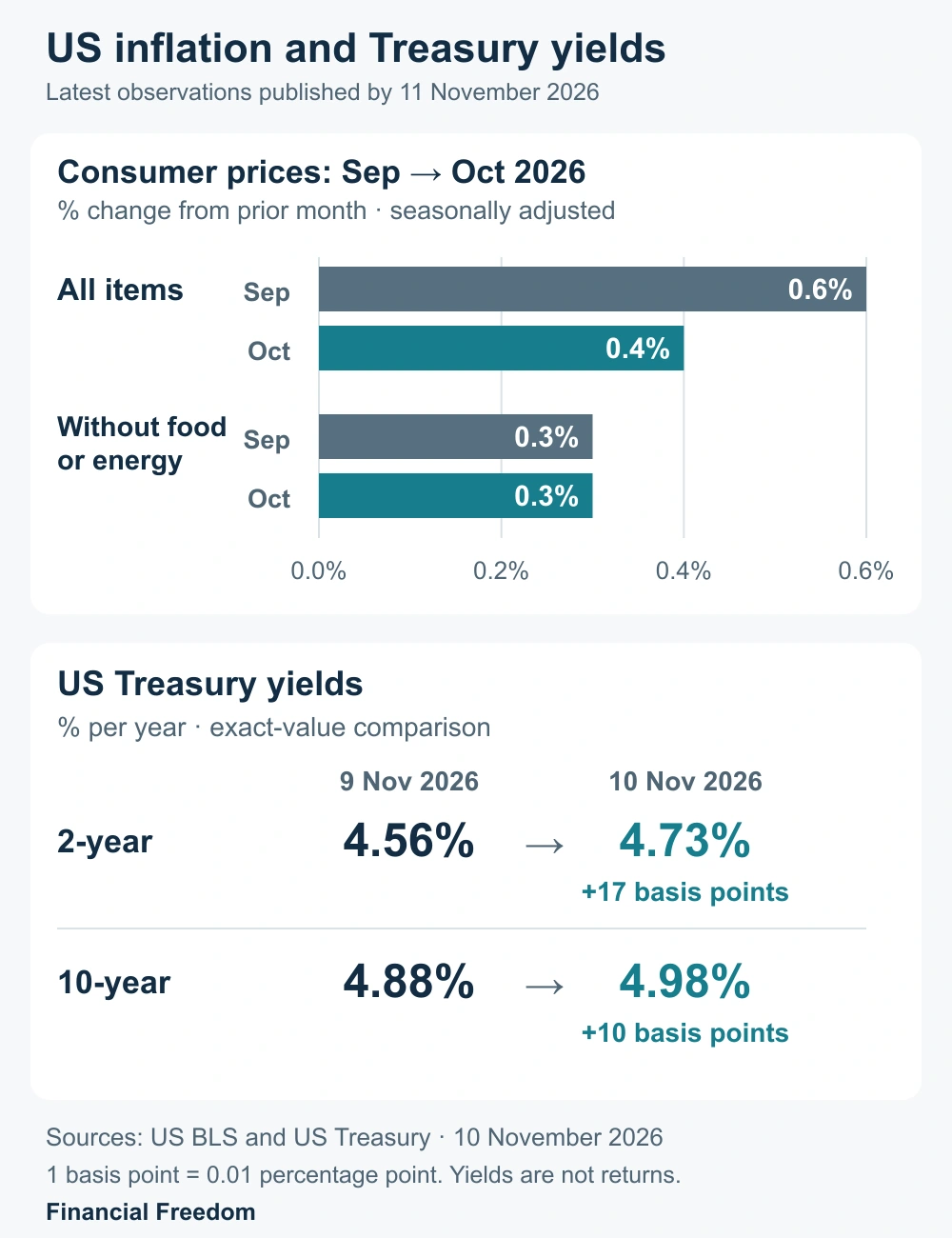
The US Treasury’s 10-year yield rose to 4.98% on 10 November, from 4.88% the previous day. The two-year yield increased from 4.56% to 4.73%. Meanwhile, the technology-heavy Nasdaq Composite price index ended the session 0.74% below its previous close. This sequence shows a reassessment towards tighter financing conditions, but does not establish that the consumer-price release alone drove every trade.
TSMC sales confirm chip demand, not its customers' investment returns
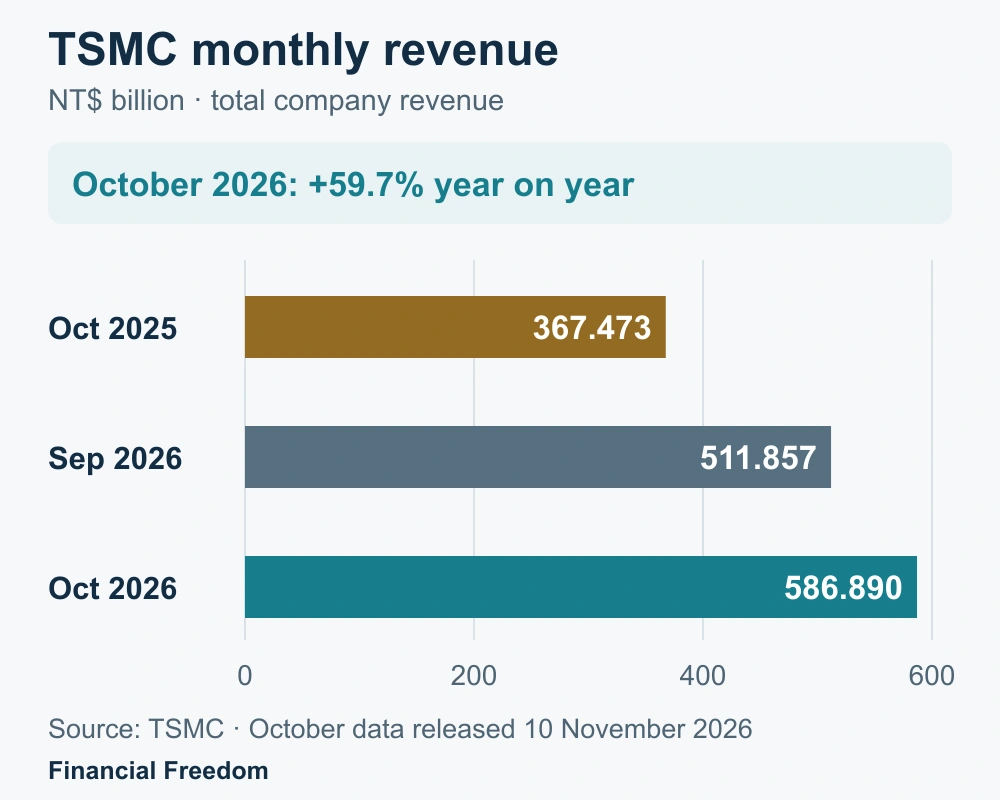
Taiwanese chipmaker TSMC reported October revenue of 586.890 billion New Taiwan dollars on 10 November. Sales were 14.7% above September and 59.7% above October 2025. Actual sales provide a counterweight to doubts about technology demand. However, TSMC’s total revenue is not exclusively artificial-intelligence revenue and does not show whether its customers’ data centres already earn enough to cover their investment.
For your investments
Let’s discuss your portfolio
 FINANCIAL FREEDOM01 / 04
Investment results since 1999
Are you beating
global equities?

at the end of the period
Jan 1999–Jun 2026 · EUR · Cumulative return, %
Linear scale · * MSCI World → MSCI ACWI.
Past performance does not guarantee future returns.
FINANCIAL FREEDOM02 / 04Historical comparison
How far did it fall?
How long to recover?
Decline from the previous high

Longest recovery to the previous high

Jan 1999–Jun 2026 · EUR · Monthly data
* MSCI World → MSCI ACWI.
Past performance does not guarantee future returns.
FINANCIAL FREEDOM03 / 04Personal investment consultation
Already investing?
Let’s review your portfolio.
Yet to start
investing?
Let’s build your first
investment plan.
FINANCIAL FREEDOM04 / 04
Personal investment
consultation
Martynas
Juška
Investment manager
Managing a portfolio
of more than€100 million
Strong chip demand does not remove uncertainty over Nvidia's investigation
On 10 November, independent directors at US chip designer Nvidia retained outside lawyers for the investigation announced on 8 November. It followed reports that chief executive Jensen Huang had been targeted by a foreign intelligence operation. The board says it has no reason to believe company secrets or national security were compromised. This is a procedural update, not a finding of wrongdoing, but it underlines that strong chip demand does not remove company-specific information-security risk.
Germany confirmed slower inflation today
On 11 November, Germany’s statistical office confirmed that its national consumer price index was 2.8% higher in October than a year earlier, following annual growth of 3.3% in September. Excluding food and energy, inflation slowed to 2.1%, from 2.4% in each month from July to September. These final figures confirm the earlier preliminary estimate rather than unexpectedly revising it down.
Motor fuel prices fell 5.5% from the previous month after fuel relief took effect on 1 October, but remained 28.9% above their level a year earlier. The relief for household spending therefore does not mean that the energy-price problem has ended. Germany’s national index is also not the inflation rate for the euro area as a whole.
Today
What matters now
Bond prices and the yield available on new investments move in opposite directions
Rising market yields put pressure on the prices of existing fixed-rate bonds. For holders of longer-dated US bonds, this is an important source of price risk; for someone investing new money, it can create an opportunity to receive higher interest income. Shorter-dated bonds are generally less sensitive to interest-rate changes, but their proceeds must be reinvested sooner, at whatever terms are then available.
? Bond yield: is this the return earned by a fund?
The US Treasury’s benchmark yields are calculated from market prices and expressed as annual percentages. A move from 4.88% to 4.98% is 0.10 percentage point, or 10 basis points; it is not a bond fund’s return. Exchange-rate changes can also affect a euro investor’s result.
Technology demand does not remove borrowing and operating-cost risks
TSMC’s sales growth matters to chip manufacturers and their equipment suppliers. For customers building data centres, the cost of electricity, equipment and loans matters too. The opportunity arises when strong orders become profits; the risk remains if additional sales require costs to rise even faster. A shared technology-sector label is not enough to assess these different businesses.
On 10 November, Federal Reserve official Michelle Bowman also highlighted the costs that higher interest rates can impose on housing and small-business investment. This is an important counterweight to Waller’s proposed stronger move, not an adopted decision to take a softer approach. The outlook for US property businesses and smaller companies growing through borrowing may therefore differ from that of profitable chip suppliers.
Today
What comes next
13 November: will producer prices confirm continuing pressure?
The US October producer price index is due on Friday, 13 November, at 15:30 Lithuanian time. It will add evidence on the prices businesses receive for their output. Slower growth would support the case for pressure on the consumer basket eventually easing; stronger growth would require closer attention to companies’ ability to preserve profits without charging customers more.
17 November: Nvidia results will distinguish demand from profit
US chip designer Nvidia plans to publish its fiscal third-quarter results at approximately 23:20 Lithuanian time on 17 November, for the quarter ended 25 October. The question is whether sales growth was accompanied by profit, and what conditions the company identifies for future demand. Its results discussion begins at 00:00 Lithuanian time on 18 November.
18 November and 9 December: distinguish discussion from a decision
The minutes of the Federal Reserve’s 27–28 October meeting will be released on 18 November at 21:00 Lithuanian time. They will explain the previous decision, not every member’s view after the new consumer-price report. The employment report on 4 December will add evidence before the 8–9 December meeting. November consumer prices is scheduled for 10 December, after the interest-rate decision.
Today is Veterans Day in the US. Industry association SIFMA recommends a full-day close for trading in US dollar-denominated bonds in the US, the UK and Japan. Individual firms decide for themselves; this recommendation is not a new Federal Reserve signal and should not be confused with an equity-market closure.
Important. This is general market analysis, not a personal recommendation to buy or sell. Historical data and company results do not guarantee future returns. Forecasts and conditional scenarios may not materialise.
How is the history preserved and updated?
All five periods in this edition share one information date. Week means the latest 7 days, quarter means 90 days, and year means the trailing 12 months. The next dated edition will have a separate URL. This text keeps its date and assessment; later events are not silently inserted into an older edition. Longer periods assess new evidence alongside earlier developments without repeating every headline.