
Week · Market review
After the equity sell-off, inflation brought interest rates back into focus
The period from 5 to 11 November showed that lower share prices need not mean an abrupt deterioration in sales or employment. US labour data and TSMC revenue provided a counterweight to fears of a downturn. Yet the US inflation release and a Federal Reserve official's warning on 10 November underlined how higher interest rates can reduce the price investors will pay for future earnings.
Period covered: 2026-11-05 – 2026-11-11Information as of 7 min read
On 10 November, published facts replaced earlier expectations: US monthly core inflation remained at 0.3%, while TSMC's October revenue rose sharply. On 11 November, Germany confirmed slower inflation.
Stronger sales do not establish stronger profits, and one Federal Reserve official's proposal is not a committee decision. The US interest-rate range remains 3.75–4.00%.
Week
What happened
The 5 November sell-off extended beyond a single technology company
On 5 November, the broad US S&P 500 price index fell 4.36% and the technology-heavy Nasdaq Composite dropped 5.52%. These one-session losses showed that selling pressure was not confined to an individual share. The Nasdaq rose 1.09% on 6 November, but that recovery was insufficient to erase the previous day’s loss. This matters to global equity fund investors: several funds may hold the same largest US companies.
? Equity index changes: which period is being compared?
The figures are individual sessions’ price changes against the previous close, not the return for the whole 5–11 November period. They exclude reinvested dividends, fund fees and the exchange-rate effect for a euro investor.
The 6 November labour report did not support an abrupt economic downturn
On 6 November, the US Bureau of Labor Statistics reported that non-farm payroll employment increased by 165,000 in October. August and September estimates were revised up by a combined 84,000. Unemployment was 4.1%, compared with 4.2% in September. This provides a firmer foundation for household incomes than the assumption that businesses are already cutting employee numbers sharply across the economy.
However, stronger employment affects another side of investment valuations. It can support sales at retailers and consumer-service companies, but reduces the need for urgent interest-rate cuts if inflation remains a problem. The October jobs report was therefore a counterweight to recession fears, not a promise that borrowing would soon become cheaper.
The 10 November inflation report met Waller's condition for a larger move
Before October consumer prices were published, Federal Reserve Governor Christopher Waller said on 10 November that he was leaning towards a 0.25 percentage-point interest-rate increase in December. If monthly inflation excluding food and energy again reached around 0.3% or more, he believed a 0.50 percentage-point move should be considered. This was a personal, conditional position, not a collective committee decision.
The core index subsequently rose 0.3%, as it had in August and September. Overall consumer price growth slowed from 0.6% in September to 0.4% in October, as the monthly energy increase eased from 5.2% to 0.7%. Energy prices did not fall: they increased more slowly. The improved headline figure and unchanged core pace therefore told different parts of the same report.
? Core inflation: why is the annual figure missing?
The core consumer price index excludes food and energy but does not replace the full basket. These are seasonally adjusted monthly changes. Most October annual comparisons are unavailable because the lapse in federal funding prevented the US Bureau of Labor Statistics from collecting the relevant October 2025 survey data.
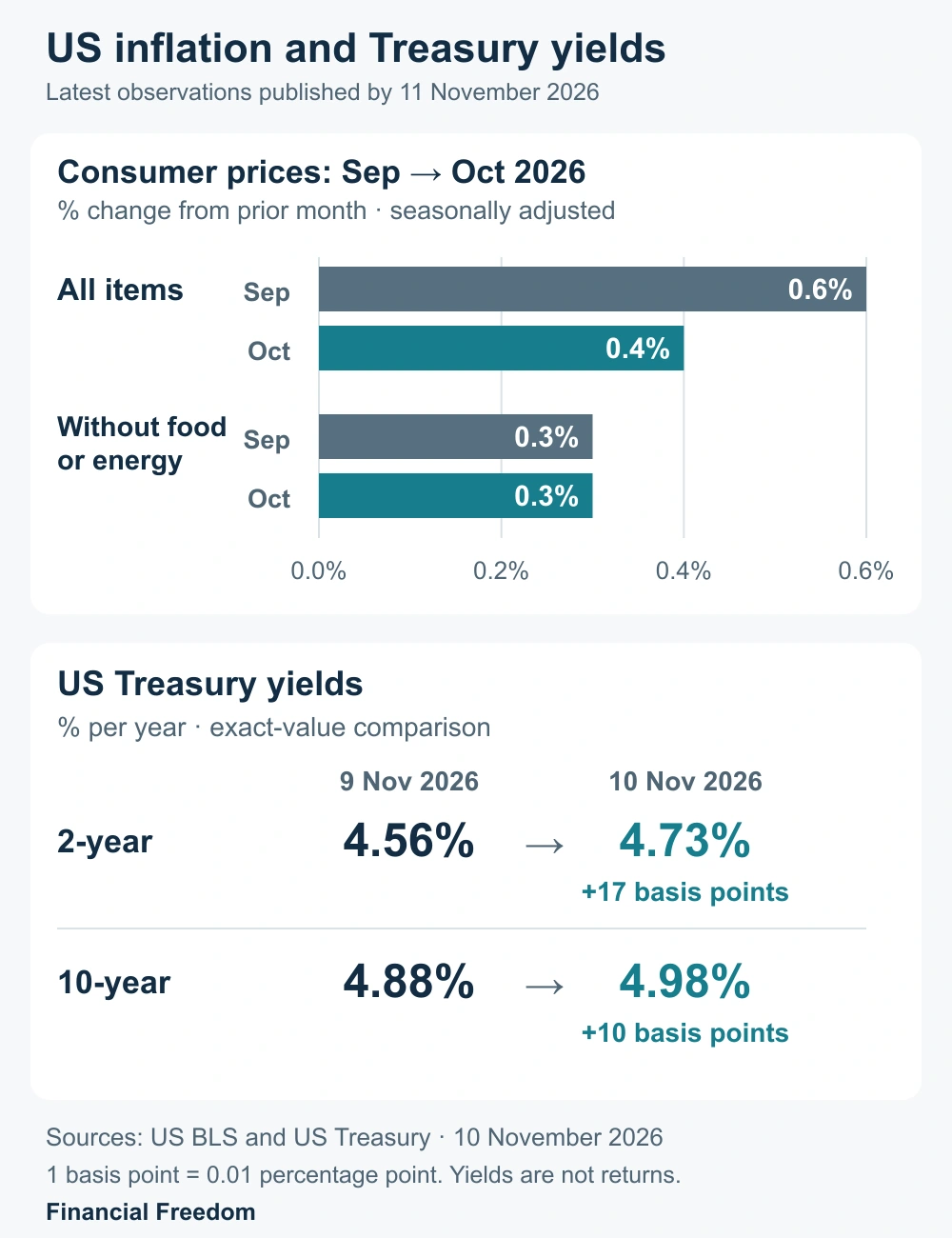
The US Treasury’s 10-year yield was 4.86% on 6 November and 4.88% on 9 November, then rose to 4.98% on 10 November. The two-year yield increased by 0.17 percentage point to 4.73% on the last of those dates. The Nasdaq Composite fell 0.74% on 10 November. These are confirmed moves in different markets, not proof that a single statement caused each of them.
For your investments
Let’s discuss your portfolio
 FINANCIAL FREEDOM01 / 04
Investment results since 1999
Are you beating
global equities?

at the end of the period
Jan 1999–Jun 2026 · EUR · Cumulative return, %
Linear scale · * MSCI World → MSCI ACWI.
Past performance does not guarantee future returns.
FINANCIAL FREEDOM02 / 04Historical comparison
How far did it fall?
How long to recover?
Decline from the previous high

Longest recovery to the previous high

Jan 1999–Jun 2026 · EUR · Monthly data
* MSCI World → MSCI ACWI.
Past performance does not guarantee future returns.
FINANCIAL FREEDOM03 / 04Personal investment consultation
Already investing?
Let’s review your portfolio.
Yet to start
investing?
Let’s build your first
investment plan.
FINANCIAL FREEDOM04 / 04
Personal investment
consultation
Martynas
Juška
Investment manager
Managing a portfolio
of more than€100 million
TSMC's new sales supplied a concrete counterweight to technology doubts
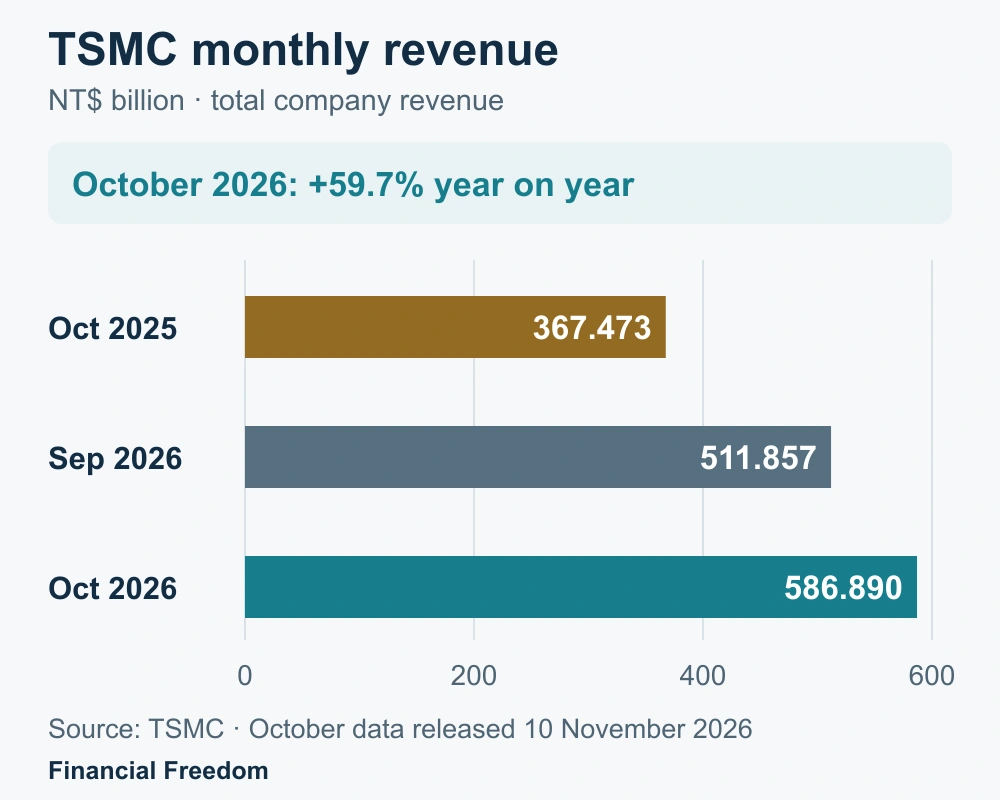
On 10 November, Taiwanese chipmaker TSMC reported October revenue of 586.890 billion New Taiwan dollars. That was 14.7% more than in September and 59.7% more than a year earlier. An actual sales result thus added evidence to the earlier question of whether chip demand would persist into the new quarter. This is not November revenue, full-quarter profit or exclusively sales of chips used for artificial intelligence.
Strong chip demand does not remove uncertainty over Nvidia's investigation
On 10 November, independent directors at US chip designer Nvidia retained outside lawyers for the investigation announced on 8 November. It followed reports that chief executive Jensen Huang had been targeted by a foreign intelligence operation. The board says it has no reason to believe company secrets or national security were compromised. This is a procedural update, not a finding of wrongdoing, but it underlines that strong chip demand does not remove company-specific information-security risk.
Germany's news ends the period with a different inflation trend
On 11 November, Germany’s statistical office confirmed final October annual inflation of 2.8% on the national consumer price index, compared with 3.3% in September. Excluding food and energy, the annual pace fell to 2.1%, having been 2.4% in each month from July to September. The preliminary headline estimate was unchanged, making this confirmation rather than an unexpected revision.
Fuel relief effective from 1 October contributed to a 5.5% monthly fall in motor fuel prices. They nevertheless remained 28.9% above their level a year earlier. For German households, that means relief against the previous month, not a return to last year’s spending level. Germany’s national figures alone do not determine the direction of interest rates across the euro area.
Week
What matters now
Resilient sales and equity valuations can diverge
The US labour report and TSMC revenue leave open a scenario in which consumption and technology orders remain strong. That would be more supportive of profitable consumer-service businesses, chipmakers and equipment suppliers. However, investors may pay less for distant future profits if safer bonds offer higher yields. A good sales result does not therefore necessarily mean a rising share price on the same day.
An important distinction concerns growth that requires continually increasing debt. If a company finances new projects with more expensive loans, additional interest costs can reduce its profits even when orders remain intact. The opportunity lies where a business maintains sales, controls costs and funds investment with cash it earns. The main risk is mistaking fast revenue growth for an already established investment payback.
Higher bond yields have two sides
For holders of long-dated fixed-rate bonds, rising market yields put pressure on prices, other things being equal. For new investors, the same move can offer higher interest income. Shorter-dated bonds are generally less sensitive to these fluctuations, but their proceeds must be reinvested sooner. These are different risks, not a single instruction to buy or sell all bonds.
? Yield and return: what is the difference?
US Treasury yields are benchmarks calculated from market prices and expressed as annual percentages, not a fund’s performance. A change of 0.10 percentage point equals 10 basis points. Dollar exchange-rate changes also affect a euro investor’s unhedged US holdings.
On 10 November, Federal Reserve official Michelle Bowman noted that higher interest rates could further constrain housing and small-business investment. This shows why the committee must weigh not just inflation but also the economic cost of tighter conditions. For property companies and businesses expanding through borrowing, this question matters more than strong chip demand alone.
Week
What comes next
13 November producer prices will test cost pressure
The US October producer price index is scheduled for 13 November at 15:30 Lithuanian time. It will help assess whether pressure on businesses’ selling prices is easing. It should not be treated as a precise map of future consumer inflation: retail, transport and other costs still lie between a producer’s price and the final customer’s bill.
17 November: Nvidia results will distinguish demand from profit
US chip designer Nvidia plans to publish its fiscal third-quarter results at approximately 23:20 Lithuanian time on 17 November, for the quarter ended 25 October. The question is whether sales growth was accompanied by profit, and what conditions the company identifies for future demand. Its results discussion begins at 00:00 Lithuanian time on 18 November.
The 18 November minutes and December decision will answer different questions
The minutes of the Federal Reserve’s 27–28 October meeting, due on 18 November at 21:00 Lithuanian time, will reveal arguments from the earlier discussion. The November employment report on 4 December will add evidence before the 8–9 December interest-rate meeting. The calendar matters: November consumer prices will be published on 10 December, after the 9 December decision, so the committee will not have that release at the meeting.
For Veterans Day on 11 November, SIFMA recommends a full-day trading close for US dollar-denominated bonds in the US, the UK and Japan; firms decide individually. Lower activity on such a day should not be treated as new evidence about inflation or company earnings. The central question remains whether price pressure will ease without undermining resilient sales and employment.
Important. This is general market analysis, not a personal recommendation to buy or sell. Historical data and company results do not guarantee future returns. Forecasts and conditional scenarios may not materialise.
How is the history preserved and updated?
All five periods in this edition share one information date. Week means the latest 7 days, quarter means 90 days, and year means the trailing 12 months. The next dated edition will have a separate URL. This text keeps its date and assessment; later events are not silently inserted into an older edition. Longer periods assess new evidence alongside earlier developments without repeating every headline.