
Today · Market review
US rate caution meets uneven price pressures
On 12 October, US central banker Beth Hammack said that interest rates still needed to restrain demand to bring inflation down: fuel was not the only source of price pressures. On 13 October, the Bank of Japan offered a fresh counterweight: producer-price growth slowed, but imported fuel became dearer in contract currencies. Investors need to distinguish relief in one cost from an improvement in all company costs or profits.
Period covered: 2026-10-13Information as of 11 min read
On 12 October, Hammack identified broader price pressures. Japan’s September producer prices released on 13 October showed slower annual growth, but the import-price direction depended on currency.
The US policy-rate range remains 3.75–4.00%, and the ECB deposit rate is 2.50%. No new additional IEA diesel stock-release volume has been agreed.
Today
What happened
A US central banker warned that energy is not the only source of inflation
On 12 October, Beth Hammack, president of the Federal Reserve Bank of Cleveland, said that interest rates still needed to restrain demand to bring inflation down. In her assessment, price pressures extend beyond oil: higher tariffs raise import costs, while demand for artificial intelligence infrastructure makes components used by other industries more expensive. This was her personal economic assessment, not a new Federal Reserve interest-rate decision.
Her speech drew on previously released statistics. On 30 September, the US Bureau of Economic Analysis reported that the Personal Consumption Expenditures price index (PCE) rose by 3.4% year on year in August 2026, or 3.0% excluding food and energy. Prices were therefore rising beyond fuel. Hammack believes cheaper energy alone would not remove every source of price growth, so a broader set of data must guide the direction of interest rates.
? Personal Consumption Expenditures price index: what does it show?
PCE measures changes in the prices of goods and services bought by US consumers or paid for on their behalf. The annual change compares the same month a year earlier; excluding food and energy helps identify other price trends but does not measure an individual person’s increase in spending.
The labour market offers a counterweight to tighter policy. On 2 October, the US Bureau of Labor Statistics reported that nonfarm jobs increased by 29 thousand in September, compared with a monthly average of 45 thousand over the preceding 12 months. Unemployment was 4.2%. Low unemployment is not the same as rapid job growth. Hammack said convincing labour-market deterioration could change her preferred policy direction.
The latest official US 10-year Treasury yield remains the observation from 9 October: 5.24% a year.
Australian minutes explain the earlier rate rise through energy and technology costs
On 13 October, the Reserve Bank of Australia published the minutes of its 28–29 September meeting. They describe a unanimous decision to raise the cash-rate target by 0.25 percentage point to 4.60%. This explains September’s decision; it is not another interest-rate increase today.
Members highlighted energy supply disruptions, limited domestic capacity and cost pressures associated with strong demand for AI equipment. They also discussed growing technology-investment debt and very favourable expectations for future earnings. However, strong current earnings growth is containing leverage for now, and Australian borrowers’ and banks’ resilience was assessed as an important counterweight.
? Meeting minutes: are they a new decision?
Minutes later reveal the arguments of an earlier meeting and members’ assessment at that time. Risks described in them are not losses already incurred, and the possibility of further rate rises is not a promise to change rates at the next meeting.
Japanese producer prices rise more slowly, but imports have not become cheaper in every currency
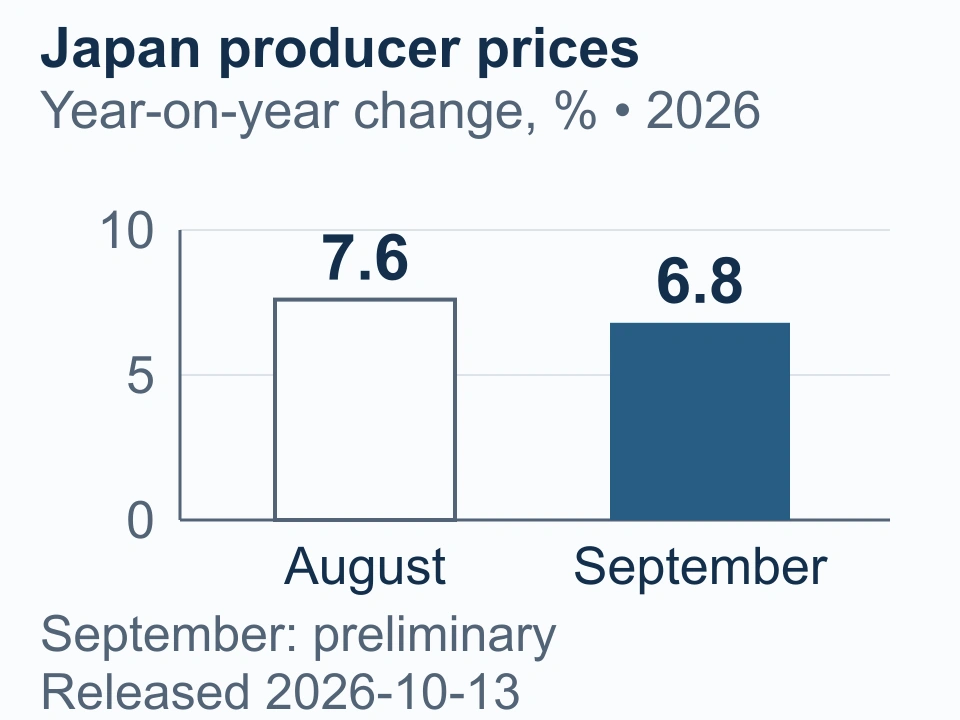
On 13 October, the Bank of Japan published its preliminary September Corporate Goods Price Index, which measures producer goods prices. Prices were 6.8% higher than a year earlier, compared with 7.6% in August. They fell 0.3% from the previous month. Annual price growth therefore slowed, but the price level remained higher than a year earlier.
? Producer and import prices: what do they measure?
The producer index measures prices of goods traded between businesses in Japan, not their entire cost basket or household consumer prices. The import index can be calculated in yen or in the currencies used in contracts, so currency conversion changes the comparison. Monthly and annual changes compare different periods; preliminary figures can still be revised.
Import prices tell a different story. In September, they fell 0.2% from August in yen but rose 1.0% in contract currencies. A small easing measured in yen is therefore not the same as an imported product becoming cheaper in its transaction currency.
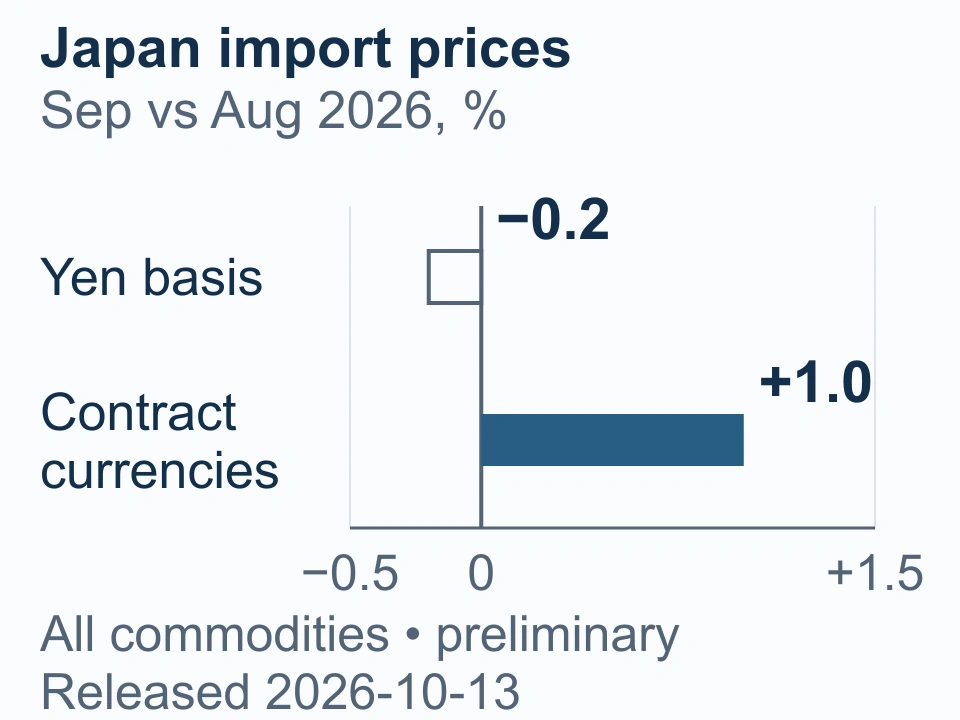
The petroleum, coal and natural-gas import group rose 2.3% over the month in contract currencies. It contributed 0.69 percentage point to the overall import-price increase. A slower domestic producer-price headline therefore did not remove the separate rise in imported fuel costs.
US permission to buy Russian diesel removes a specific restriction, but is not a quantity of fuel delivered
On 9 October, the US Treasury’s sanctions authority, the Office of Foreign Assets Control (OFAC), issued General Licence 135. Under the US sanctions rules specified in the licence, it permits transactions connected with the sale, delivery, offloading and import of Russian-origin diesel, including imports into the United States. Permission runs until 7 April 2027 at 00:01 US Eastern Daylight Time (EDT). This was Friday’s decision, not a new authorisation on Tuesday.
The licence does not permit debits to Russian central-bank, National Wealth Fund or Finance Ministry accounts at US financial institutions. It specifies neither a diesel volume nor an arrival schedule, and does not itself change other countries’ import rules. Separately, on 11 October the International Energy Agency asked countries to assess additional diesel stock releases, but no new volume has been agreed.
? A general sanctions licence: what does it permit?
It authorises defined transactions under particular US sanctions rules and specified exceptions, rather than removing every sanction. Legal permission is not yet diesel sold or delivered to a buyer.
Open AI hardware designs could ease expansion, but their benefits still need to become profits
For your investments
Let’s discuss your portfolio
 FINANCIAL FREEDOM01 / 04
Investment results since 1999
Are you beating
global equities?

at the end of the period
Jan 1999–Jun 2026 · EUR · Cumulative return, %
Linear scale · * MSCI World → MSCI ACWI.
Past performance does not guarantee future returns.
FINANCIAL FREEDOM02 / 04Historical comparison
How far did it fall?
How long to recover?
Decline from the previous high

Longest recovery to the previous high

Jan 1999–Jun 2026 · EUR · Monthly data
* MSCI World → MSCI ACWI.
Past performance does not guarantee future returns.
FINANCIAL FREEDOM03 / 04Personal investment consultation
Already investing?
Let’s review your portfolio.
Yet to start
investing?
Let’s build your first
investment plan.
FINANCIAL FREEDOM04 / 04
Personal investment
consultation
Martynas
Juška
Investment manager
Managing a portfolio
of more than€100 million
Also on 12 October, processor designer AMD introduced its open Helion rack design for AI agents, which perform tasks rather than only provide an answer. Hardware configurations are still being developed with partners; the company plans availability in November 2026. This is a new expansion plan, not Helion sales revenue already reported.
? A hardware-efficiency comparison: what does it leave out?
A gigabit is a billion bits, a unit measuring the quantity of data transmitted. The manufacturers’ comparison describes a particular connection and its baseline, not the whole data centre’s electricity bill or a customer’s profit. An open design helps equipment from different manufacturers work together, but orders and investment returns still require demand and actual deliveries.
The euro weakened at the 12 October reference rate, not at a transaction rate today
On 12 October, the European Central Bank published a reference rate of 1.1181 US dollars per euro. On 9 October it was 1.1206. The euro weakened by approximately 0.22% on this comparison. This is Monday’s published reference observation, not a spot or transaction rate for 13 October.
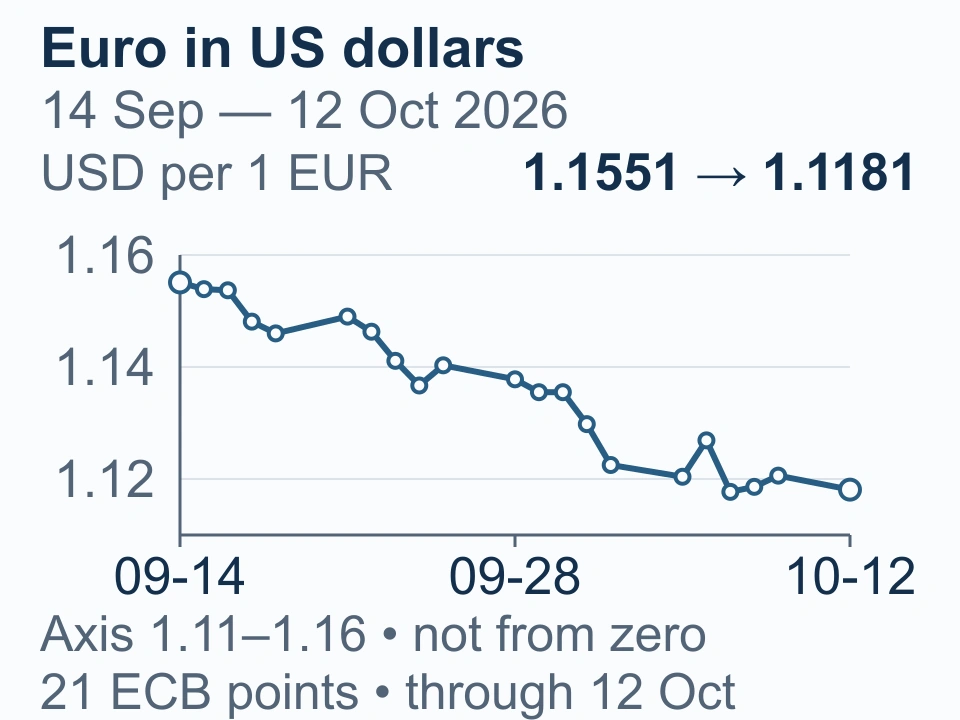
This ECB reference observation was published before Beth Hammack’s later speech in the United States. Its change therefore cannot be attributed to a response to that speech. The exchange-rate series alone also does not identify which news mattered most to the currency market that day.
? The euro–dollar reference rate: how should it be read?
The number shows US dollars per euro; a lower number means a weaker euro against the dollar. The ECB publishes it for information, not as an offered transaction price or an exchange closing price. A fund trading in euros is not necessarily hedged against changes in its dollar exposure.

Financial independence calculator
How much would you need to save?
Enter your target monthly income and current savings. See the gap and how changing your saving period affects the result.
Results depend on your assumptions, not guaranteed returns.
Today
What matters now
Future financing costs matter for bonds and debt-funded expansion
If persistent inflation pushed market yields higher, existing long-dated US bonds would face price pressure. New bond buyers could obtain a higher yield but would also risk further price falls.
Technology companies financing new data centres with debt, and property businesses, need to watch future borrowing and refinancing costs. Higher interest rates can leave less money for expansion. Existing fixed-rate loan payments do not automatically change after one central banker speaks. New borrowing costs also depend on the borrower’s own risk.
More moderate actual price growth could help bonds and debt-funded businesses. Yet very weak demand would also reduce revenues: lower interest costs do not always outweigh lower profits. Pessimistic consumer surveys alone cannot show that conditions will improve for all these portfolio exposures.
US September consumer-price data, due on 14 October at 15:30 Lithuanian time, will show whether price pressures are easing. The Federal Reserve’s 28 October decision, at 20:00 Lithuanian time, will answer whether the committee sees grounds to change interest rates. Hammack’s view is not a promise about that decision.
The same Australian interest rates offer different benefits to banks and consumer businesses
Higher interest rates could support Australian banks’ interest income, but weaker borrowers’ finances would offset that benefit. For discretionary retailers and property companies, expensive loans could constrain demand and expansion. The borrower buffers discussed at the meeting are a counterweight, not a guarantee for every business. The bank’s next decision is scheduled for 3 November; until then, the questions are whether cost pressures ease and demand slows sufficiently.
A Japanese producer needs to consider both its selling prices and its purchase costs
For shares in Japanese chemical producers importing raw materials and in transport companies, payment currencies and exchange-rate hedges matter. More favourable conversion into yen could ease some costs, but rising fuel prices in contract currencies leave a risk. If companies cannot pass them on to customers, sales can grow without increasing profits.
Holders of Japanese bonds and exporters’ shares face different signals: slower overall price growth would weaken one argument for higher interest rates, while imported energy could sustain it. The Bank of Japan’s 29–30 October meeting will show how it assesses these forces alongside wages and consumer prices. The producer index alone does not determine the next decision.
Diesel buyers need deliveries and prices to show the benefit, not just a licence
Additional supply could ease costs for fuel-consuming transport and industrial companies, benefiting their shares. However, permission must still be followed by contracts, payments, insurance and safe delivery. Before fuel reaches buyers, lower costs cannot be treated as an improvement in profits already achieved.
For oil-refiner shares, more competing diesel could narrow the gap between its selling price and the cost of crude feedstock. This is the other side of the same opportunity for fuel users. The International Energy Agency’s Oil Market Report on 14 October, followed by its Board discussion and US weekly stocks on 15 October, will help assess physical supply. Another disruption or late delivery would postpone that relief.
A hardware supplier's sale and the buyer's investment return remain different questions
For chip and networking-equipment shares, open designs could broaden the pool of potential buyers; for cloud-company shares, the issue is whether equipment reduces service costs and increases revenue. A faster connection does not itself create a paying customer. The main risk is spending more on expanding centres than new services earn. AMD’s quarterly results on 3 November and planned Helion availability in November will provide further tests of orders, spending and implementation.
The same dollar move affects asset values and purchasing costs differently
For a Lithuanian investor, unhedged US equities and dollar-denominated bonds are affected differently from a business buying equipment or fuel in dollars. If the dollar value of the asset stayed unchanged, this exchange-rate move alone would increase its euro value by approximately 0.22%; that is a conditional conversion, not a fund return. The same dollar invoice would cost the buyer more euros. A stronger dollar can offset part of an asset-price decline but can also reverse; asset prices, currency hedging and costs determine the final result.
Today
What comes next
On 13 October, Germany will release final September inflation at 09:00 Lithuanian time; Federal Reserve Governor Christopher Waller will participate in a discussion about artificial intelligence at 10:45. Will prices and technology assessments add to, or weaken, the case for rates staying high for longer?
On 13 October, US bank JPMorganChase will release quarterly results at about 14:00 Lithuanian time and discuss them at 15:30. Will growth in interest income offset credit losses, and what will actual results reveal about borrowers’ finances?
On 14 October, the IEA will publish its Oil Market Report; at 15:30 Lithuanian time, the US Bureau of Labor Statistics will release September’s Consumer Price Index. Will supply conditions and actual prices show less pressure on company costs?
On 15 October, the IEA Governing Board will review stock-release actions. US September retail sales are due at 15:30 Lithuanian time; at 19:00, the Energy Information Administration will report stocks for the week ending 9 October. Will diesel discussions become specified volumes and dates, and is consumer caution already visible in sales?
The Federal Reserve’s decision is scheduled for 28 October at 20:00 Lithuanian time, followed by the ECB on 29 October and the Bank of Japan’s meeting on 29–30 October. The Reserve Bank of Australia’s next decision is scheduled for 3 November; AMD will report results after the US market closes that day. Will policy decisions and hardware sales confirm the expectations now being discussed?
Important. This is general market analysis, not a personal recommendation to buy or sell. Historical data and company results do not guarantee future returns. Forecasts and conditional scenarios may not materialise.
How is the history preserved and updated?
All five periods in this edition share one information date. Week means the latest 7 days, quarter means 90 days, and year means the trailing 12 months. The next dated edition will have a separate URL. This text keeps its date and assessment; later events are not silently inserted into an older edition. Longer periods assess new evidence alongside earlier developments without repeating every headline.