
Week · Market review
Week: price pressures and uneven business demand
On 12 October, Beth Hammack highlighted costs associated with tariffs and technology demand. During 7–13 October, central-bank minutes, bond auctions and a consumer survey had already shown that cheaper financing was not assured. Fresh Japanese import prices, defined US diesel permission and open hardware designs add to the weekly question: where could cost relief reach profits, and where could demand or new debt offset it?
Period covered: 2026-10-07 – 2026-10-13Information as of 18 min read
On 12 October, Hammack identified broader price pressures. Japan’s September producer prices released on 13 October showed slower annual growth, but the import-price direction depended on currency.
The US policy-rate range remains 3.75–4.00%, and the ECB deposit rate is 2.50%. No new additional IEA diesel stock-release volume has been agreed.
Week
What happened
7 October: September Fed minutes and long-term borrowing
The US central bank’s 15–16 September minutes, released on 7 October, recalled that most participants had then envisaged another rate rise. The 0.25-percentage-point rise decided on 16 September took effect the next day, taking the range to 3.75–4.00%. These were earlier meeting discussions, not a new October decision.
On 7 October, the US Treasury sold a further $39 billion of 10-year bonds at a high yield of 5.30%, with a bid-to-cover ratio of 2.77. This is an auction of a specific issue, not a bond fund’s overall return.
7 October stock programme: speeding up an earlier commitment’s remainder
On 7 October, International Energy Agency members agreed to accelerate the unfinished part of the March stock-release programme, prioritising diesel. That implements an earlier commitment rather than agreeing a new additional volume. On 11 October, the agency also highlighted renewed attacks on Saudi Arabian civilian and energy infrastructure.
German exports fell, but sales to different destinations diverged
The rise in Germany’s August production reported on 7 October was mainly driven by construction; trade figures released on 8 October showed that exports had not recovered in the same way that month. According to the statistical office Destatis, August goods exports fell 0.8% from July to €137.6 billion. Imports rose 0.9% to €118.1 billion. The goods trade surplus narrowed from July’s €21.6 billion to €19.5 billion.
The clearest new difference is between destination markets. Exports to the United States fell 6.3%, while shipments to the euro area rose 0.8%, China 4.7% and the United Kingdom 16.7%. Exporters did not experience a uniform decline. Moreover, sales to the US remained 22.6% above August 2025: the monthly fall did not erase the earlier year-on-year increase.
These figures do not yet explain which goods or causes produced the differences. The decline in exports to the US therefore cannot simply be attributed to tariffs: a more detailed goods breakdown and companies’ own sales may still change the assessment.
? Export change: what is being compared?
August and July goods values in euros are calendar and seasonally adjusted. They measure nominal value, not physical quantities alone. Destination changes are not additive contributions to the total; the annual comparison uses a different denominator.
Europe’s risk assessment linked technology borrowing and profit expectations
On 8 October, the European Systemic Risk Board published the assessment from its 1 October meeting: EU financial-stability risks had increased during the preceding quarter. The Board highlighted technology companies borrowing to expand artificial intelligence and the risk that future profit expectations may be too optimistic. This is a warning about a possible scenario, not a report of those companies already defaulting.
The risk extends beyond technology shares. More expensive government debt servicing reduces fiscal room, while funds investing with borrowed money can amplify bond-market swings. Conversely, the Board noted European banks’ strong capital, liquidity and profitability. Technology-financing concentration is smaller in the EU than in the US, so the two regions should not be treated as carrying identical risks.
8 October context: no promise of a rate pause
US central-bank Governor Christopher Waller on 8 October left open another rate rise if data develop as he expects. The European Central Bank’s September meeting account released that day also announced no new decision. September’s discussion had not yet shown a broad spread of energy inflation to wages and other prices; that remained an important condition for further rises.
In the US Treasury’s $22 billion reopening auction of 30-year bonds on 8 October, the high yield was 5.618%, compared with 5.308% in the same issue’s 10 September auction. This monthly comparison of new government borrowing differs from the indicative Friday yield discussed later; it is not a bond fund return.
US consumers rated current conditions more poorly, while their outlook improved
On 9 October, the University of Michigan published its preliminary October survey of US consumers. The sentiment index fell from September’s 48.1 to 46.3 points.
The assessment of current economic conditions deteriorated most sharply: its index fell from 50.9 to 44.7 points. The university highlighted high prices and borrowing costs that made consumers less comfortable with major purchases. However, the expectations index rose from 46.3 to 47.3 points, so the survey does not show a uniform deterioration across all expectations.
Meanwhile, the median of consumers’ expected inflation over the coming year rose from 4.6 to 4.7%. Weaker sentiment and higher price expectations can coexist: people who approach purchases more cautiously do not necessarily expect goods to become cheaper soon.
? Consumer surveys and inflation expectations: what do they show?
The survey measures consumers’ views, not a change in spending that has already taken place. The median is the middle response: half expect inflation no higher and half no lower; it is not a central-bank forecast or actual price growth. October’s results are still preliminary.
US bond yields rebounded on Friday from Thursday’s levels
On 9 October, the annual yield on 10-year US Treasury securities rose from the previous trading day’s 5.22 to 5.24%. The decline on 8 October therefore did not continue on Friday. This is the observation measured on 9 October.
The two-year yield rose from 4.75 to 4.80%, while the 30-year yield remained at 5.60%. However, the weekly comparison points in the other direction: since 2 October, yields at these maturities fell by 3, 4 and 3 basis points respectively. One day’s rebound did not erase the small weekly decline.
? Bond yield: how does it differ from return?
This is an indicative annual constant-maturity yield derived from US Treasury quotations, not a fund return already earned or the central bank’s policy rate. One basis point equals 0.01 percentage point. The table alone does not prove that the consumer survey caused Friday’s move.
German insolvency cases rise, but creditors' total claims fall
On 9 October, Germany’s statistical office Destatis reported that in July 2026 courts registered 2,373 corporate insolvency cases. That was 8.0% more than in July 2025.
Risk is unevenly distributed. In January–July, transport and warehousing recorded 85.5 insolvency cases per 10,000 companies, compared with 42.8 across Germany’s economy. That is almost twice the frequency. The comparison highlights weakness in the sector, but does not tell us whether a particular logistics company can repay its bonds.
The number of cases is not the whole credit-risk story. Creditors’ claims in January–July cases amounted to about EUR21.9 billion, compared with EUR31.8 billion a year earlier. Destatis explains that more economically significant companies had filed for insolvency in the earlier period. More frequent cases therefore do not necessarily mean a larger aggregate sum of creditors’ claims.
? Corporate insolvency frequency: what does it measure?
Frequency is the number of court-registered cases per 10,000 companies in the relevant sector; it is not the probability that an individual bond will default. A filing enters the statistics after the court’s first decision, often about three months after submission. Creditors’ claims are not realised losses, and businesses closing for other reasons are not counted here.
A US central banker warned that energy is not the only source of inflation
On 12 October, Beth Hammack, president of the Federal Reserve Bank of Cleveland, said that interest rates still needed to restrain demand to bring inflation down. In her assessment, price pressures extend beyond oil: higher tariffs raise import costs, while demand for artificial intelligence infrastructure makes components used by other industries more expensive. This was her personal economic assessment, not a new Federal Reserve interest-rate decision.
Her speech drew on previously released statistics. On 30 September, the US Bureau of Economic Analysis reported that the Personal Consumption Expenditures price index (PCE) rose by 3.4% year on year in August 2026, or 3.0% excluding food and energy. Prices were therefore rising beyond fuel. Hammack believes cheaper energy alone would not remove every source of price growth, so a broader set of data must guide the direction of interest rates.
? Personal Consumption Expenditures price index: what does it show?
PCE measures changes in the prices of goods and services bought by US consumers or paid for on their behalf. The annual change compares the same month a year earlier; excluding food and energy helps identify other price trends but does not measure an individual person’s increase in spending.
For your investments
Let’s discuss your portfolio
 FINANCIAL FREEDOM01 / 04
Investment results since 1999
Are you beating
global equities?

at the end of the period
Jan 1999–Jun 2026 · EUR · Cumulative return, %
Linear scale · * MSCI World → MSCI ACWI.
Past performance does not guarantee future returns.
FINANCIAL FREEDOM02 / 04Historical comparison
How far did it fall?
How long to recover?
Decline from the previous high

Longest recovery to the previous high

Jan 1999–Jun 2026 · EUR · Monthly data
* MSCI World → MSCI ACWI.
Past performance does not guarantee future returns.
FINANCIAL FREEDOM03 / 04Personal investment consultation
Already investing?
Let’s review your portfolio.
Yet to start
investing?
Let’s build your first
investment plan.
FINANCIAL FREEDOM04 / 04
Personal investment
consultation
Martynas
Juška
Investment manager
Managing a portfolio
of more than€100 million
Australian minutes explain the earlier rate rise through energy and technology costs
On 13 October, the Reserve Bank of Australia published the minutes of its 28–29 September meeting. They describe a unanimous decision to raise the cash-rate target by 0.25 percentage point to 4.60%. This explains September’s decision; it is not another interest-rate increase today.
Members highlighted energy supply disruptions, limited domestic capacity and cost pressures associated with strong demand for AI equipment. They also discussed growing technology-investment debt and very favourable expectations for future earnings. However, strong current earnings growth is containing leverage for now, and Australian borrowers’ and banks’ resilience was assessed as an important counterweight.
? Meeting minutes: are they a new decision?
Minutes later reveal the arguments of an earlier meeting and members’ assessment at that time. Risks described in them are not losses already incurred, and the possibility of further rate rises is not a promise to change rates at the next meeting.
Japanese producer prices rise more slowly, but imports have not become cheaper in every currency
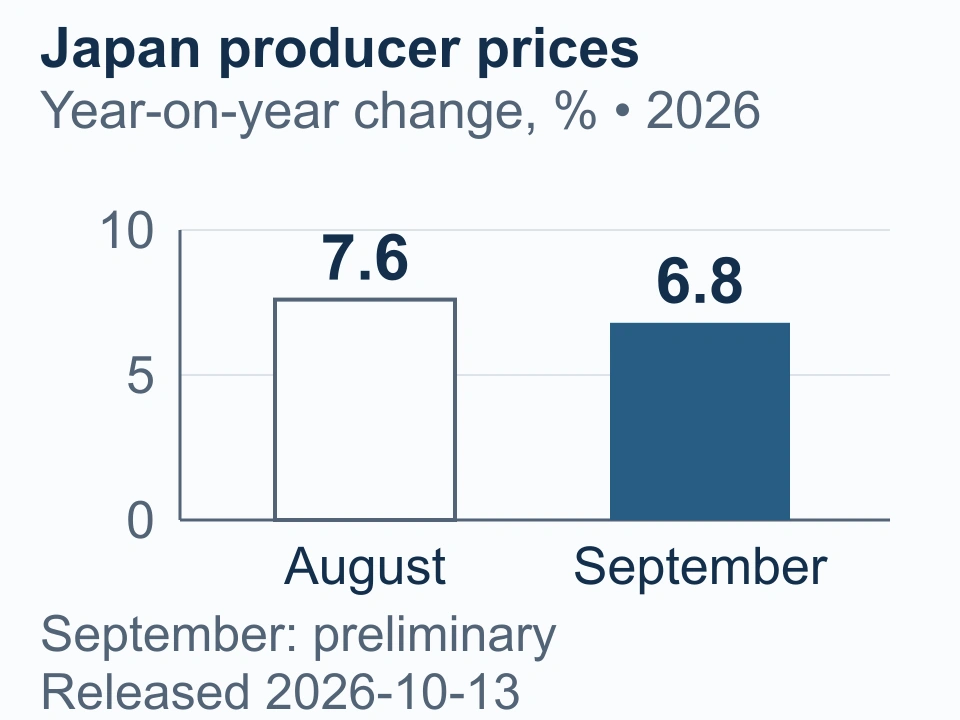
On 13 October, the Bank of Japan published its preliminary September Corporate Goods Price Index, which measures producer goods prices. Prices were 6.8% higher than a year earlier, compared with 7.6% in August. They fell 0.3% from the previous month. Annual price growth therefore slowed, but the price level remained higher than a year earlier.
? Producer and import prices: what do they measure?
The producer index measures prices of goods traded between businesses in Japan, not their entire cost basket or household consumer prices. The import index can be calculated in yen or in the currencies used in contracts, so currency conversion changes the comparison. Monthly and annual changes compare different periods; preliminary figures can still be revised.
Import prices tell a different story. In September, they fell 0.2% from August in yen but rose 1.0% in contract currencies. A small easing measured in yen is therefore not the same as an imported product becoming cheaper in its transaction currency.
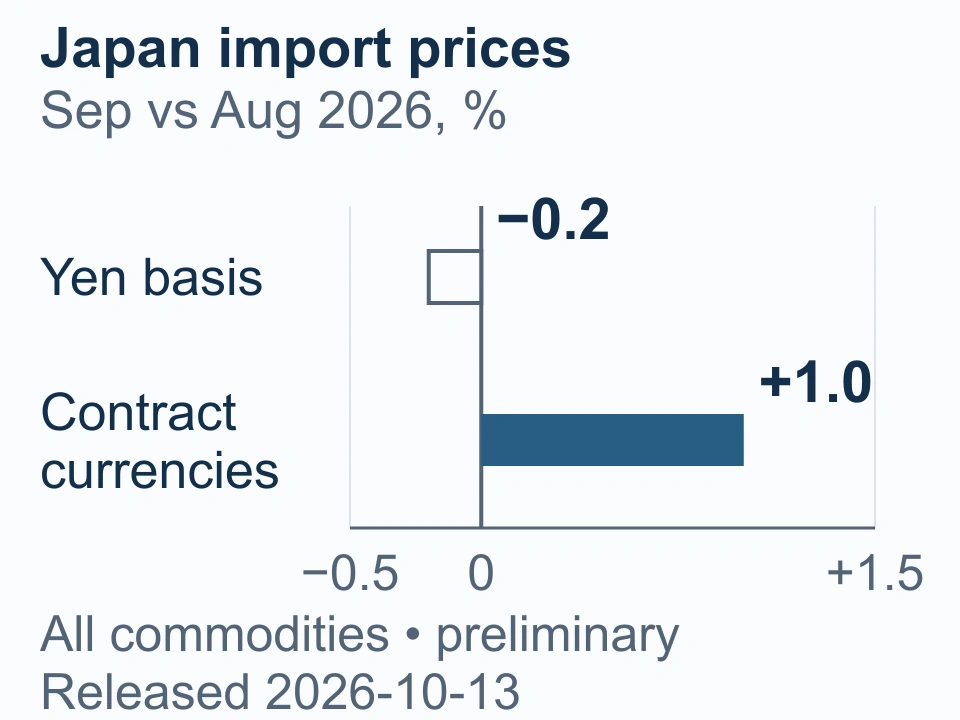
The petroleum, coal and natural-gas import group rose 2.3% over the month in contract currencies. It contributed 0.69 percentage point to the overall import-price increase. A slower domestic producer-price headline therefore did not remove the separate rise in imported fuel costs.
US permission to buy Russian diesel removes a specific restriction, but is not a quantity of fuel delivered
On 9 October, the US Treasury’s sanctions authority, the Office of Foreign Assets Control (OFAC), issued General Licence 135. Under the US sanctions rules specified in the licence, it permits transactions connected with the sale, delivery, offloading and import of Russian-origin diesel, including imports into the United States. Permission runs until 7 April 2027 at 00:01 US Eastern Daylight Time (EDT). This was Friday’s decision, not a new authorisation on Tuesday.
The licence does not permit debits to Russian central-bank, National Wealth Fund or Finance Ministry accounts at US financial institutions. It specifies neither a diesel volume nor an arrival schedule, and does not itself change other countries’ import rules. Separately, on 11 October the International Energy Agency asked countries to assess additional diesel stock releases, but no new volume has been agreed.
? A general sanctions licence: what does it permit?
It authorises defined transactions under particular US sanctions rules and specified exceptions, rather than removing every sanction. Legal permission is not yet diesel sold or delivered to a buyer.
Open AI hardware designs could ease expansion, but their benefits still need to become profits
On 12 October, chip designer NVIDIA and networking company Cisco announced plans for denser optical data connections for AI centres. Their design comparison with 200-gigabit-per-second-per-lane modules envisages four times the bandwidth density and approximately 1.3 times the power efficiency. NVIDIA also contributed parts of its next-generation rack and compute-tray designs to an open technical-standards community.
Also on 12 October, processor designer AMD introduced its open Helion rack design for AI agents, which perform tasks rather than only provide an answer. Hardware configurations are still being developed with partners; the company plans availability in November 2026. This is a new expansion plan, not Helion sales revenue already reported.
? A hardware-efficiency comparison: what does it leave out?
A gigabit is a billion bits, a unit measuring the quantity of data transmitted. The manufacturers’ comparison describes a particular connection and its baseline, not the whole data centre’s electricity bill or a customer’s profit. An open design helps equipment from different manufacturers work together, but orders and investment returns still require demand and actual deliveries.
The euro weakened at the 12 October reference rate, not at a transaction rate today
On 12 October, the European Central Bank published a reference rate of 1.1181 US dollars per euro. On 9 October it was 1.1206. The euro weakened by approximately 0.22% on this comparison. This is Monday’s published reference observation, not a spot or transaction rate for 13 October.
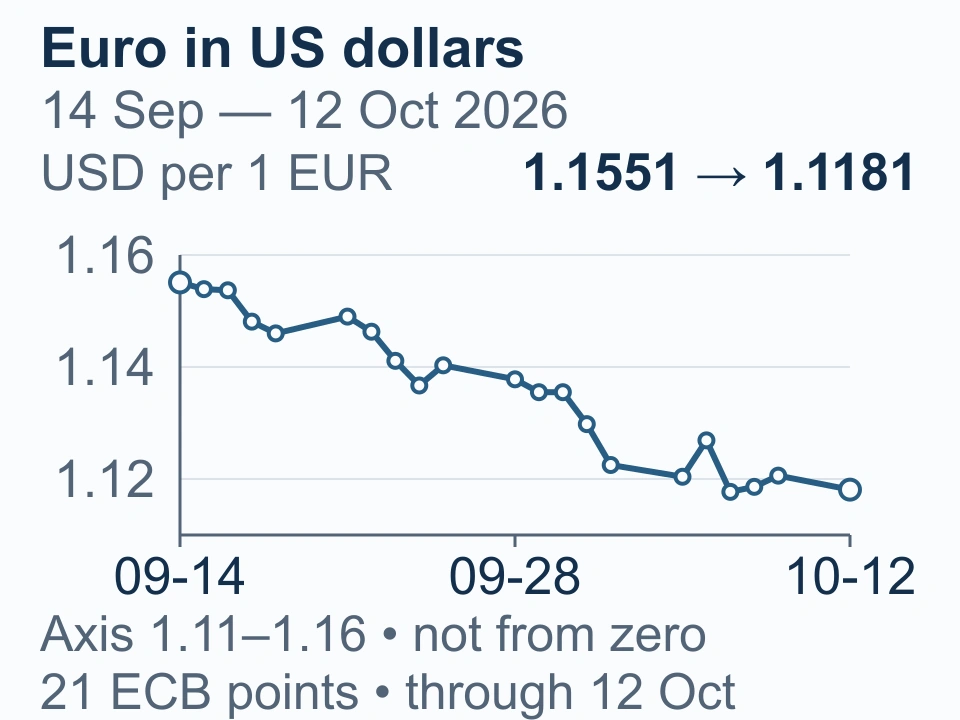
This ECB reference observation was published before Beth Hammack’s later speech in the United States. Its change therefore cannot be attributed to a response to that speech. The exchange-rate series alone also does not identify which news mattered most to the currency market that day.
? The euro–dollar reference rate: how should it be read?
The number shows US dollars per euro; a lower number means a weaker euro against the dollar. The ECB publishes it for information, not as an offered transaction price or an exchange closing price. A fund trading in euros is not necessarily hedged against changes in its dollar exposure.

Financial independence calculator
How much would you need to save?
Enter your target monthly income and current savings. See the gap and how changing your saving period affects the result.
Results depend on your assumptions, not guaranteed returns.
Week
What matters now
Future financing costs matter for bonds and debt-funded expansion
If persistent inflation pushed market yields higher, existing long-dated US bonds would face price pressure. New bond buyers could obtain a higher yield but would also risk further price falls.
Technology companies financing new data centres with debt, and property businesses, need to watch future borrowing and refinancing costs. Higher interest rates can leave less money for expansion. Existing fixed-rate loan payments do not automatically change after one central banker speaks. New borrowing costs also depend on the borrower’s own risk.
More moderate actual price growth could help bonds and debt-funded businesses. Yet very weak demand would also reduce revenues: lower interest costs do not always outweigh lower profits. Pessimistic consumer surveys alone cannot show that conditions will improve for all these portfolio exposures.
US September consumer-price data, due on 14 October at 15:30 Lithuanian time, will show whether price pressures are easing. The Federal Reserve’s 28 October decision, at 20:00 Lithuanian time, will answer whether the committee sees grounds to change interest rates. Hammack’s view is not a promise about that decision.
The same Australian interest rates offer different benefits to banks and consumer businesses
Higher interest rates could support Australian banks’ interest income, but weaker borrowers’ finances would offset that benefit. For discretionary retailers and property companies, expensive loans could constrain demand and expansion. The borrower buffers discussed at the meeting are a counterweight, not a guarantee for every business. The bank’s next decision is scheduled for 3 November; until then, the questions are whether cost pressures ease and demand slows sufficiently.
A Japanese producer needs to consider both its selling prices and its purchase costs
For shares in Japanese chemical producers importing raw materials and in transport companies, payment currencies and exchange-rate hedges matter. More favourable conversion into yen could ease some costs, but rising fuel prices in contract currencies leave a risk. If companies cannot pass them on to customers, sales can grow without increasing profits.
Holders of Japanese bonds and exporters’ shares face different signals: slower overall price growth would weaken one argument for higher interest rates, while imported energy could sustain it. The Bank of Japan’s 29–30 October meeting will show how it assesses these forces alongside wages and consumer prices. The producer index alone does not determine the next decision.
Diesel buyers need deliveries and prices to show the benefit, not just a licence
Additional supply could ease costs for fuel-consuming transport and industrial companies, benefiting their shares. However, permission must still be followed by contracts, payments, insurance and safe delivery. Before fuel reaches buyers, lower costs cannot be treated as an improvement in profits already achieved.
For oil-refiner shares, more competing diesel could narrow the gap between its selling price and the cost of crude feedstock. This is the other side of the same opportunity for fuel users. The International Energy Agency’s Oil Market Report on 14 October, followed by its Board discussion and US weekly stocks on 15 October, will help assess physical supply. Another disruption or late delivery would postpone that relief.
A hardware supplier's sale and the buyer's investment return remain different questions
For chip and networking-equipment shares, open designs could broaden the pool of potential buyers; for cloud-company shares, the issue is whether equipment reduces service costs and increases revenue. A faster connection does not itself create a paying customer. The main risk is spending more on expanding centres than new services earn. AMD’s quarterly results on 3 November and planned Helion availability in November will provide further tests of orders, spending and implementation.
The same dollar move affects asset values and purchasing costs differently
For a Lithuanian investor, unhedged US equities and dollar-denominated bonds are affected differently from a business buying equipment or fuel in dollars. If the dollar value of the asset stayed unchanged, this exchange-rate move alone would increase its euro value by approximately 0.22%; that is a conditional conversion, not a fund return. The same dollar invoice would cost the buyer more euros. A stronger dollar can offset part of an asset-price decline but can also reverse; asset prices, currency hedging and costs determine the final result.
For consumer businesses, the question is whether caution is already reducing sales
The University of Michigan’s 9 October survey sends a different signal to sellers of major purchases and consumer-equity funds than to companies supplying everyday necessities. A car or household appliance is easier to postpone, while people may keep buying essential goods by switching to cheaper alternatives. These are possible patterns of demand, not company sales results already reported.
Consumer lenders also need to consider borrowers’ ability to repay. If price pressures eased, demand for major purchases could recover; if household incomes failed to keep pace with costs, risks to sales and credit losses would increase. Results from US bank JPMorganChase on 13 October will help assess borrowers’ finances, while US September retail-sales data on 15 October will show actual sales.
A company's ability to repay matters more than the insolvency headline
For holders of higher-risk European corporate bonds, the issue is not just the interest rate but whether the issuer will have enough cash to pay interest and principal. Bank and supplier shareholders, meanwhile, face customers’ late payments and potential credit losses. Sector statistics help identify where company finances deserve closer scrutiny, but do not replace an assessment of cash, debt maturities and customer concentration.
The smaller aggregate sum of claims is a counterweight, so more registered cases do not automatically imply equal pressure on every creditor. An opportunity could arise where a bond’s price already reflects its specific risk and the company has sufficient cash to meet its obligations. Germany’s final September inflation release on 13 October will update the cost assessment; it will not establish whether an individual borrower is solvent. That requires its results and actual payments.
Week
What comes next
On 13 October, Germany will release final September inflation at 09:00 Lithuanian time; Federal Reserve Governor Christopher Waller will participate in a discussion about artificial intelligence at 10:45. Will prices and technology assessments add to, or weaken, the case for rates staying high for longer?
On 13 October, US bank JPMorganChase will release quarterly results at about 14:00 Lithuanian time and discuss them at 15:30. Will growth in interest income offset credit losses, and what will actual results reveal about borrowers’ finances?
On 14 October, the IEA will publish its Oil Market Report; at 15:30 Lithuanian time, the US Bureau of Labor Statistics will release September’s Consumer Price Index. Will supply conditions and actual prices show less pressure on company costs?
On 15 October, the IEA Governing Board will review stock-release actions. US September retail sales are due at 15:30 Lithuanian time; at 19:00, the Energy Information Administration will report stocks for the week ending 9 October. Will diesel discussions become specified volumes and dates, and is consumer caution already visible in sales?
The Federal Reserve’s decision is scheduled for 28 October at 20:00 Lithuanian time, followed by the ECB on 29 October and the Bank of Japan’s meeting on 29–30 October. The Reserve Bank of Australia’s next decision is scheduled for 3 November; AMD will report results after the US market closes that day. Will policy decisions and hardware sales confirm the expectations now being discussed?
Important. This is general market analysis, not a personal recommendation to buy or sell. Historical data and company results do not guarantee future returns. Forecasts and conditional scenarios may not materialise.
How is the history preserved and updated?
All five periods in this edition share one information date. Week means the latest 7 days, quarter means 90 days, and year means the trailing 12 months. The next dated edition will have a separate URL. This text keeps its date and assessment; later events are not silently inserted into an older edition. Longer periods assess new evidence alongside earlier developments without repeating every headline.