
Today · Market review
Korea’s rebound and rising energy costs: market review
On 21 October, South Korea’s exchange paused programmatic buy orders for five minutes after a sharp price rise. The reversal follows yesterday’s decline, but companies’ profits still depend on energy costs and the actual quantity of goods sold.
Period covered: 2026-10-21Information as of 8 min read
A buy-order pause was triggered in Korea on 21 October, and Japan released September trade data. The ZEW survey and Netflix results published on 20 October add to the previous edition’s information.
A sharp equity rebound does not itself change companies’ revenue or costs. Higher industrial energy prices in Germany and uneven consumption remain important for assessing profits.
Today
What happened
Korea’s price surge triggered a pause in programmatic buying
At 04:51:56 Lithuanian time on 21 October, South Korea’s exchange KRX suspended the validity of programmatic buy orders for five minutes. Its notice recorded a KOSPI 200 index futures price of 904.84 points, a base of 859.90 points and an exchange-reported increase of 5.22%. The mechanism was triggered after the price remained at least 5% higher for at least one minute.
? Programmatic order pause: what actually stopped?
This exchange mechanism briefly suspends programmatic buy orders in the share market when futures prices rise unusually quickly. It is not a halt to all trading. The futures price change is also not the return of the KOSPI share index itself.
On 20 October, Korea’s KOSPI share index had closed 3.73% lower. Today’s buying wave indicates a change in trading direction, not proof of an equivalent improvement in companies’ profit outlook. The Asian session on 21 October had not finished at this review’s data cutoff.
US session results on 20 October were mixed: the broad S&P 500 equity index rose 0.28%, the thirty-company Dow Jones Industrial Average gained 1.02%, and the Nasdaq Composite fell 0.02%. These are price-index changes from the 19 October close, not fund returns measured in euros. The differences alone do not show how much money investors moved between sectors.
The US Treasury’s indicative 10-year bond yield fell from 5.15% to 5.12% on 20 October, while the 2-year yield rose from 4.77% to 4.79%. Different maturities therefore moved in opposite directions even within the same country’s bond market.
? Bond yield: how should this figure be read?
These are daily points on the US Treasury’s estimated nominal yield curve, based on indicative quotations. They are not the Federal Reserve’s policy rate or a bond fund’s return. Other things equal, rising market yields reduce the prices of existing fixed-rate bonds.
German industry faces higher energy costs and a more cautious outlook
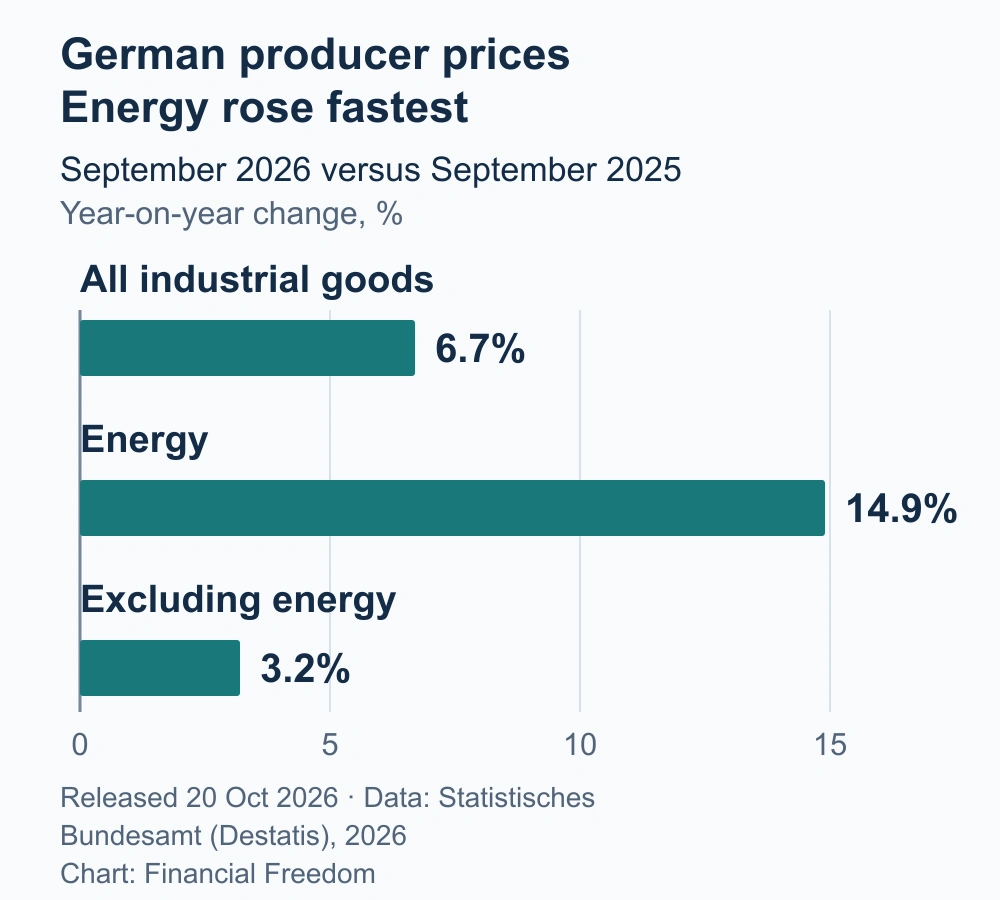
On 20 October, Germany’s statistical office Destatis reported that industrial producer prices in September were 6.7% higher than a year earlier. Energy prices rose 14.9%, while prices excluding energy increased 3.2%. Cost pressure is therefore uneven: energy-intensive production faces the largest burden.
? Producer prices: what do they measure?
The index covers industrial goods produced and sold within Germany, excluding value added tax. It is not consumer inflation: retail prices also reflect distribution and transport costs and sellers’ margins.
Also on 20 October, the German economic research institute ZEW reported that its financial experts’ expectations indicator fell from 34.7 points in September to 28.1 in October. However, their assessment of the current situation improved from −47.1 to −35.9 points. The distinction matters: respondents are less negative about the present but more cautious about the next six months.
? ZEW expectations: how should the indicator be read?
The share of financial experts expecting conditions to deteriorate is subtracted from the share expecting improvement. A positive reading means optimists outnumber pessimists, not that the economy is growing by that percentage.
Japan’s export value rose much faster than the quantity shipped
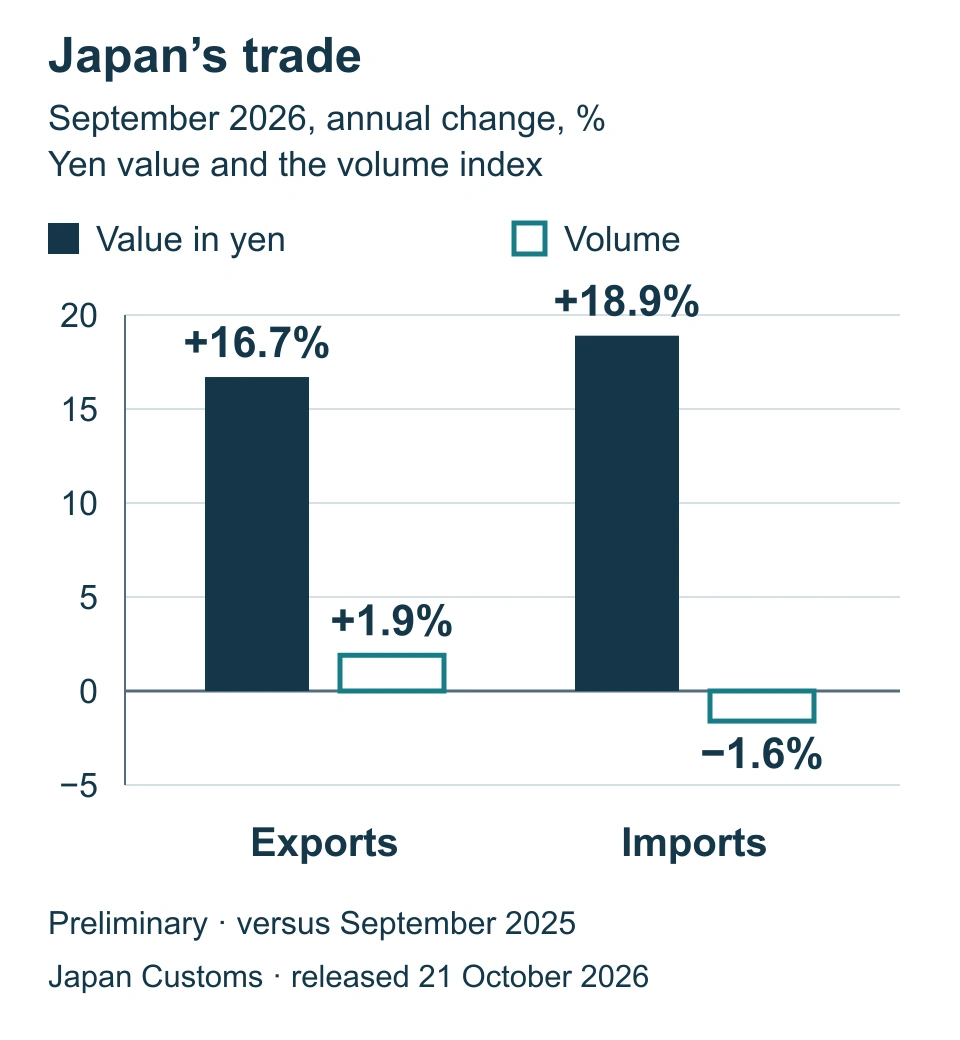
On 21 October, Japan Customs reported that September export value in yen was 16.7% higher than a year earlier, while the export volume index rose just 1.9%. A much larger sales total therefore does not mean an equally strong increase in overseas demand. These are preliminary September figures, not October trade results.
For your investments
Let’s discuss your portfolio
 FINANCIAL FREEDOM01 / 04
Investment results since 1999
Are you beating
global equities?

at the end of the period
Jan 1999–Jun 2026 · EUR · Cumulative return, %
Linear scale · * MSCI World → MSCI ACWI.
Past performance does not guarantee future returns.
FINANCIAL FREEDOM02 / 04Historical comparison
How far did it fall?
How long to recover?
Decline from the previous high

Longest recovery to the previous high

Jan 1999–Jun 2026 · EUR · Monthly data
* MSCI World → MSCI ACWI.
Past performance does not guarantee future returns.
FINANCIAL FREEDOM03 / 04Personal investment consultation
Already investing?
Let’s review your portfolio.
Yet to start
investing?
Let’s build your first
investment plan.
FINANCIAL FREEDOM04 / 04
Personal investment
consultation
Martynas
Juška
Investment manager
Managing a portfolio
of more than€100 million
The import gap was wider: value in yen increased 18.9%, even though the volume index fell 1.6%. Greater trade turnover therefore does not necessarily show a stronger economy.
? Trade value and volume: what is the difference?
Value is measured in yen; the volume index helps separate price effects. The gap is not pure inflation: currency movements and the mix of goods also matter. All changes compare September 2026 with September 2025.
Netflix’s profitability improved, but its advertising outlook weakened
On 20 October, video-streaming company Netflix reported third-quarter revenue of $12.874 billion, up 11.8% from a year earlier. Its operating margin increased from 28.2% to 34.6%. However, operating profit exceeded the company’s own forecast mainly because of expense timing, so the whole improvement should not be treated as permanent.
Netflix also cut its 2026 advertising revenue forecast from approximately $3 billion to $2.7 billion. The new expectation is about 10% below the previous one because advertising product capabilities are being rolled out more slowly than expected. This is a forecast reduction, not a 10% decline in advertising revenue already earned.
? Operating margin: what does 34.6% show?
Operating profit divided by revenue: this quarter, $100 of revenue produced $34.60 of operating profit. This is neither net profit nor cash paid to shareholders. Expense timing can affect an individual quarter’s result.
Today
What matters now
A rebound does not remove shared technology and interest-rate risks
Korean equity funds and broader Asian funds may recover together if investors raise their valuations of the same semiconductor and electronics companies. That offers an opportunity after a decline, but different country labels do not guarantee independent sources of revenue. If both funds hold many of the same technology suppliers, one reduction in orders can affect both investments. The exchange pause also illustrates a practical limit: during unusually fast moves, an order may not execute at the time or price expected.
Lower yields were a favourable price factor for longer-dated US bonds, but shorter-term yields did not support the same conclusion. For a euro-based investor, a change in the dollar can amplify or offset the result of both bonds and US shares. One session’s gains are therefore insufficient evidence that financing is becoming cheaper for every company.
Industrial profits depend on the ability to pass costs to customers
For German chemical and other energy-intensive companies’ shares, the question is whether selling prices can cover higher costs. Contracts allowing price adjustments can protect part of their profit. Weak demand limits that opportunity: customers may reduce orders or choose another supplier. Upcoming results should therefore distinguish revenue growth driven by prices from an increase in the quantity sold.
Long-dated, fixed-rate euro bonds face a different risk. Persistent price pressure could make investors demand higher yields, reducing the prices of existing bonds. The counterweight would be weaker consumption and investment restraining inflation. Shorter-dated bonds generally show smaller price changes when interest-rate expectations shift.
Exporters’ revenue and importers’ costs can move differently
Higher sales value can support Japanese exporters’ shares if companies preserve their profits. Modest volume growth nevertheless cautions against treating the entire revenue increase as a surge in orders. Japanese retailers and other businesses reliant on imported goods face a different exposure: if they cannot pass higher costs on to customers, their share of sales retained as profit falls.
The opportunity lies in businesses growing both volume and profit. The risk is an attractive revenue figure driven mainly by higher prices or currency translation. A Japanese equity fund’s return in euros also depends on the yen; these statistics do not measure that portfolio effect.
Strong current profit does not validate every growth expectation
Both sides matter for Netflix shares and communication-services funds holding the company. Current profitability gives it greater capacity to fund content and service development. A lower advertising outlook nevertheless weakens one argument for future growth that may underpin the price investors pay for its shares.
For a broader basket of digital-advertising companies, this is not evidence of an industry-wide demand decline: Netflix identified its own product rollout pace. The opportunity would be delayed capabilities reaching customers and revenue catching up. The risk is a prolonged delay alongside expenses returning in later quarters.
Today
What comes next
Korea’s session close on 21 October will show whether the buying wave lasted through the day. The final share-index result should be distinguished from the morning’s futures price surge.
The US Federal Reserve meeting on 27–28 October will help clarify how the central bank balances price pressure and growth. For bonds, its explanation of future interest rates matters alongside the decision itself.
At the cutoff, the United Kingdom’s September consumer-price data scheduled for 21 October, 09:00 Lithuanian time were still due. For sterling and UK bond investors, the question is whether price pressure remains widespread or is concentrated in particular product groups.
29 October: the European Central Bank will announce its monetary-policy decision. The key question is how it assesses the transmission of higher energy costs to other prices alongside the effect of weak demand.
29–30 October: Bank of Japan meeting. Its economic and price outlook is scheduled for 30 October. Does the bank see domestic demand strong enough for more expensive imports to feed broader price growth, rather than simply squeezing company profits?
Fourth quarter of 2026, ending 31 December. Netflix forecasts a 26.0% operating margin. The next test is whether advertising product rollout accelerates while returning expenses remain consistent with that forecast. The quarter-end is not the results publication date.
Important. This is general market analysis, not a personal recommendation to buy or sell. Historical data and company results do not guarantee future returns. Forecasts and conditional scenarios may not materialise.
How is the history preserved and updated?
All five periods in this edition share one information date. Week means the latest 7 days, quarter means 90 days, and year means the trailing 12 months. The next dated edition will have a separate URL. This text keeps its date and assessment; later events are not silently inserted into an older edition. Longer periods assess new evidence alongside earlier developments without repeating every headline.