
Today · Market review
US chip shares rebounded as Korea curbed buy orders
On 24 November, the Korea Exchange paused programme buy orders for five minutes on two of its markets. Asian shares followed Monday’s US rebound, when an index of chipmakers and equipment suppliers climbed 14.03%. The US government’s borrowing costs did not fall on Monday. Data cut-off: 08:53 Vilnius time.
Period covered: 2026-11-24Information as of 4 min read
On Monday the Korea Exchange restricted automated sell orders. On Tuesday the same kind of safeguard kicked in on the buy side. Taiwan’s share index rose 8.99% on Tuesday.
Nvidia’s returning chief reduces uncertainty about who leads the company, but customers still need to earn a return on the equipment they buy for data centres.
Today
What happened
Chip shares bounced, but the earlier loss did not disappear
Before the US opening bell on 23 November, Nvidia announced that cofounder Jensen Huang had returned as chief executive and board director. When the company announced his departure on 12 November, investors had to reconsider who would make product decisions and manage relationships with its largest customers. Finance chief Colette Kress, who had served as interim chief executive, returned to her finance role alone.
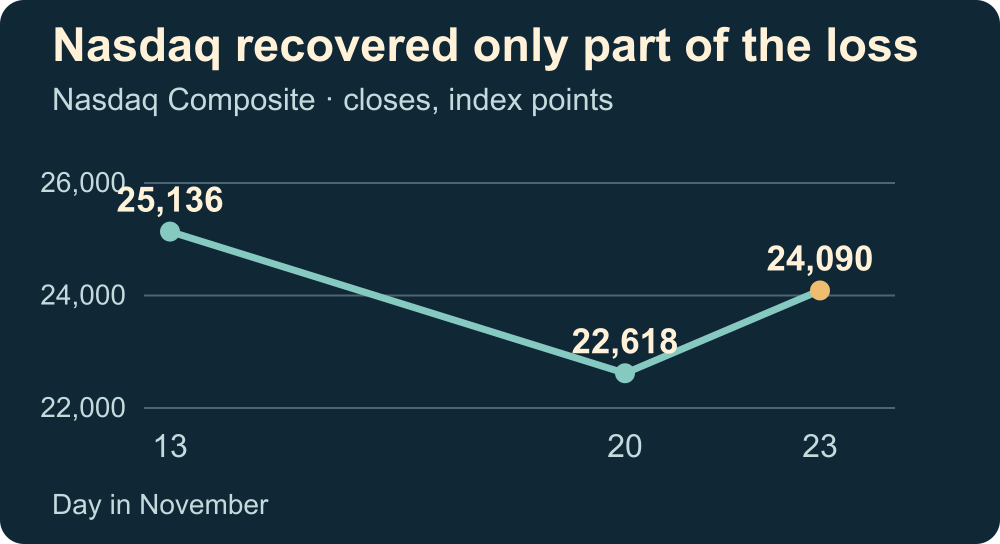
US trading ended on Monday with a sharp rebound. The Nasdaq Composite gained 6.51% and the US semiconductor share index, which covers 30 chipmakers and equipment suppliers, rose 14.03%. Nvidia shares gained 31.48% from Friday’s USD 125.53 close to Monday’s close of USD 165.05 per share. That distinction matters: a diversified share fund and a specialist semiconductor fund can respond quite differently to the same news.
Different indices of the same US market also delivered different results on Monday. The standard S&P 500’s total return, including dividends, was 4.73% in US dollars, against 3.88% for a version capping each company at 3%. The comparison shows why weights matter; it does not identify one company as the source of the entire gap.
The Korea Exchange did not close the whole market
On Tuesday the Korea Exchange paused automated buy orders for five minutes, at 02:06 Vilnius time on its main market and at 02:28 on its smaller-company market. The first safeguard kicked in when the futures contract tracking large Korean companies had risen 6.66%. Ordinary share orders were not halted. On Monday the same main market paused automated selling after futures fell 5.08%. The percentages use separate session reference levels. Adding them would not give a return on the Korean cash equity index.
For your investments
Let’s discuss your portfolio
 FINANCIAL FREEDOM01 / 04
Investment results since 1999
Are you beating
global equities?

at the end of the period
Jan 1999–Jun 2026 · EUR · Cumulative return, %
Linear scale · * MSCI World → MSCI ACWI.
Past performance does not guarantee future returns.
FINANCIAL FREEDOM02 / 04Historical comparison
How far did it fall?
How long to recover?
Decline from the previous high

Longest recovery to the previous high

Jan 1999–Jun 2026 · EUR · Monthly data
* MSCI World → MSCI ACWI.
Past performance does not guarantee future returns.
FINANCIAL FREEDOM03 / 04Personal investment consultation
Already investing?
Let’s review your portfolio.
Yet to start
investing?
Let’s build your first
investment plan.
FINANCIAL FREEDOM04 / 04
Personal investment
consultation
Martynas
Juška
Investment manager
Managing a portfolio
of more than€100 million
Taiwan’s and Japan’s shares have not recovered all their losses
Taiwan’s benchmark TAIEX closed 8.99% above Monday’s level but still 8.13% below 13 November. Following the 23 November holiday, Japan’s Nikkei 225 rose 3.91% from Friday, while Japan’s semiconductor share index gained 8.11%. The Taiwan and Japan percentages use different previous local sessions as a base; both measure share prices in local currencies.
The rates backdrop did not improve as much as share prices
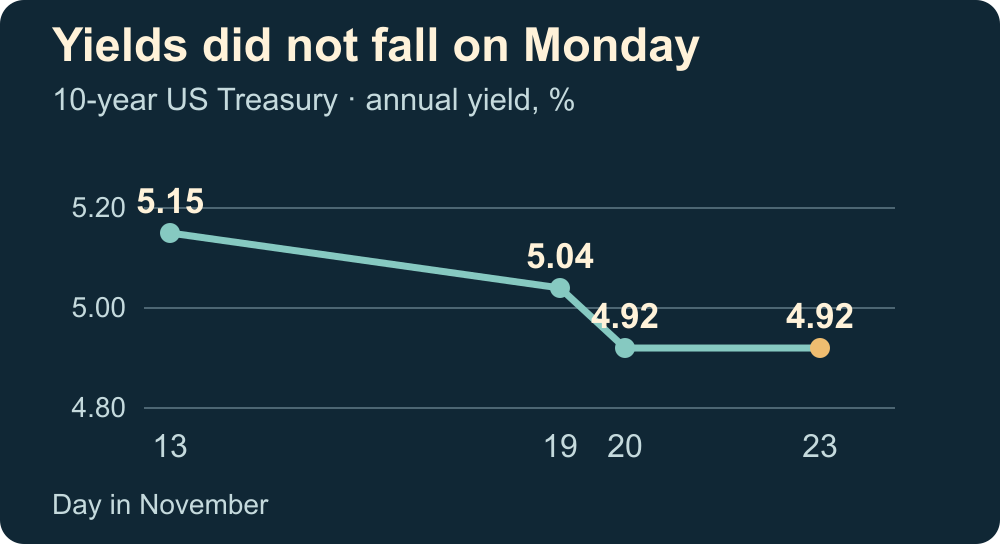
The ten-year US Treasury yield held at 4.92% on 23 November, and the two-year yield at 4.63%, unchanged from Friday. The European Central Bank’s reference rate was USD 1.0939 per euro, against 1.0990 on Friday. The euro fell 0.46% against the dollar. That currency move alone does not tell us how much a particular fund gained or lost in euros.
Business surveys on 23 November showed different growth rates. The preliminary US composite purchasing managers’ index fell from 55.9 in October to 54.6 in November. The preliminary euro area measure stayed at 51.7. Readings above 50 indicate expansion in both cases, but US growth slowed. The broad European STOXX Europe 600 price index rose 1.81% on Monday.
Today
What matters now
A rebound can reduce a loss without removing the risk
From 13 November to Friday’s close, the Nasdaq Composite lost 2,519 index points. It recovered almost 1,472 on Monday, or about 58% of that decline in points. Investors who hold both US technology funds and a sizeable allocation to Taiwan should know how much of each depends on the same data-centre orders. Distinct geographies do not automatically separate that risk.
Monday’s bond market did not offer cheaper funding to indebted data-centre operators. If infrastructure attracts more paying customers, large orders could eventually translate into revenue for more than chip suppliers. If demand grows more slowly than power, equipment and financing costs, a share-price jump will not raise customer profits. For holders of longer-dated US bonds, inflation remains the more important near-term signal than a change of leadership at one chipmaker.
Today
What comes next
24 November, 17:00 Vilnius time: US consumer confidence
The Conference Board survey will show whether Americans’ views on income and jobs are changing before holiday shopping.
25 November, 15:30 Vilnius time: consumer prices and growth
The US Bureau of Economic Analysis releases October personal consumption prices and its second estimate of third-quarter growth. The question is whether slower activity is relieving price pressures or borrowing costs could stay high.
Important. This is general market analysis, not a personal recommendation to buy or sell. Historical data and company results do not guarantee future returns. Forecasts and conditional scenarios may not materialise.
How is the history preserved and updated?
All five periods in this edition share one information date. Week means the latest 7 days, quarter means 90 days, and year means the trailing 12 months. The next dated edition will have a separate URL. This text keeps its date and assessment; later events are not silently inserted into an older edition. Longer periods assess new evidence alongside earlier developments without repeating every headline.