
Week · Market review
The week in shares: a sell-off and a sudden rebound
Between 18 and 24 November, shares changed direction within a few sessions. US and Japanese shares fell on Friday. Semiconductor shares stood out in the rebound on 23 and 24 November, but US government borrowing costs did not fall on Monday. Data cut-off: 08:53 Vilnius time.
Period covered: 2026-11-18 – 2026-11-24Information as of 4 min read
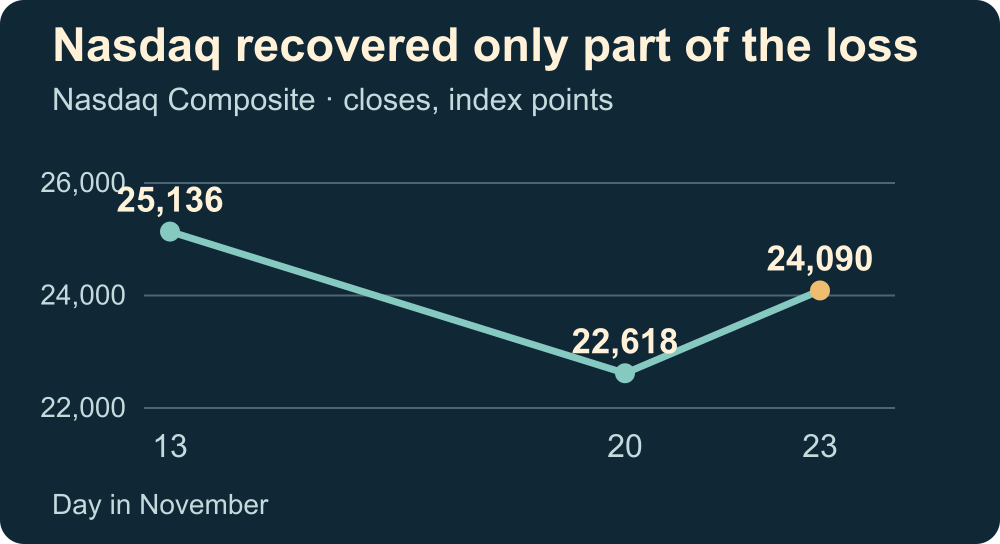
The Nasdaq Composite recovered part of last week’s loss on 23 November. The next morning, the Korea Exchange restricted automated buy orders, rather than sell orders as it had on Monday.
Large investments in artificial intelligence still do not guarantee that data-centre owners can recover the cost of equipment and the borrowing used to pay for it.
Week
What happened
The sell-off came before buyers returned
The US Federal Reserve’s October meeting minutes, released on 18 November, confirmed that two voting members had preferred a rate increase. The October decision itself did not change: the policy rate stayed at 3.75–4.00%. The same day, Eurostat confirmed that euro area inflation had accelerated from 3.8% in September to 4.0% in October. Energy prices rose 21.0% from a year earlier, while inflation excluding energy was 2.3%. Those components matter because rising energy costs do not hit households and businesses equally.
On 19 November, shares in artificial intelligence company Anthropic began trading on the US exchange. On 20 November the company confirmed the share offering’s total value of USD 93.5 billion. Roughly USD 91.6 billion went to the company before offering costs. New share proceeds fund expansion; they are not sales revenue. The amount raised and the ability to earn from artificial intelligence services are two separate questions.
October US consumer price data were not yet available. In the latest Bureau of Economic Analysis release, September personal consumption prices rose 3.6% from a year earlier, and 3.1% excluding food and energy. Even during a sell-off, it did not follow that the central bank would have to make borrowing cheaper immediately. Investors first needed to distinguish slower growth from persistent price pressures.
On Friday 20 November, the US semiconductor share index fell 10.73% and Japan’s Nikkei 225 lost 5.06% during its own session. US ten-year Treasury yields ended Friday at 4.92%, down from 5.04% on Thursday. Bonds offered a counterweight to shares that day, not a universal rule. If a fresh inflation shock drives shares lower, longer-dated bonds can also lose value.
For your investments
Let’s discuss your portfolio
 FINANCIAL FREEDOM01 / 04
Investment results since 1999
Are you beating
global equities?

at the end of the period
Jan 1999–Jun 2026 · EUR · Cumulative return, %
Linear scale · * MSCI World → MSCI ACWI.
Past performance does not guarantee future returns.
FINANCIAL FREEDOM02 / 04Historical comparison
How far did it fall?
How long to recover?
Decline from the previous high

Longest recovery to the previous high

Jan 1999–Jun 2026 · EUR · Monthly data
* MSCI World → MSCI ACWI.
Past performance does not guarantee future returns.
FINANCIAL FREEDOM03 / 04Personal investment consultation
Already investing?
Let’s review your portfolio.
Yet to start
investing?
Let’s build your first
investment plan.
FINANCIAL FREEDOM04 / 04
Personal investment
consultation
Martynas
Juška
Investment manager
Managing a portfolio
of more than€100 million
Technology shares recovered at different speeds
On 23 November, Nvidia announced that cofounder Jensen Huang was back as chief executive. The Nasdaq Composite rose 6.51% and the US chipmakers and equipment suppliers index gained 14.03%. The broader European STOXX Europe 600 rose 1.81% that day. These were not simultaneous trades on one exchange: the figures compare local closes for price indices.
On 24 November the Korea Exchange paused automated buy orders for five minutes at different times on its main and smaller-company markets. After a public holiday Japan’s Nikkei 225 recovered 3.91%, and Taiwan’s TAIEX gained 8.99% from Monday. Japan’s figure is measured from Friday, so those percentages alone cannot show which market attracted more buying over the same 24 hours. Both moves matter for portfolios holding the semiconductor supply chain across several geographic funds.
Japan’s preliminary survey on 24 November illustrates why a rise in technology shares is not the same as a recovery in the whole economy. The services activity index fell to 50.5 from 51.7 in October, while the manufacturing index rose to 53.7 from 53.3. Better orders for electronics manufacturers do less for companies that depend on demand for domestic services. That is how a national equity index can rise even as businesses that earn locally face fewer fresh orders.
Business activity outside US technology expanded at a slower pace
S&P Global’s preliminary survey on 23 November showed that the US composite activity index fell from 55.9 to 54.6. The euro area measure was unchanged at 51.7. A reading above 50 still means that activity expanded overall in the survey. Companies can have more orders than before while growth in orders slows. That makes the ability to pass on higher costs especially important for profit margins.
Week
What matters now
Two questions to assess separately
For equity funds, the name of the sector is only a starting point. If two funds in different countries own companies selling to the same cloud operators, both can feel the impact of fewer orders. Conversely, a few strong sessions for shares do not by themselves change the rates an indebted company will pay when it refinances.
For bonds, the relationship between falling yields and rising prices applies to the same fixed-rate bond. A fund’s value may also change with its sensitivity to rates, credit risk and currencies. For an investor measuring their portfolio in euros, a US gain or loss needs to reflect the exchange rate as well as the index’s dollar return.
Week
What comes next
25 November, 15:30 Vilnius time: US prices and economic growth
October personal consumption prices and the updated third-quarter growth reading will help show whether resilient consumption can coexist with slower inflation.
26 November, 14:30 Vilnius time: European Central Bank meeting account
October’s discussion will show how much weight the European Central Bank gave to energy prices and how much to broader price pressures.
Important. This is general market analysis, not a personal recommendation to buy or sell. Historical data and company results do not guarantee future returns. Forecasts and conditional scenarios may not materialise.
How is the history preserved and updated?
All five periods in this edition share one information date. Week means the latest 7 days, quarter means 90 days, and year means the trailing 12 months. The next dated edition will have a separate URL. This text keeps its date and assessment; later events are not silently inserted into an older edition. Longer periods assess new evidence alongside earlier developments without repeating every headline.