
Today · Market review
22 September: lower US real yields meet higher European cost risk
The new pre-07:00 fact was South Korea’s KRW34 trillion in temporary liquidity. The more important market shift came in yesterday’s US session: long and real yields fell while the S&P 500 rose. ECB research added a warning that gas prices can reach consumers faster and companies expect higher costs alongside weaker profit.
Period covered: 2026-09-22Information as of 7 min read
Three things changed since the previous cutoff. On 21 September, the US ten-year nominal yield fell to 4.96%, the real yield to 2.62%, and the S&P 500 rose 1.49%. The ECB published evidence that gas-price moves reach consumers faster and that company cost expectations greatly exceed profit expectations. Before 07:00 on 22 September, the Bank of Korea supplied KRW34.00 trillion in 14-day liquidity without cutting its policy rate.
The longer-horizon conclusion is unchanged: a lower yield alone does not guarantee higher equity profit or a safe bond return. Investors still need to separate the real discount rate, inflation compensation, credit quality and a company’s ability to pass on energy and labour costs. Temporary central-bank liquidity is not the same as a recovery in final demand.
Today
What happened
Before 07:00, South Korea supplied temporary bank liquidity without cutting its policy rate
Early on 22 September in Lithuanian time, the Bank of Korea accepted KRW34.00 trillion in 14-day repurchase-agreement bids. Banks offered KRW35.62 trillion, the average rate was 3.00%, and the operation matures on 6 October. This was the only major new official market fact published before this edition’s 07:00 cutoff. Information released later in the morning is not included.
The operation temporarily increases cash in the financial system. It can ease interbank funding pressure, but it does not mean household or company loans automatically became cheaper. Bank shares depend on more than the amount of liquidity: deposit costs, lending margins and borrowers’ ability to repay still matter. For Korean bonds, the next test is whether an operation of similar scale is needed after two weeks. A one-off technical need and persistent funding stress would carry different portfolio implications.
? What does a repurchase agreement do?
A central bank uses a repurchase agreement to provide temporary cash against securities collateral. The transaction is reversed at the agreed maturity. It is a liquidity tool, not automatically a new policy rate or a promise of cheaper bank loans.
Yesterday, long US yields fell while equities rose
On 21 September, the two-year US Treasury yield stayed at 4.76%, while the ten-year yield fell from 5.01% to 4.96%. The ten-minus-two-year spread therefore narrowed from 0.25 to 0.20 percentage points. The thirty-year yield also declined 0.05 points to 5.29%. In the same session, the S&P 500 rose from 7,650.50 to 7,764.70, or 1.49%. This was yesterday’s US close, not early European trading on 22 September.
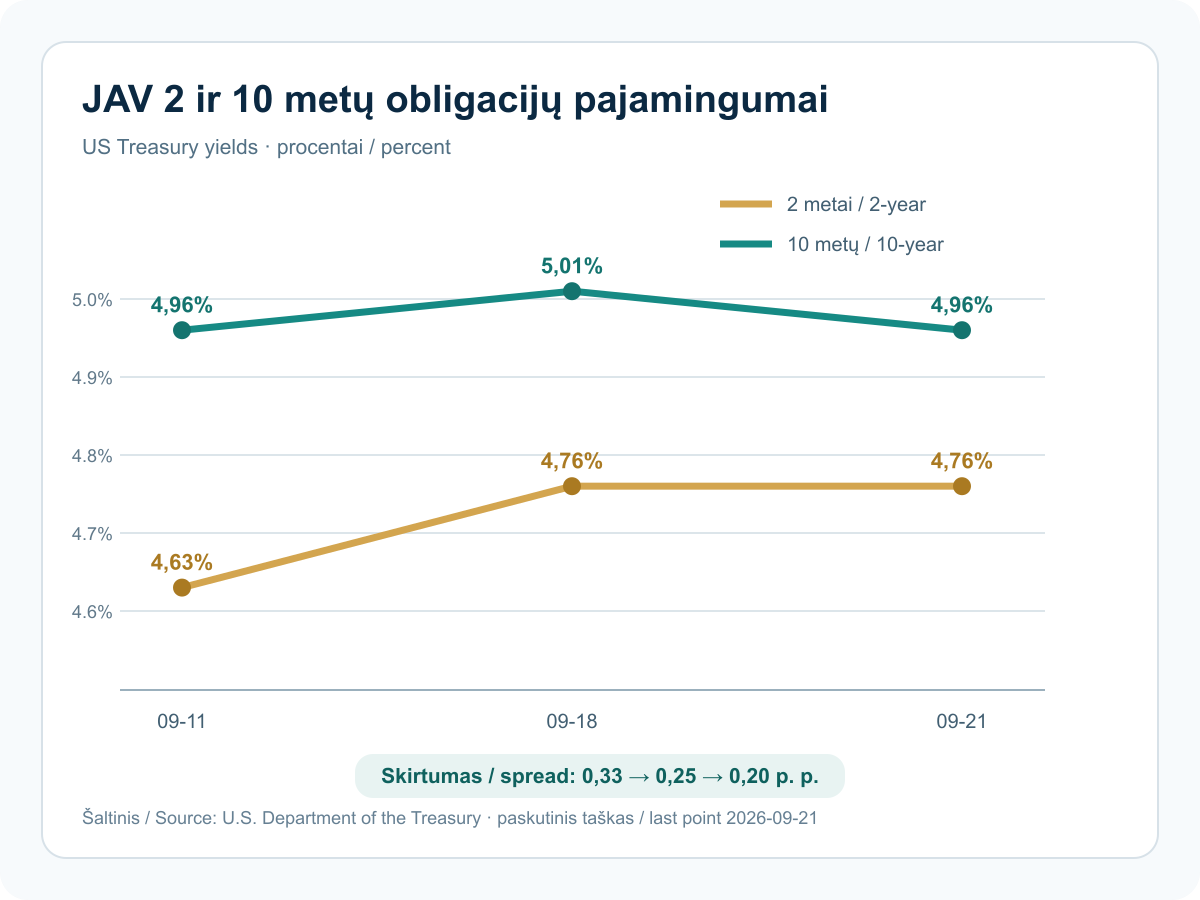
A lower long-term yield normally reduces the discount rate applied to profits far in the future. That can support growth shares and the price of existing longer-duration fixed-rate bonds. Yet one day of coincident moves does not prove that yields were the only cause of the equity gain. If long yields fall because investors fear weaker growth, the benefit for cyclical companies can be short-lived. The next checks are profit forecasts, credit spreads and whether short yields begin to fall as well.
Real yields fell more, while inflation compensation barely changed
The real yield on ten-year US inflation-protected Treasuries declined from 2.68% on 18 September to 2.62% on 21 September. The arithmetic gap between the nominal and real yield changed only from roughly 2.33% to 2.34%. Yesterday’s nominal-yield decline was therefore driven more by a lower market-required real return than by a clear fall in inflation compensation.
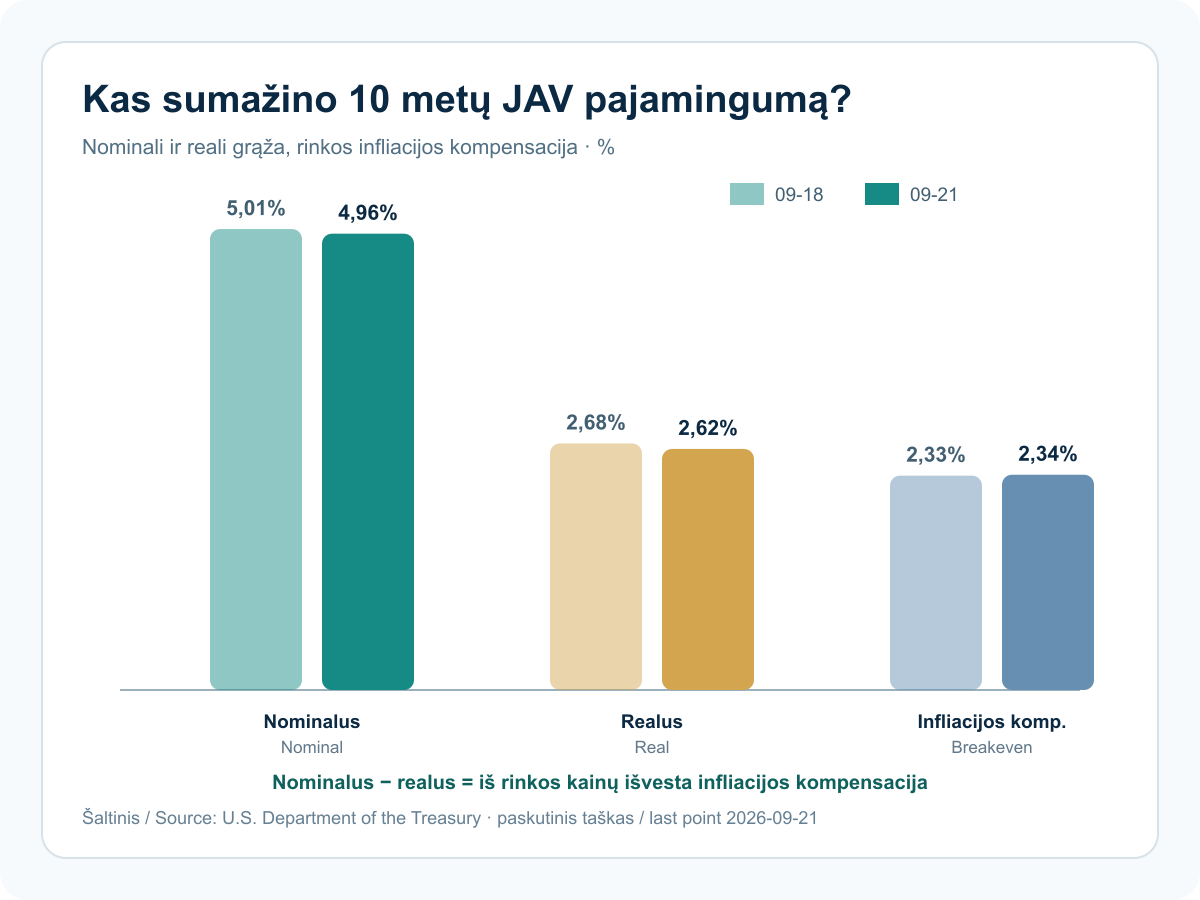
Lower real yields are supportive for the price direction of long-duration bonds, but a new buyer also receives a lower yield to maturity. The most sensitive equities are those whose valuation depends heavily on earnings many years ahead. Banks and insurers care about the entire curve rather than one ten-year point. If inflation compensation rises again with energy prices, nominal yields could move back up without a new central-bank decision.
? How should real yields and inflation compensation be read?
Real yields are inferred from inflation-protected bond prices. The nominal-real yield gap is often called inflation compensation. It includes expected inflation as well as risk and liquidity premia, so it is not a precise consumer-price forecast.
The ECB showed that gas-price moves can reach consumers faster than four years ago
On 21 September, the European Central Bank published an analysis of wholesale energy-price pass-through. In its 2026 survey, more than half of respondents said gas-price changes reach the consumer-price index within one to three months. About 10% selected four to six months and roughly one-third seven to twelve months. The share selecting a long 13–24 month lag fell from about 40% in 2022 to about 5% in 2026. These are approximate survey shares, not a mechanical forecast for every country.
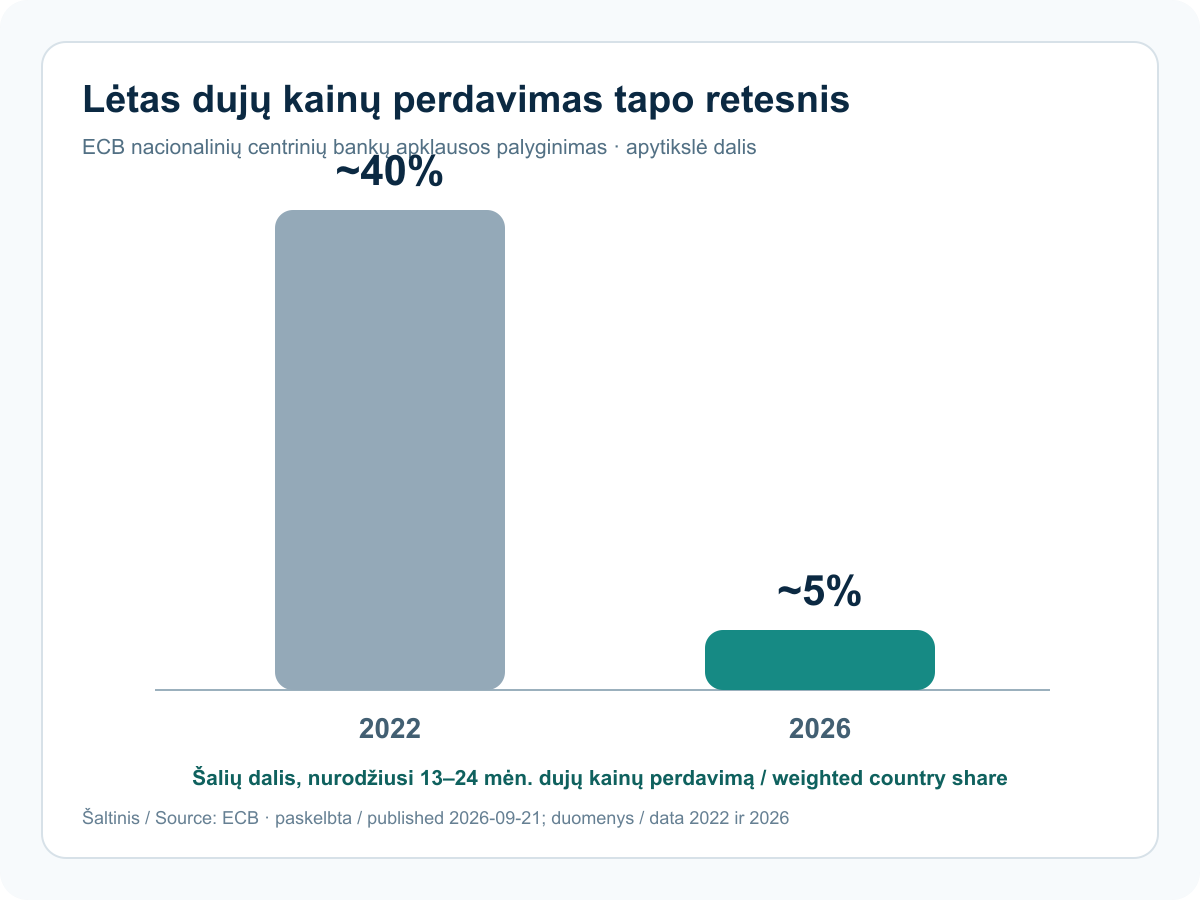
Taxes and regulated charges made up about 31% of the final gas bill and 27% of the electricity bill in 2025. A wholesale move is therefore not passed through uniformly or in full. Electricity pass-through remains more uneven because of contracts, regulation and grid charges. Faster pass-through can protect energy-company margins, but it also raises bills sooner for households and energy-intensive businesses. Inflation and interest-rate risk would rise if wholesale energy prices increased for several months.
? What does price pass-through not prove?
Pass-through timing describes how long wholesale-price changes usually take to appear in consumer prices. It does not mean the full wholesale move is transferred at one fixed ratio. Taxes, regulation, contracts and supplier hedging all affect the final bill.
Euro-area companies expect higher costs and weaker profit
A second ECB publication on 21 September reported a survey of company expectations for the second quarter of 2026. Fieldwork ran from 21 May to 26 June, so the figures are expectations rather than realised results on 22 September. Net balances were +79% for input costs, +58% for selling prices and +43% for wages. The profit balance was −40% and the demand balance −14%.
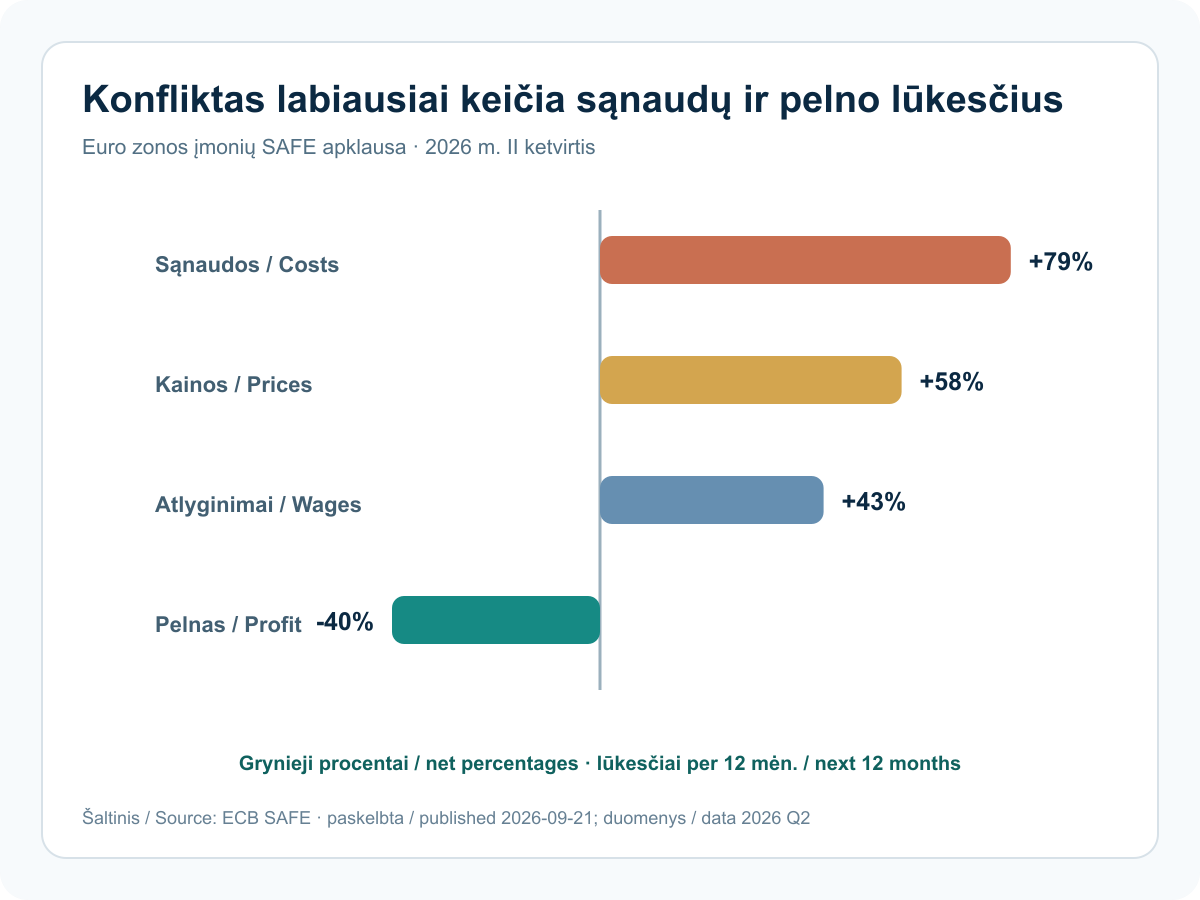
The combination matters because a higher selling price does not guarantee more profit. If costs and wages rise faster, margins shrink. Service, infrastructure or niche industrial companies with pricing power may preserve more profit; retailers facing weak demand and energy-intensive manufacturers carry more risk. For companies with high conflict exposure, turnover and investment expectations were only +10% and +2%, compared with +34% and +14% in the earlier all-company baseline. Actual quarterly margins and order books are the next test.
? What does a +79% net survey balance mean?
A net balance is the share of firms expecting an increase minus the share expecting a decrease. +79% does not mean costs will rise by 79%. It measures the direction of opinion, not the size of the expected change.
The older divergence in policy rates still matters, but this morning did not change it
On 16 September the Federal Reserve raised its target range to 3.75–4.00%. The Bank of England held 3.75% on 17 September, although three of nine members preferred an increase. The Bank of Japan raised its overnight guideline to about 1.25% on 18 September, effective 24 September. An earlier ECB decision raising its deposit rate to 2.50% took effect on 16 September. These are prior-day conditions, not news from this morning.
Debt maturity and currency matter alongside the rate direction. A shorter-duration bond adapts more quickly to a new policy rate; a longer one moves more when required real returns and inflation compensation change. A cash-rich company faces a different risk from a business refinancing debt this year. For a euro investor, moves in the dollar, yen and Korean won can amplify or soften the return in the local market.

Professional portfolio management
A plan for your portfolio. No rush.
Let’s discuss your goals, risk tolerance and time horizon. Find out how your portfolio would be built and managed.
The first conversation is free, with no obligation.
Today
What matters now
What matters now: a lower real return helps valuations, but profit risk remains
The new pre-07:00 liquidity fact came from South Korea. Yesterday’s US combination was broader: the ten-year nominal yield fell to 4.96%, the real yield to 2.62%, and the S&P 500 rose 1.49%. That temporarily eases pressure on long-duration bonds and growth-equity valuations. Inflation compensation nevertheless stayed around 2.34%, so one session did not show that price risk had disappeared.
The ECB’s energy and company research provides the counterweight. A gas shock can reach consumers sooner, while surveyed companies expect costs and wages to rise more often than profit. Equity portfolios therefore need to compare selling prices with margins, bonds need maturity alongside credit quality, and regional positions need currency-adjusted returns. The opportunity would be falling real yields with resilient realised earnings. The risk would be renewed energy inflation and the negative profit expectations becoming actual results.
Today
What comes next
What comes next?
- Japan’s new rate taking effect on 24 September. The response of banks, bonds and yen-funded positions after implementation will matter more than one currency minute.
- Continuity of South Korean liquidity. The 14-day operation matures on 6 October and will show whether this was a one-off technical need or requires renewed funding.
- Actual company margins and the macro data due on 2 October. US labour figures and euro-area inflation will test whether lower real yields can coexist with resilient demand.
No next-meeting Federal Reserve probability has been invented from memory. A current official CME FedWatch table reading was not reliably captured before the cutoff, so no number is presented as a Federal Reserve forecast or promise.
Important. This is general market analysis, not a personal recommendation to buy or sell. Historical data and company results do not guarantee future returns. Forecasts and conditional scenarios may not materialise.
How is the history preserved and updated?
All five periods in this edition share one information date. Week means the latest 7 days, quarter means 90 days, and year means the trailing 12 months. The next dated edition will have a separate URL. This text keeps its date and assessment; later events are not silently inserted into an older edition. Longer periods assess new evidence alongside earlier developments without repeating every headline.