
Weekly market review · 16–20 November
Nasdaq fell 10%: why did record AI revenue not help?
The US Nasdaq Composite fell 10.02% in the week of 16–20 November, and Taiwan’s main index fell even further. Record revenue at chipmaker Nvidia and a large share offering by artificial intelligence company Anthropic failed to stop the slide. A profitable business is not necessarily a good investment if the share price already assumes a lot of future growth.
The week at a glance
What moved markets before the detailed explanation
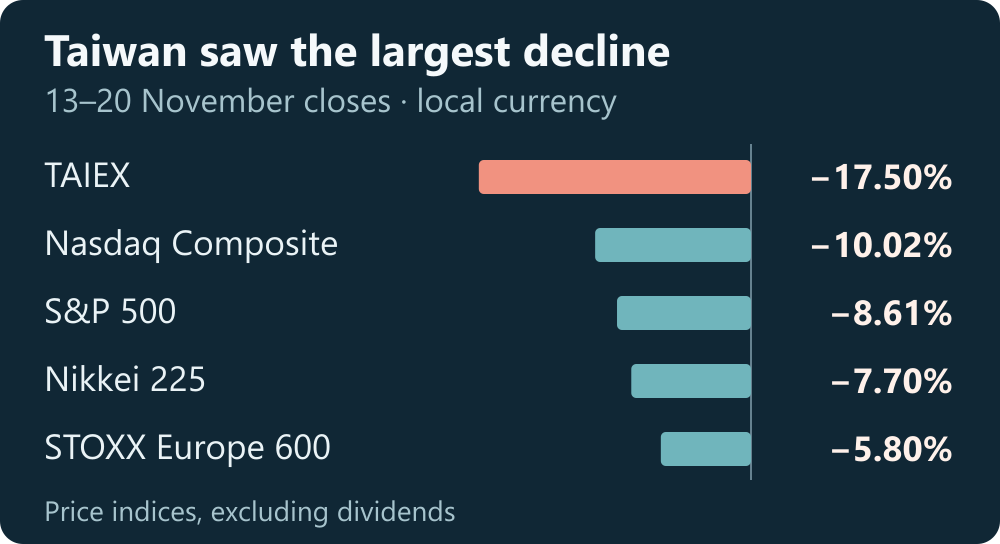
The Nasdaq Composite fell 10.02% and Taiwan’s TAIEX dropped 17.50%. Record chipmaker revenue did not stop the slide, while US Treasury yields fell.
- TAIEX−17.50%13–20 November · local currency
- Nasdaq Composite−10.02%13–20 November · local currency
- S&P 500−8.61%13–20 November · local currency
- Nikkei 225−7.70%13–20 November · local currency
- STOXX Europe 600−5.80%13–20 November · local currency
How the sell-off spread over the week
US shares opened the week lower on 16 November. By Wednesday’s close, the broad S&P 500 index had already lost 3.15% from the previous Friday. Nvidia’s results on 17 November showed that chip demand was still strong. The index did not recover: strong sales at one supplier tell us little about how much its customers will earn from the equipment they buy.
Anthropic shares began trading on the US Nasdaq exchange on 19 November. The company confirmed the offering had closed the next day, but the US semiconductor index, which covers chipmakers and equipment suppliers, fell 10.73% on Friday. Before the US session, Japan’s Nikkei 225 fell 5.06% on the day and Taiwan’s main index lost 6.23%. The S&P 500 fell 3.70% on Friday and ended the week 8.61% lower. Nearly two-thirds of its weekly decline in index points came in the final two sessions.
Bonds and shares moved in opposite directions this time. The ten-year US Treasury fell from 5.15% to 4.92%, supporting the prices of existing fixed-rate bonds. Meanwhile, the European Central Bank’s reference rates showed the euro fell 0.56% against the dollar. For euro investors without currency protection, the stronger dollar softened the loss on US shares but did not erase it.
Yield is an annual rate of return implied by a bond’s price and promised payments. When the price of the same fixed-rate bond rises, its yield falls. Yield is not the return earned over the week.
Equipment sales are rising. Customer profits are a separate question
On 17 November, Nvidia reported USD 115.8 billion in revenue for the quarter to 25 October, 103% more than a year earlier. Data centres accounted for most of it. On 20 November, Anthropic confirmed its public share offering totalled USD 93.5 billion. Roughly USD 91.6 billion went to the company before offering expenses; the rest went to the shareholders who sold stock.
Equipment sales and funding raised for expansion tell us little about when customer revenue will cover infrastructure costs. If usage and profits grow together, chipmakers and cloud providers can both benefit. If costs grow faster, equipment buyers could earn less and later place fewer orders.
For your investments
Let’s discuss your portfolio
 FINANCIAL FREEDOM01 / 04
Investment results since 1999
Are you beating
global equities?

at the end of the period
Jan 1999–Jun 2026 · EUR · Cumulative return, %
Linear scale · * MSCI World → MSCI ACWI.
Past performance does not guarantee future returns.
FINANCIAL FREEDOM02 / 04Historical comparison
How far did it fall?
How long to recover?
Decline from the previous high

Longest recovery to the previous high

Jan 1999–Jun 2026 · EUR · Monthly data
* MSCI World → MSCI ACWI.
Past performance does not guarantee future returns.
FINANCIAL FREEDOM03 / 04Personal investment consultation
Already investing?
Let’s review your portfolio.
Yet to start
investing?
Let’s build your first
investment plan.
FINANCIAL FREEDOM04 / 04
Personal investment
consultation
Martynas
Juška
Investment manager
Managing a portfolio
of more than€100 million
Different markets did not necessarily mean different risks
Taiwan’s TAIEX fell 17.50% over the week, Japan’s Nikkei 225 lost 7.70%, and the STOXX Europe 600 fell 5.80%. These are price index moves in local currencies, without dividends. An allocation to Taiwan and Japan can add geographic variety to a US fund, but the risks overlap if both funds hold many companies in the chip supply chain. The smaller loss in the broad European index this week does not mean it will always offset a US decline.
On 20 November, the Korea Exchange restricted programme sell orders for five minutes each in the KOSPI and KOSDAQ markets. Regular stock trading did not stop. On the same day, Taiwan’s financial regulator lowered the daily limit on sales of borrowed shares from 3% to 1% of each stock’s average trading volume over the previous 30 sessions. The restriction had exceptions, and Taiwan’s main index continued to fall on Friday.
US bonds rallied, but the inflation question remained open
On 18 November, the US Federal Reserve released the minutes of its 27–28 October meeting. The policy rate range stayed at 3.75–4.00% in October, with two voters favouring a rise. The minutes were not a new decision. Long-term bonds can rise when investors seek safer assets even if the central bank is not preparing to cut short-term rates.
On the same day, Eurostat confirmed annual euro-area inflation rose from 3.8% to 4.0% in October. Energy prices were up 21.0% from a year earlier, while inflation excluding energy remained at 2.3%. The difference matters to euro-area investors: dearer energy can squeeze profits at energy-intensive firms, and long-term bonds can fall again if inflation spreads to other goods and services.
Oil moved in the opposite direction to October’s energy inflation this week. The final trade on 20 November for Brent crude due to be delivered in January 2027 was USD 92.59 a barrel, down 3.84% from a week earlier. That is a futures price, not the price of fuel: one week’s move does not tell us how much consumers could save on energy.
What to watch after a week like this
On 25 November, the US Bureau of Economic Analysis will publish its October consumer spending price index and a revised estimate of third-quarter economic growth. The reports will help distinguish softer demand from persistent price pressure. Eurostat’s 1 December flash estimate will show whether the effect of energy prices in the euro area is easing. The Federal Reserve’s 8–9 December decision will show how it weighs the two risks.
The lesson for portfolios is not that every technology business weakened. It is that different equity funds can depend on the same assumptions about future profits. Bonds offered a counterweight this time; a renewed rise in inflation could push yields up and weaken that protection.
Important. This is general market commentary, not a personal investment recommendation.