
Today · Market review
Japanese stocks fell 5.06%: what is behind the sell-off?
Japan’s Nikkei 225 fell 5.06% on 20 November, extending the sell-off seen in US technology stocks the previous day. The important contrast is that US Treasury yields are falling, while rising costs and uncertain demand still threaten company profits. This is a morning review, not a report of Friday’s completed US session. Information cutoff: 20 November 2026, 10:00 Lithuanian time.
Period covered: 2026-11-20Information as of 5 min read
This morning’s Japanese sell-off came alongside new October price data: headline inflation accelerated, but inflation excluding fresh food and energy slowed. Yesterday’s US manufacturing survey showed weaker orders and wider cost pressure.
The October US interest-rate decision remains in force. The minutes published this week are not a new increase, and falling equities do not automatically bring a rate cut.
Today
What happened
From Thursday in the US to Friday in Japan
Japan’s Nikkei 225 closed at 56,436.65 points, down 3,007.56 points from 19 November. The US Nasdaq Composite lost 2.25% on Thursday and closed at 23,879.20 points. These are different countries’ sessions: Friday’s Japanese trading has finished, while Friday’s US session has not begun. Index changes are measured in local currencies, excluding dividends; they are not a Lithuanian investor’s return in euros.
The broader issue is not just one company’s results. When investors become less willing to pay for profits expected far in the future, even a business with strong sales can fall in value. US technology and Japanese equities therefore do not necessarily offset each other: both parts of a portfolio can depend on the same global investment spending. This explains a risk, rather than proving that one news item caused the entire sell-off.
Lower yields helped bonds; there was no new Fed decision
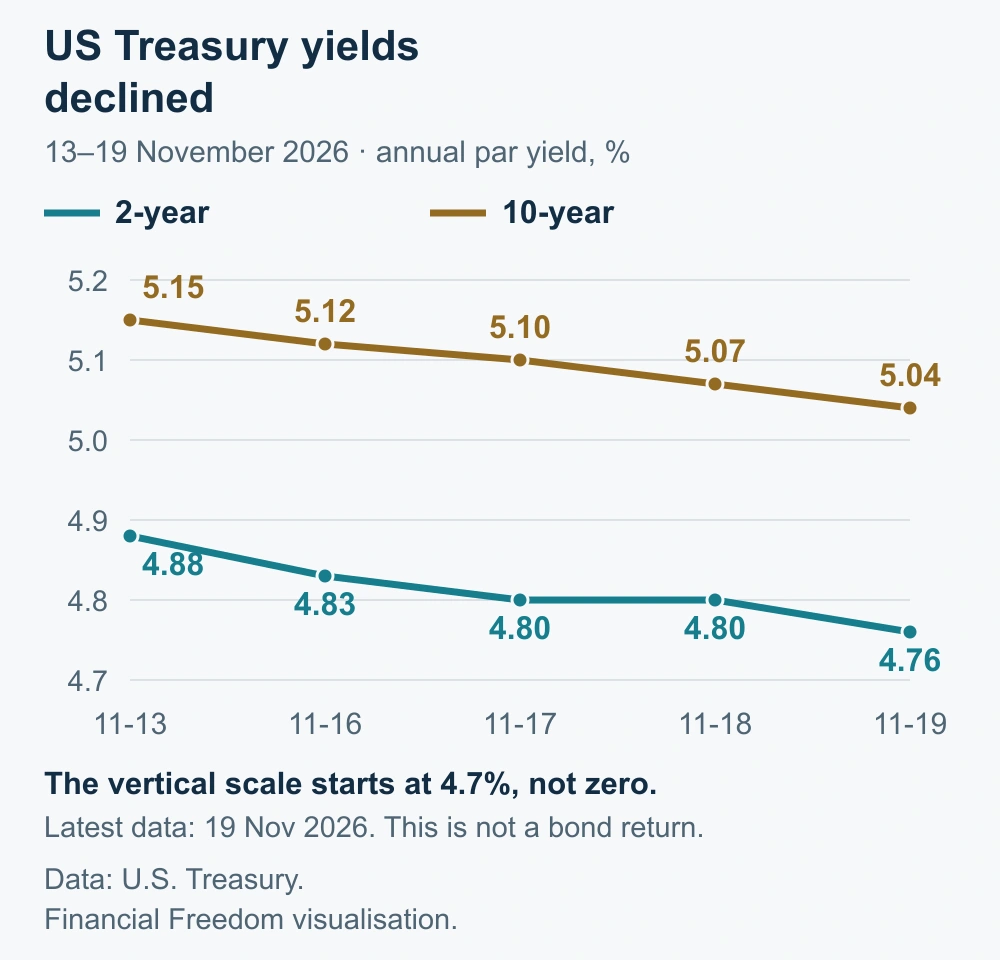
The US 10-year Treasury bond yield fell from 5.07% to 5.04% on 19 November; the 2-year yield declined from 4.80% to 4.76%. Equities therefore fell while safer debt offered a lower yield. This combination can occur when investors value dependable payments more highly and become less confident about companies’ future profits.
The Federal Reserve’s minutes, published on 18 November, highlighted a separate constraint. At the 27–28 October meeting, the target interest-rate range remained 3.75–4.00%, and almost all participants considered further increases likely appropriate under their baseline outlook. This was an earlier, conditional discussion, not an agreed December decision. The minutes do not include November data published after the meeting. Slower demand does not remove the need to watch price pressure.
For your investments
Let’s discuss your portfolio
 FINANCIAL FREEDOM01 / 04
Investment results since 1999
Are you beating
global equities?

at the end of the period
Jan 1999–Jun 2026 · EUR · Cumulative return, %
Linear scale · * MSCI World → MSCI ACWI.
Past performance does not guarantee future returns.
FINANCIAL FREEDOM02 / 04Historical comparison
How far did it fall?
How long to recover?
Decline from the previous high

Longest recovery to the previous high

Jan 1999–Jun 2026 · EUR · Monthly data
* MSCI World → MSCI ACWI.
Past performance does not guarantee future returns.
FINANCIAL FREEDOM03 / 04Personal investment consultation
Already investing?
Let’s review your portfolio.
Yet to start
investing?
Let’s build your first
investment plan.
FINANCIAL FREEDOM04 / 04
Personal investment
consultation
Martynas
Juška
Investment manager
Managing a portfolio
of more than€100 million
Fewer orders do not necessarily mean lower costs
In the Philadelphia regional manufacturing survey released on 19 November, the activity indicator fell from October’s 20.9 to 6.3 points; new orders fell from 4.3 to minus 0.4. The prices-paid indicator rose from 43.2 to 58.2. These are survey balance readings, not percentages of output growth or inflation.
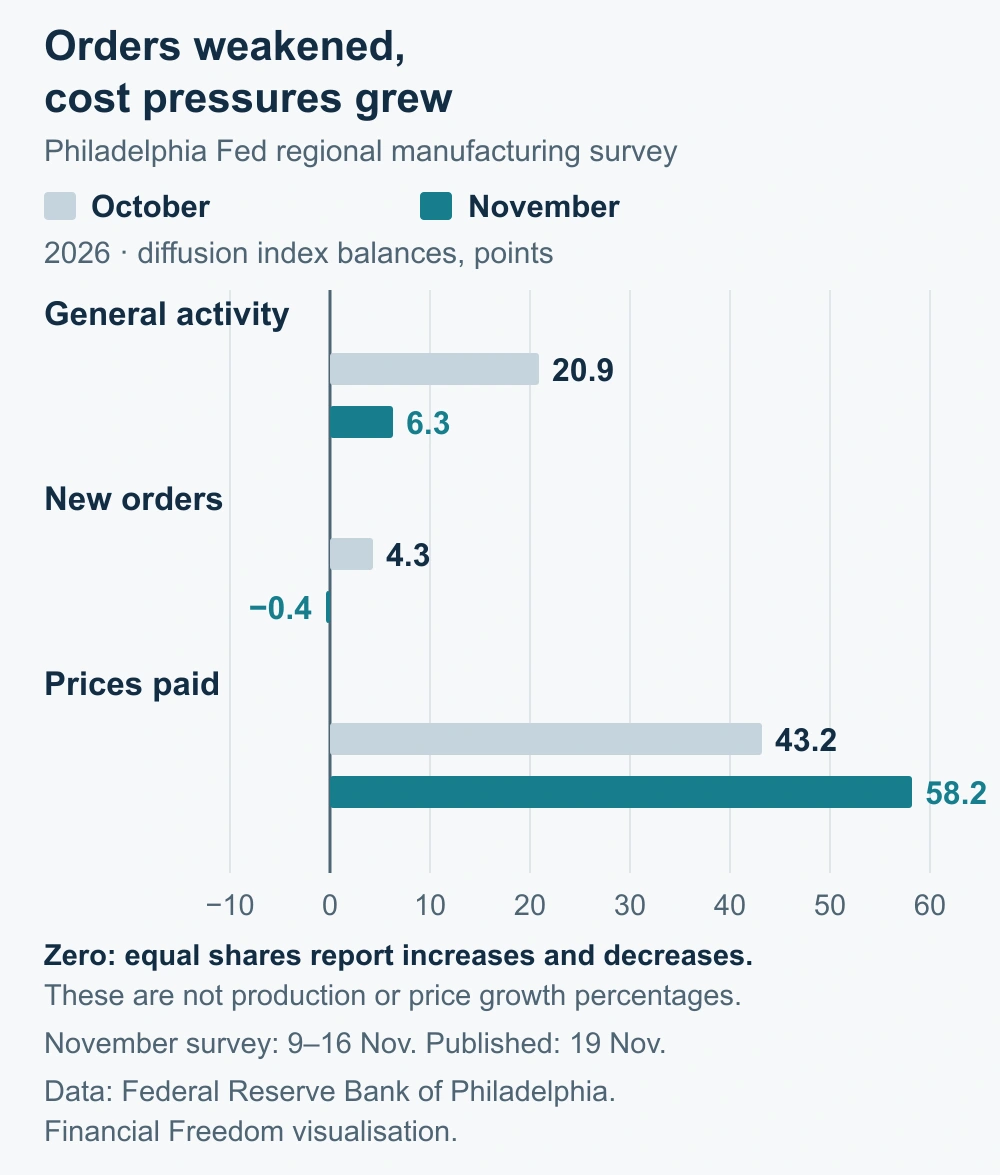
Responses were collected over 9–16 November. They do not show every factory contracting: shipment and employee-number indicators remained positive. But the survey illustrates a profit problem. If customers resist higher prices while materials become more expensive, the company has to absorb more of the increase itself.
Japan’s price data send a mixed message
Japan’s statistics bureau reported on 20 November that October annual inflation accelerated from 2.1% to 2.3%. Excluding fresh food and energy, however, it slowed from 2.4% to 2.2%. The higher headline reading therefore does not establish that prices are rising faster across all goods and services.
European bank buffers provide a counterweight, not a guarantee
In its supervisory assessment on 19 November, the European Central Bank reported an aggregate liquidity coverage ratio of 155% for supervised banks in the second quarter, against a 100% minimum. This describes the earlier quarter, not a measurement taken this week. Buffers help banks withstand funding stress, but do not prevent share-price falls or losses on loans.
Today
What matters now
Different assets depend on different sources of cash
Lower yields generally support existing fixed-rate government bonds. That alone is not enough for technology shares: their value also depends on customer demand and the profits left after investment spending. Corporate bonds add another question: can the borrower pay on time? A similar maturity does not make government debt and a weak company’s debt equivalent.
For an industrial business, an opportunity would arise if orders recovered before it needed to cut selling prices. The opposite risk is weak demand and costly materials squeezing profits together. Slower price growth excluding fresh food and energy would help Japanese households, but the overall basket is still becoming more expensive.
A Lithuanian investor’s result also depends on the dollar and yen against the euro, dividends, fund expenses and currency hedging. Investments listed in different countries can still carry the same economic risk; counting countries does not remove it.
Today
What comes next
20 November: the US session
Once US trading begins, investors can assess whether Thursday’s selling and Japan’s decline develop into a broader downturn. The question is not only where equities go, but whether lower government-bond yields persist.
25 November: a revised view of US growth
The second estimate of third-quarter gross domestic product will help assess how demand supported growth. The Federal Reserve’s meeting on 8–9 December addresses a different question: whether to change the interest-rate range.
Important. This is general market analysis, not a personal recommendation to buy or sell. Historical data and company results do not guarantee future returns. Forecasts and conditional scenarios may not materialise.
How is the history preserved and updated?
All five periods in this edition share one information date. Week means the latest 7 days, quarter means 90 days, and year means the trailing 12 months. The next dated edition will have a separate URL. This text keeps its date and assessment; later events are not silently inserted into an older edition. Longer periods assess new evidence alongside earlier developments without repeating every headline.