
Week · Market review
The sell-off spreads: lower yields do not ensure profits
During this seven-day window, doubts about future profits increased even as US government-bond yields fell. Monday’s Asian data showed a gap between business investment and consumption; later, a US survey highlighted cost pressures. Friday’s Japanese sell-off followed Thursday’s US decline. This is a rolling 14–20 November window, not the final account of a completed US trading week. Information cutoff: 20 November 2026, 10:00 Lithuanian time.
Period covered: 2026-11-14 – 2026-11-20Information as of 6 min read
Since the previous edition, the US has published October’s interest-rate meeting minutes and November’s manufacturing survey. Japan released October inflation on Friday, when its equity index fell 5.06%.
Business investment can support equipment suppliers’ sales before the owners of those investments earn enough revenue. Weaker consumption does not remove that timing gap.
Week
What happened
Monday: production and investment outpaced consumption
On 16 November, China reported 4.8% annual growth in October value added at larger industrial businesses, while the value of retail consumer-goods sales rose just 0.4%. The first measure removes price changes; the second uses current prices. They cannot simply be subtracted, but together they help distinguish manufacturers’ activity from buyers’ spending.
Japan’s first third-quarter estimate, released the same day, showed an almost unchanged real economy from the previous quarter. Private consumption fell 0.3%, while private non-residential investment increased 1.6%. This helps explain why an equipment producer can receive orders without retailers seeing an equally strong increase in consumer spending.
Tuesday: growth in US goods sales slowed
On 17 November, the US Census Bureau reported monthly growth of 0.2% in October retail and food-service sales, following September’s 0.8%. These sales are seasonally adjusted, but not inflation-adjusted, and do not cover every consumer service. The small advance monthly estimate has a margin of error that includes zero. It is therefore more accurate to describe a lower reported growth rate than a definite increase in the quantities bought.
Industrial production showed a 0.4% monthly decline, although manufacturing output rose 0.3%. Other activities pulled down the overall reading. One weak aggregate therefore does not establish an equal decline in orders at every factory.
Wednesday: an earlier interest-rate debate became public
The Federal Reserve published minutes of its 27–28 October meeting on 18 November. The target interest-rate range remained 3.75–4.00%, but almost all participants considered further increases likely appropriate under their baseline outlook. The minutes reflect information available then. They are not a new Wednesday increase and cannot include November data published afterwards.
The week’s question remained specific: would demand weaken faster than companies’ cost pressures eased? If so, businesses would struggle both to increase sales and to preserve profits, while the central bank could not yet regard inflation as resolved. Thursday’s new manufacturing survey added evidence to this tension.
Thursday: orders and costs moved in different directions
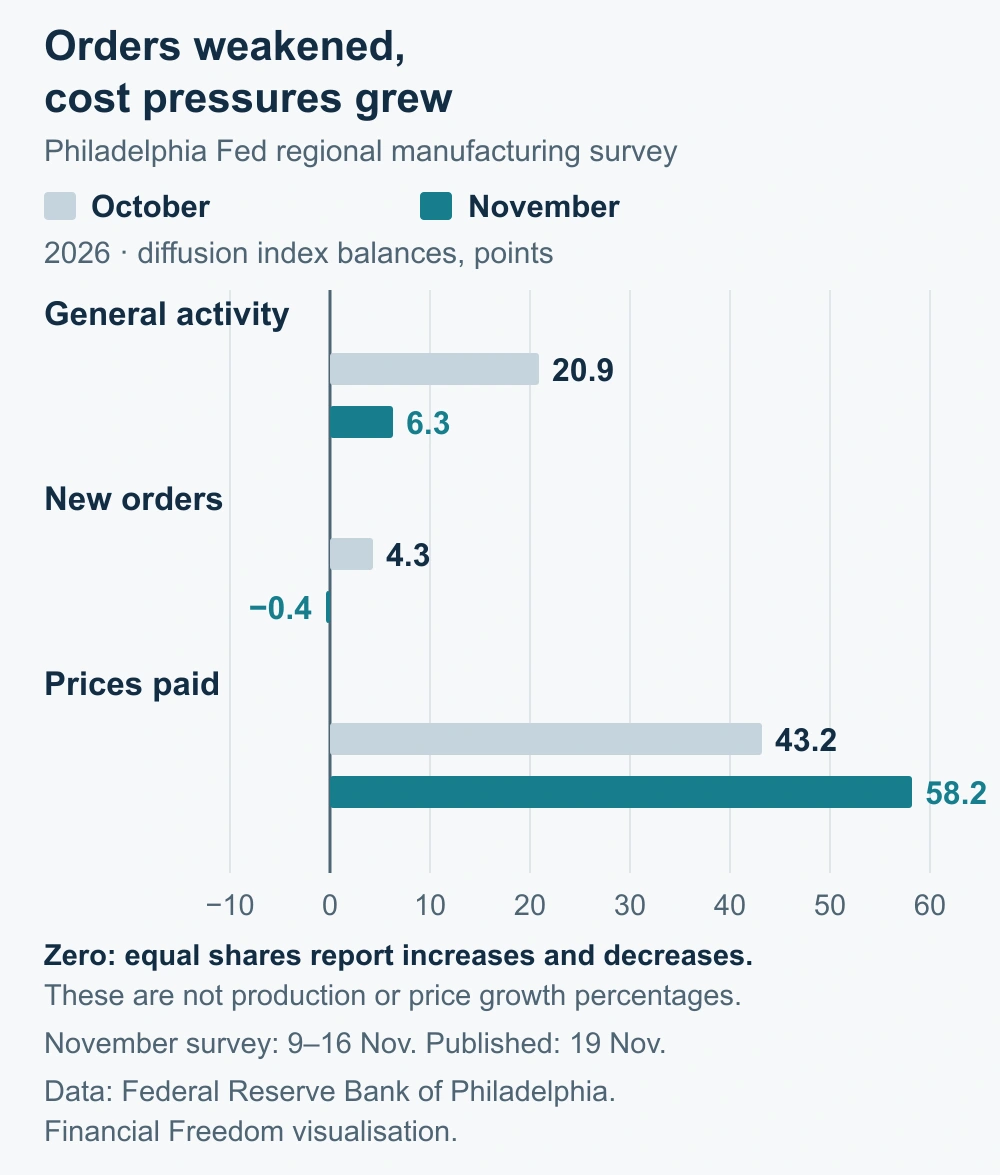
In Philadelphia’s November regional manufacturing survey, the activity indicator fell from 20.9 to 6.3 points and new orders from 4.3 to minus 0.4; prices paid rose from 43.2 to 58.2. Each reading is a survey balance. Responses were collected over 9–16 November and the report was released on 19 November.
For your investments
Let’s discuss your portfolio
 FINANCIAL FREEDOM01 / 04
Investment results since 1999
Are you beating
global equities?

at the end of the period
Jan 1999–Jun 2026 · EUR · Cumulative return, %
Linear scale · * MSCI World → MSCI ACWI.
Past performance does not guarantee future returns.
FINANCIAL FREEDOM02 / 04Historical comparison
How far did it fall?
How long to recover?
Decline from the previous high

Longest recovery to the previous high

Jan 1999–Jun 2026 · EUR · Monthly data
* MSCI World → MSCI ACWI.
Past performance does not guarantee future returns.
FINANCIAL FREEDOM03 / 04Personal investment consultation
Already investing?
Let’s review your portfolio.
Yet to start
investing?
Let’s build your first
investment plan.
FINANCIAL FREEDOM04 / 04
Personal investment
consultation
Martynas
Juška
Investment manager
Managing a portfolio
of more than€100 million
Shipment and employee-number indicators remained positive. That exception matters: the survey does not establish a contraction across all US manufacturing. It shows that production continues for some businesses, while adjusting selling prices to higher expenses can become more difficult.
By Friday morning: cheaper equities and lower yields
The Nasdaq Composite fell 5.00% from its 13 November close of 25,136.27 to 23,879.20 on 19 November. Thursday alone accounted for a 2.25% decline. This is a US-dollar price change excluding dividends; Friday’s US result is not included. Japan’s Nikkei 225 had already closed on 20 November at 56,436.65 points, down 5.06% from the previous session.
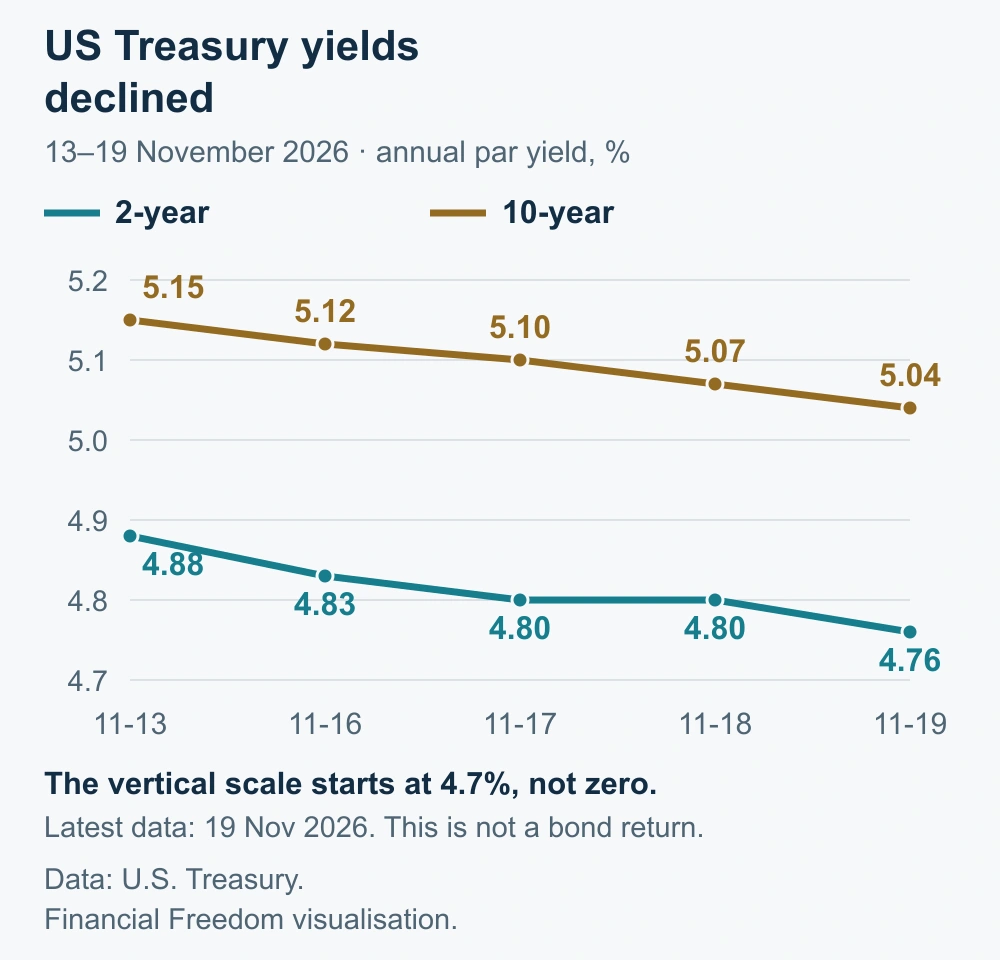
The US 10-year Treasury bond yield declined from 5.15% to 5.04% over 13–19 November; the 2-year yield fell from 4.88% to 4.76%. Equities falling alongside yields is a reminder that borrowing costs are only part of the valuation. Investors also need to assess how much a company will actually earn.
Friday’s Japanese inflation did not support a simple conclusion
October annual inflation, released on 20 November, rose from 2.1% to 2.3%. Excluding fresh food and energy, however, it fell from 2.4% to 2.2%. The overall basket and the narrower measure moved in opposite directions. These figures alone neither promise a new Japanese interest-rate decision nor explain the entire day’s equity decline.
Week
What matters now
Distinguish the supplier from its customer
Industrial-equipment and technology suppliers can earn revenue from today’s investment. Their customers still need the income that pays for equipment, electricity and borrowing. If consumption and final demand for services lag newly installed capacity, suppliers’ orders could weaken later. Shares in different businesses can therefore depend on the same spending programme.
Government bonds can offset equity risk when yields fall. Bonds issued by heavily indebted companies are not the same offset: a weaker business raises the risk of delayed payments. Stabilising orders alongside slower cost growth would provide an opportunity for equities; a lower market price alone does not prove it.
Europe also shows signs of resilience
In the European Central Bank’s 19 November assessment, supervised banks’ aggregate liquidity coverage ratio was 155% in the second quarter, compared with a 100% minimum. These buffers counter funding stress; they do not guarantee that bank shares cannot fall. European exporters still depend on US and Asian demand, while currency changes additionally affect an investor measuring foreign assets in euros.
Week
What comes next
20 November: the last US session of the week
It will show how Thursday’s decline and Friday’s Japanese result affect the week’s finish. Before that session closes, this rolling seven-day window cannot be presented as the result of a completed trading week.
25 November and 8–9 December: demand, then interest rates
The second estimate of US third-quarter gross domestic product will refine the picture of demand. The later Federal Reserve meeting will decide on interest rates. Philadelphia’s next survey, on 17 December, will test whether November’s divergence between orders and costs persists.
Important. This is general market analysis, not a personal recommendation to buy or sell. Historical data and company results do not guarantee future returns. Forecasts and conditional scenarios may not materialise.
How is the history preserved and updated?
All five periods in this edition share one information date. Week means the latest 7 days, quarter means 90 days, and year means the trailing 12 months. The next dated edition will have a separate URL. This text keeps its date and assessment; later events are not silently inserted into an older edition. Longer periods assess new evidence alongside earlier developments without repeating every headline.