
30 days · Market review
30 days: a rate pause followed by another equity sell-off
Japan’s equity decline on 20 November extended the previous day’s sell-off in US technology shares. Over the past 30 days, equipment sales grew, but borrowing did not become cheaper everywhere and consumer demand lagged some investment. What matters is not just rising revenue, but what remains after operating and debt costs. Information cutoff: 20 November 2026, 10:00 Lithuanian time.
Period covered: 2026-10-22 – 2026-11-20Information as of 8 min read
Following the Federal Reserve minutes released on 18 November, a new US manufacturing survey showed weaker orders and more widespread cost increases. The equity sell-off also reached Japan.
The US target range retained on 28 October remains 3.75–4.00%. Data-centre equipment suppliers’ sales do not, by themselves, establish the returns earned by their customers.
30 days
What happened
Interest rates took different directions at the end of October
On 28 October, the US Federal Reserve retained its 3.75–4.00% target range, while the Bank of Canada raised its rate by a quarter of a percentage point to 2.50%. The European Central Bank kept its deposit rate at 2.50% on 29 October. It also warned that a prolonged increase in energy costs could raise inflation and reduce growth.
The Bank of Japan retained its 1.25% policy rate on 30 October and announced that it would accelerate sales of its exchange-traded-fund holdings from January 2027. That was a future change in the pace of disposals, not additional sales already completed in November. Australia raised its rate to 4.85% on 3 November and the United Kingdom to 4.00% on 5 November; both increases were 0.25 percentage points.
Shares fell in early November, while employment provided a counterweight
On 5 November, the US S&P 500 price index declined 4.36% in one session, and Japan’s Nikkei 225 fell 5.96% on 6 November. These are separate daily price changes in US dollars and yen, not returns for this whole month. They showed that geographic equity diversification does not provide protection from broadly cautious investors.
The US October employment report released on 6 November also showed 165,000 additional non-farm payroll jobs and unemployment of 4.1%. The foundation for household income had not visibly collapsed. Falling share prices alone therefore did not establish that the central bank would need to cut interest rates urgently.
The 10 November price release left the interest-rate question open
US October monthly consumer-price growth was 0.4%, following 0.6% in September. However, prices excluding food and energy increased 0.3% for a third consecutive month. The headline pace slowed, but persistent price pressure had not disappeared. That matters for households’ purchasing power and businesses’ ability to pass increased expenses on to customers.
Equipment suppliers’ growth differed from their customers’ financing
On 10 November, US computing-infrastructure provider CoreWeave reported a striking third-quarter gap: operating profit was US$207 million, while net interest expense reached US$846 million.
German industrial-technology company Siemens reported on 12 November that July–September Smart Infrastructure orders rose 40% year on year and revenue increased 16%. Data-centre demand in the United States and Europe supported the business, although US tariff refunds also helped profit. This was strong demand at one stage of the supply chain, not uniform profitability across all projects.
Europe paid more for energy while Asian consumption lagged
Eurostat reported on 13 November that the euro area’s September goods-trade deficit was €10.3 billion, compared with a €13.5 billion surplus a year earlier. The energy-trade deficit widened from €20.7 billion to €33.0 billion. These are nominal amounts, not simply changes in imported quantities. A larger energy bill leaves less money for other purchases and investment.
China’s October figures released on 16 November showed industrial value added rising 4.8% year on year, but retail sales of consumer goods growing just 0.4%. The first measure is real and the second nominal. Japan’s third-quarter real GDP, published the same day, was almost unchanged from the previous quarter: consumption fell 0.3%, while private non-residential investment increased 1.6%.
At 23:20 Lithuanian time on 17 November, after the US market close, US chip designer NVIDIA reported revenue of US$115.8 billion for the quarter ended 25 October, 103% more than a year earlier. This is new confirmation that technology-infrastructure expansion is turning into supplier sales; the return on its customers’ investment remains a separate question.
For your investments
Let’s discuss your portfolio
 FINANCIAL FREEDOM01 / 04
Investment results since 1999
Are you beating
global equities?

at the end of the period
Jan 1999–Jun 2026 · EUR · Cumulative return, %
Linear scale · * MSCI World → MSCI ACWI.
Past performance does not guarantee future returns.
FINANCIAL FREEDOM02 / 04Historical comparison
How far did it fall?
How long to recover?
Decline from the previous high

Longest recovery to the previous high

Jan 1999–Jun 2026 · EUR · Monthly data
* MSCI World → MSCI ACWI.
Past performance does not guarantee future returns.
FINANCIAL FREEDOM03 / 04Personal investment consultation
Already investing?
Let’s review your portfolio.
Yet to start
investing?
Let’s build your first
investment plan.
FINANCIAL FREEDOM04 / 04
Personal investment
consultation
Martynas
Juška
Investment manager
Managing a portfolio
of more than€100 million
The 18 November minutes explained why a rate pause is not a promise to cut
The Federal Reserve published minutes of its 27–28 October meeting. It had retained the 3.75–4.00% target range by ten votes to two; both dissenters wanted an increase. Almost all participants regarded a further increase as likely to be needed in their baseline scenario. This was an earlier discussion, not a new November decision: the December choice will also depend on subsequent data.
On 19 November, weaker orders coincided with higher costs
The Philadelphia manufacturing survey index declined from October’s 20.9 to 6.3 points in November. New orders fell from 4.3 to −0.4, while prices paid rose from 43.2 to 58.2. Responses were collected on 9–16 November. This is an uncomfortable combination for a manufacturer unable to pass more expensive inputs on through its selling prices.
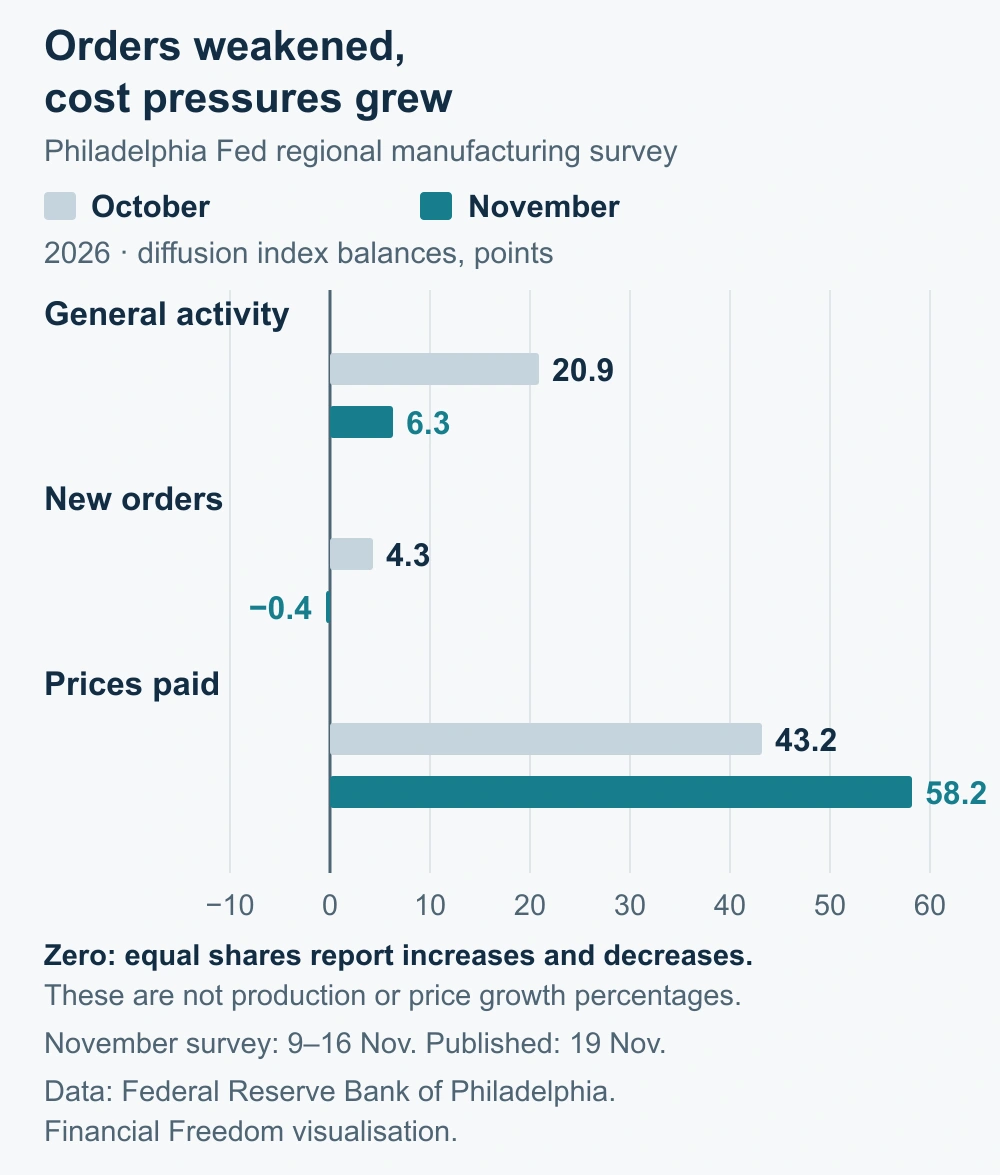
Shipment and employment indices remained positive at the same time. The survey therefore cannot be read as an established decline in manufacturing across the US. It identifies a more specific risk: weaker new orders and less scope to protect profits if costs continue to rise.
On 20 November, Japanese shares fell while inflation measures diverged
Following a 2.25% decline in the US Nasdaq Composite on 19 November, Japan’s Nikkei 225 closed 5.06% below its previous session on 20 November. These are separate-session price-index changes in dollars and yen, excluding dividends, not a euro portfolio return over this review period. Friday’s US trading had not begun by the information cutoff.
That morning, Japan released October consumer-price figures. Annual headline growth accelerated from September’s 2.1% to 2.3%, but slowed from 2.4% to 2.2% excluding fresh food and energy. Price pressure was therefore not increasing uniformly. This release is not a new Bank of Japan rate decision, and its timing alone does not establish that it caused the entire equity decline.
30 days
What matters now
Bond prices and corporate profits do not depend on exactly the same things
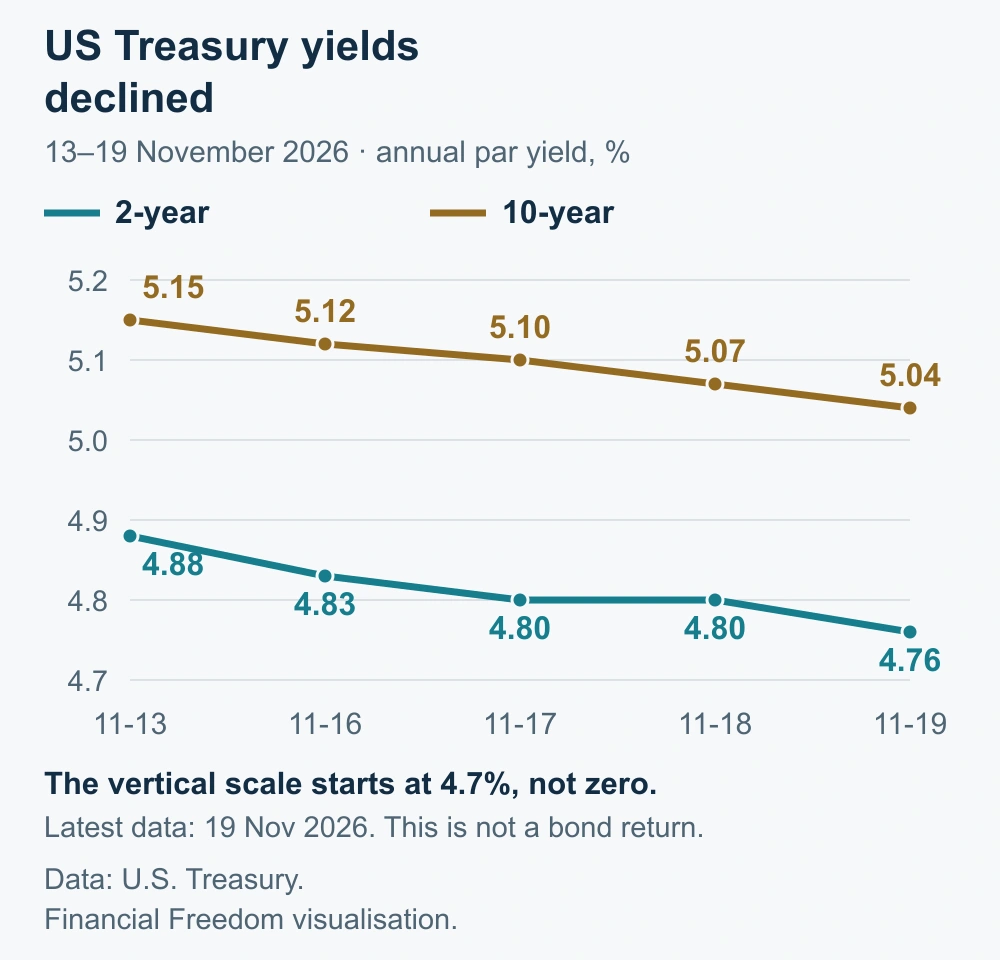
US Treasury yields continued to decline on 19 November: the two-year yield was 4.76% and the ten-year yield was 5.04%. Their respective levels on 13 November were 4.88% and 5.15%. Lower market yields generally support previously issued fixed-rate bonds, but a technology share still needs sufficient future earnings.
Which part of the expansion receives cash, and which spends it?
For technology and electrical-equipment manufacturers’ shares, order volumes and profitable delivery matter. For data-centre operators’ shares and bonds, service usage, customer payments and debt burdens are important. An opportunity emerges when demand grows faster than additional costs. Risk increases when extra revenue can only be achieved by borrowing still more.
Energy producers and energy-intensive industrial businesses also face different conditions. More expensive commodities can increase the former’s revenue but are a cost for transport or chemical companies. If a business cannot increase its selling price, the difference reduces profit. Long-term energy contracts may delay the effect without necessarily removing it.
Portfolio diversification needs to cover more than country names
Several equity funds can own the same technology suppliers or depend on the same investment in data centres. Bond maturity, the borrower’s ability to repay and currency help reveal additional risks. Longer-dated fixed-rate bonds generally react more strongly to changes in yields, while exchange rates also affect the value of dollar assets for a euro-based investor.
European banks’ capital provides an important counterweight to financing concerns. On 19 November, the ECB announced total capital requirements and guidance of 15.7% of risk-weighted assets for 2027, while the actual ratio using the same capital definition stood at 20.1% in the second quarter of 2026. This buffer can help absorb losses, but does not protect bank shares against falling prices or future bad loans.
30 days
What comes next
20 November US trading: will the selling continue?
The US session had not begun by the information cutoff. It will show whether US shares remain under pressure after Japan’s decline and whether falling Treasury yields continue to provide a counterweight. A single Friday will not establish a lasting reversal.
25 November US economic estimate: how strong is demand?
The US Bureau of Economic Analysis will publish its second estimate of third-quarter gross domestic product. The key question is whether revisions change the assessment of consumption and investment: spending by final customers will help determine the use of capacity being built today.
The 8–9 December Fed meeting and 17 December manufacturing survey
The US central bank will decide whether to change its target range. The following Philadelphia survey will test whether weaker orders and rising costs have persisted. Stronger demand without another jump in costs would provide a clearer earnings outlook than a share-price rebound alone.
Important. This is general market analysis, not a personal recommendation to buy or sell. Historical data and company results do not guarantee future returns. Forecasts and conditional scenarios may not materialise.
How is the history preserved and updated?
All five periods in this edition share one information date. Week means the latest 7 days, quarter means 90 days, and year means the trailing 12 months. The next dated edition will have a separate URL. This text keeps its date and assessment; later events are not silently inserted into an older edition. Longer periods assess new evidence alongside earlier developments without repeating every headline.