
Today · Market review
US prices squeeze shoppers as chipmakers grow
On 14 October, the US reported faster September price growth, while the purchasing power of hourly pay fell. Today, 15 October, Taiwan’s chipmaker TSMC reported a much larger quarterly profit. These are two different sides of the market: households face tighter budgets, while technology investment continues to lift revenue for some businesses.
Period covered: 2026-10-15Information as of 5 min read
US annual inflation rose from 3.4% to 3.7%. New ASML and TSMC results showed growing revenue in the semiconductor industry.
The Federal Reserve’s September target range of 3.75–4.00% remains in force. Its next decision is scheduled for 28 October.
Today
What happened
US shoppers have less purchasing power for other spending
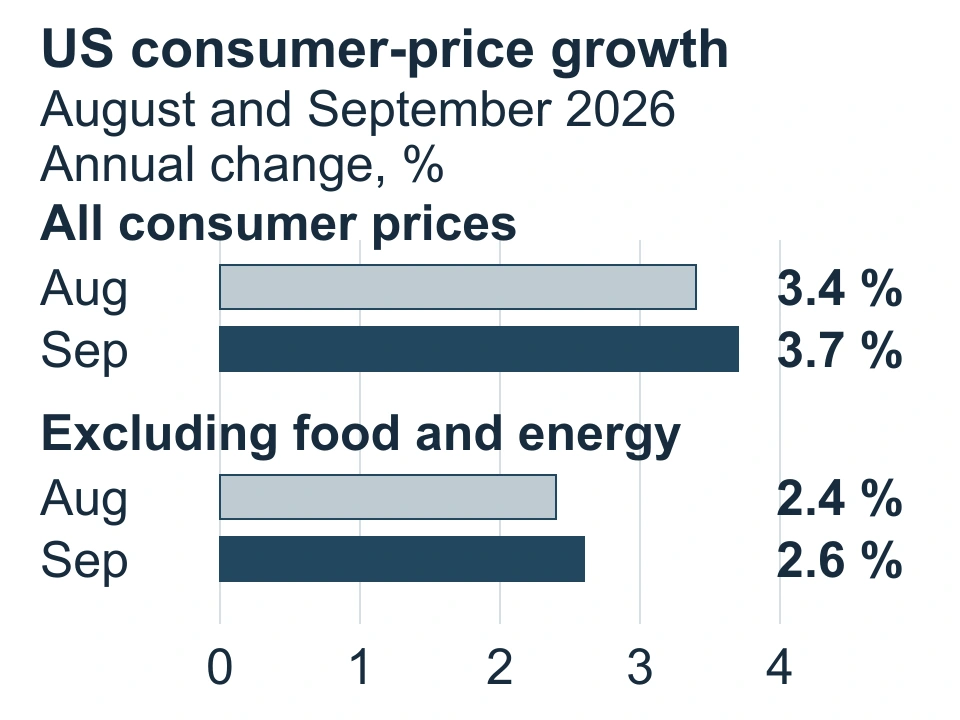
On 14 October, the US Bureau of Labor Statistics reported that September consumer prices were 3.7% higher than a year earlier. Annual growth had been 3.4% in August. Excluding food and energy, the increase also accelerated, from 2.4% to 2.6%.
? Consumer Price Index: what does it measure?
The Consumer Price Index measures changes in the price of an average basket of goods and services. The annual comparison with the same month a year earlier is not seasonally adjusted, while the monthly changes quoted here are adjusted. Excluding food and energy helps examine other prices but does not describe a household’s entire bill.
Petrol delivered the largest monthly shock. It became 9.1% more expensive in September and accounted for more than half of the overall monthly price increase. The full basket rose 0.6% from August, while monthly growth excluding food and energy remained 0.3%. Annual inflation therefore accelerated even though monthly growth in the basket excluding food and energy did not accelerate.
Pay figures published the same day showed the practical consequence. Average hourly earnings in US private nonfarm jobs rose 0.1% in September, but their purchasing power fell 0.5% after adjusting for prices. That can constrain discretionary spending: a larger share of pay is needed for the same fuel and everyday expenses.
? Purchasing power of pay: whose change is measured?
This is the change in average hourly earnings adjusted for consumer prices; the monthly figures are seasonally adjusted. It is not every individual’s pay, and the August and September earnings estimates remain preliminary.
Oil supply recovers while fuel constraints remain
On 14 October, the International Energy Agency estimated that global oil supply rose by 2.5 million barrels a day in September to 102.3 million. That was roughly 2.5% more than in August. Delivering crude and turning it into the required fuel are different steps, however, and diesel supply remains constrained.
For your investments
Let’s discuss your portfolio
 FINANCIAL FREEDOM01 / 04
Investment results since 1999
Are you beating
global equities?

at the end of the period
Jan 1999–Jun 2026 · EUR · Cumulative return, %
Linear scale · * MSCI World → MSCI ACWI.
Past performance does not guarantee future returns.
FINANCIAL FREEDOM02 / 04Historical comparison
How far did it fall?
How long to recover?
Decline from the previous high

Longest recovery to the previous high

Jan 1999–Jun 2026 · EUR · Monthly data
* MSCI World → MSCI ACWI.
Past performance does not guarantee future returns.
FINANCIAL FREEDOM03 / 04Personal investment consultation
Already investing?
Let’s review your portfolio.
Yet to start
investing?
Let’s build your first
investment plan.
FINANCIAL FREEDOM04 / 04
Personal investment
consultation
Martynas
Juška
Investment manager
Managing a portfolio
of more than€100 million
The chip industry grows, but not every profit measure improves
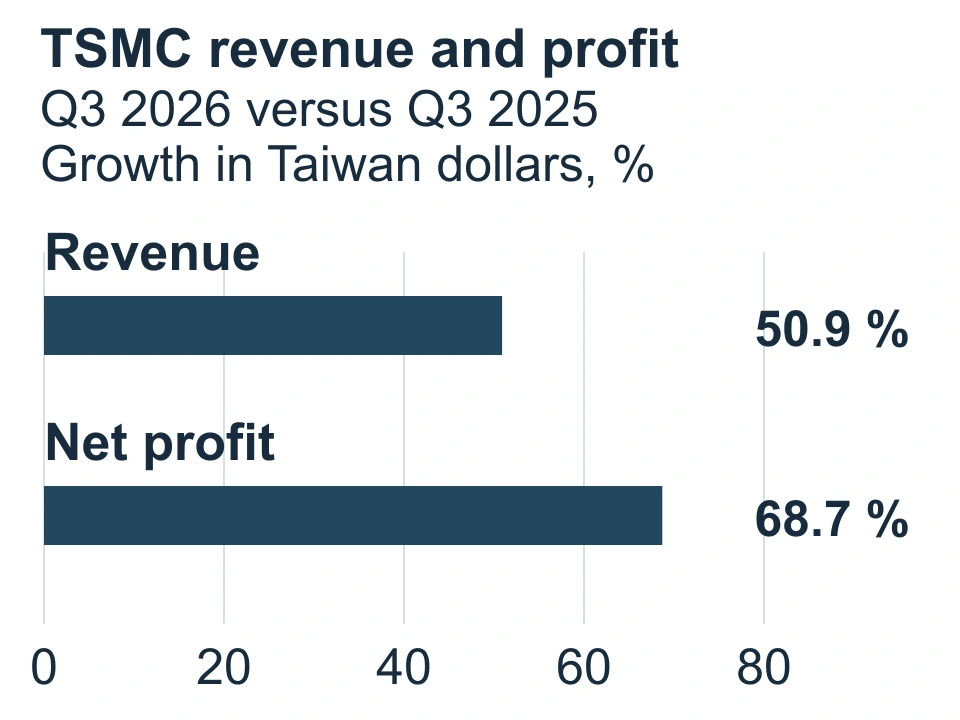
On 15 October, Taiwan’s TSMC, which manufactures chips designed by other companies, reported its third-quarter results. Revenue in Taiwan dollars rose 50.9% year on year and net profit increased 68.7%. In US dollars, TSMC’s sales grew 41.2%: translating into another currency changes the reported growth rate.
TSMC’s gross profit margin nevertheless fell from 67.7% in the second quarter to 66.4% in the third. Rapid sales growth does not automatically mean that each dollar of revenue produces more gross profit. The margin was 59.5% a year earlier, so the annual and quarterly comparisons tell different stories.
? Gross profit margin: what does it show?
It is the share of revenue left after the cost of producing the goods sold. It excludes some operating expenses, taxes and investment, so it is not a measure of net profit or available cash.
On 14 October, Dutch chipmaking-equipment supplier ASML reported quarterly sales of 11.66 billion euros, around 55% higher than a year earlier. Sales of both equipment and chips point to strong demand across this industry. However, ASML’s 4.96 billion euros of net profit included about 0.51 billion euros of gains on an equity investment; the entire increase cannot be attributed to equipment sales.
Today
What matters now
More expensive fuel first reduces the amount households can spend elsewhere. That creates risks for discretionary retailers and consumer lenders. Everyday-goods businesses may prove more resilient, but they too must judge how much of their higher delivery costs customers will accept. Today’s retail-sales release will help test whether the squeeze is already visible in sales.
The bond market did not move in a single direction after the US price release. On 14 October, the reference 2-year US Treasury yield rose from the previous day’s 4.79% to 4.82%, while the 10-year yield fell from 5.21% to 5.19%. Persistent inflation makes rate cuts harder, but longer-dated bonds also depend on expectations for future growth.
? Bond yield: is it a realised return?
The US Treasury measure is derived from indicative bond quotations and expressed as an annualised yield. It is not a fund’s daily return; these data establish the movement but do not identify its cause on their own.
Technology investment provides a counterweight to weaker household purchasing power. Chip and equipment suppliers receive orders, but their customers need costly equipment to generate enough money later. Chipmaker shares and the bonds of companies financing data centres are therefore different exposures. Growing revenue creates an opportunity; the main risk arises when expansion and debt increase faster than cash generated by operations.
Today
What comes next
15 October, 15:30 Lithuanian time: US September retail sales and producer prices. The former will show the value of sales; the latter will test whether price pressure is also visible among producers. Any sales increase must be assessed alongside inflation, as sales dollars are not the quantity of goods sold.
16 October, 15:30: US September import and export prices. They will help assess how much cost pressure is coming through international trade.
27–28 October: the Federal Reserve meeting. The question is whether faster inflation outweighs the risk of weaker demand and requires another change in interest rates.
Important. This is general market analysis, not a personal recommendation to buy or sell. Historical data and company results do not guarantee future returns. Forecasts and conditional scenarios may not materialise.
How is the history preserved and updated?
All five periods in this edition share one information date. Week means the latest 7 days, quarter means 90 days, and year means the trailing 12 months. The next dated edition will have a separate URL. This text keeps its date and assessment; later events are not silently inserted into an older edition. Longer periods assess new evidence alongside earlier developments without repeating every headline.