
Today · Market review
US shares rebounded, but Korea’s KOSPI fell 3.73%
On 20 October, South Korea’s KOSPI closed 3.73% lower even though US technology shares had risen the previous day. Japanese shares also fell in the morning trading snapshot. For investors holding several regions, a rebound in one market does not establish that risks elsewhere have declined.
Period covered: 2026-10-20Information as of 5 min read
After the US rebound on 19 October, Korea’s KOSPI closed 3.73% lower on 20 October. Chinese and Canadian data added to the picture: headline growth or inflation masked very different directions among their components.
Stronger production does not remove weak consumer demand. Technology companies’ earnings prospects and the price investors pay for their shares still need separate assessment.
Today
What happened
Korean shares fell despite the previous US rebound
On 20 October, South Korea’s main KOSPI index closed at 5,552.74 points, down 3.73% on the day. The KOSDAQ index fell 3.33% to 781.97 points. In its daily review compiled at 09:45 Lithuanian time, the exchange linked the KOSPI decline to concerns about artificial-intelligence profitability and financing, and the international situation. This is the exchange’s market interpretation, not proof that every seller had the same motive.
On 19 October, the US Nasdaq Composite equity index rose 1.11%, while the Nasdaq-100 index of large non-financial companies gained 1.17%. The PHLX Semiconductor index advanced 1.61%. These are results from the previous US trading day, not changes during the 20 October US session.
At 09:25 Lithuanian time on 20 October, Japan’s Nikkei 225 stood at 64,037.26 points, 1.35% below its previous close. The Nikkei Semiconductor Stock Index was down 2.82% at that point. These were intraday readings, not Japan’s final daily result. They show that companies in similar businesses were not moving in the same direction across markets that morning.
Index changes alone do not establish why investors bought or sold. Nor do they show a euro investor’s return: that would require the particular fund’s holdings, fees and currency movement.
Chinese production grew much faster than consumer sales
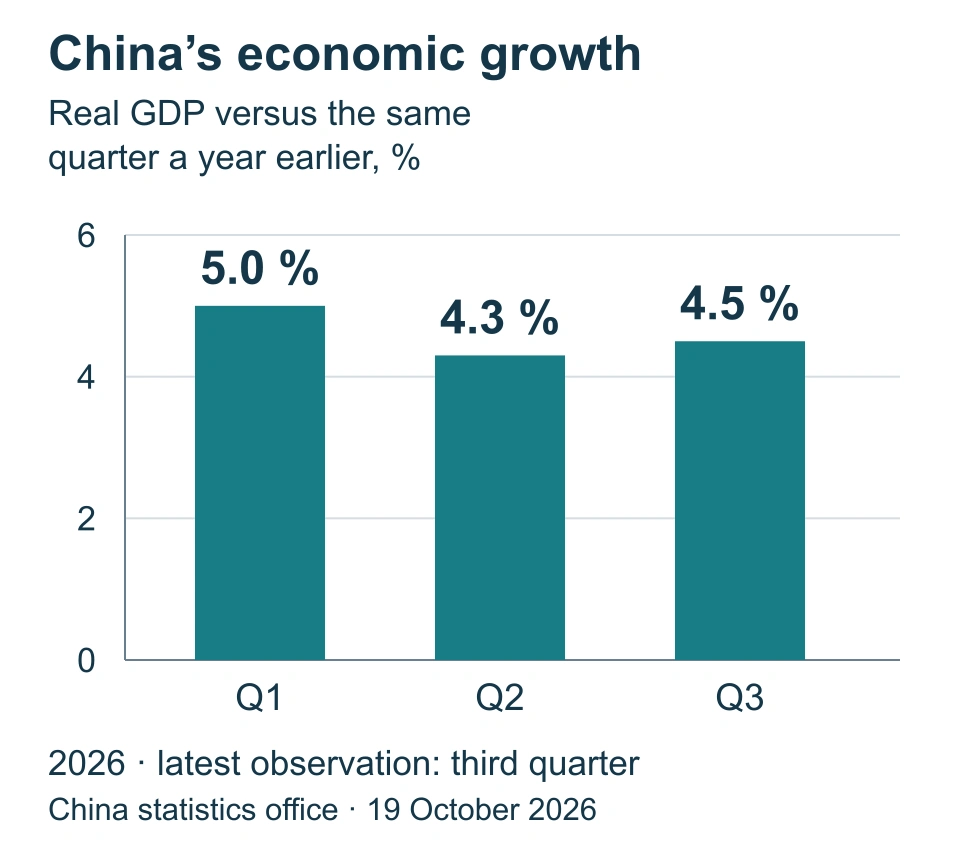
On 19 October, China’s statistics office reported that real gross domestic product in the third quarter was 4.5% higher than a year earlier. Growth had been 4.3% in the second quarter. In September, value added by industrial enterprises meeting the specified size threshold increased 5.5% year on year, but retail sales grew only 1.1%. Industrial value added is adjusted for price changes, whereas sales are reported at current prices; these are not identically calculated measures of volume.
For your investments
Let’s discuss your portfolio
 FINANCIAL FREEDOM01 / 04
Investment results since 1999
Are you beating
global equities?

at the end of the period
Jan 1999–Jun 2026 · EUR · Cumulative return, %
Linear scale · * MSCI World → MSCI ACWI.
Past performance does not guarantee future returns.
FINANCIAL FREEDOM02 / 04Historical comparison
How far did it fall?
How long to recover?
Decline from the previous high

Longest recovery to the previous high

Jan 1999–Jun 2026 · EUR · Monthly data
* MSCI World → MSCI ACWI.
Past performance does not guarantee future returns.
FINANCIAL FREEDOM03 / 04Personal investment consultation
Already investing?
Let’s review your portfolio.
Yet to start
investing?
Let’s build your first
investment plan.
FINANCIAL FREEDOM04 / 04
Personal investment
consultation
Martynas
Juška
Investment manager
Managing a portfolio
of more than€100 million
On 20 October, China’s one-year loan prime rate was set at 3.0%, and the rate for loans over five years at 3.5%. These are reference rates used in bank loan pricing. An individual borrower’s interest rate also depends on the contract and the bank’s risk assessment, so neither figure is a loan price available equally to everyone.
Petrol pushed Canada’s headline price measure higher
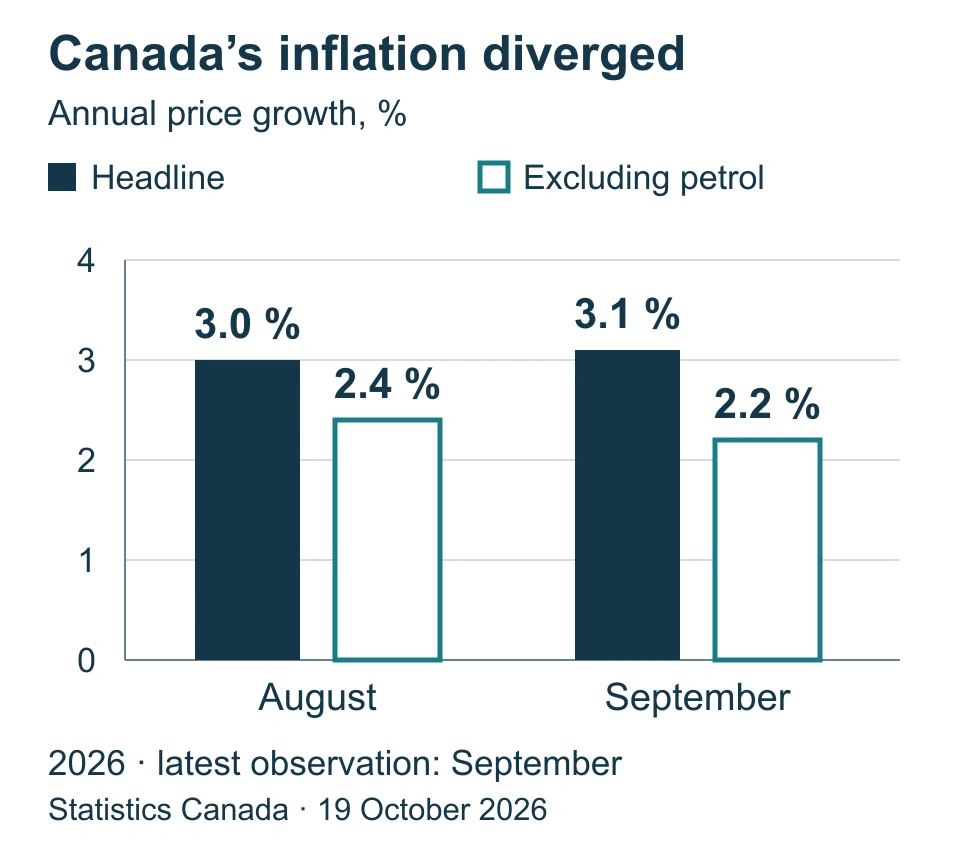
On 19 October, Statistics Canada reported that annual inflation in September had accelerated from 3.0% to 3.1%. Excluding petrol, however, price growth slowed from 2.4% to 2.2%. Petrol cost 27.8% more than a year earlier, compared with annual growth of 22.8% in August. The higher headline inflation rate therefore does not indicate uniformly stronger pressure across all prices.
? Annual inflation: which prices are being compared?
This compares a consumer price basket with the same month a year earlier, not with the previous month. The measure excluding petrol helps separate its influence but is not the same as a measure excluding all energy products.
Today
What matters now
Funds covering different regions can depend on the same customers
A portfolio holding US technology companies, Korean electronics businesses and Japanese semiconductor producers has a shared link to electronics and data-centre investment. When the same customers reduce orders, geographical diversity does not always mean different earnings risks. A Korean equity fund and a broader Asian fund will also depend on their individual company weights. An opportunity can arise where a lower share price accompanies firm orders and cash generation; a falling price alone does not establish that case.
Suppliers of industrial equipment to China may be in a different position from sellers of consumer goods or construction materials. The former depend on factory orders, while the latter need household purchases and new building activity. Someone assessing a Chinese equity fund or a European exporter should therefore ask which customers generate revenue, rather than rely only on the country’s headline economic growth rate.
More expensive fuel changes household spending and bond risks
For Canadian transport companies, petrol and other fuel prices matter through costs; for retailers, they matter through the money customers have left for discretionary purchases. Higher selling prices can help energy companies, but production, refining and financing costs still shape their profits. The overall consumer price index does not establish the profitability of each of these businesses.
For Canadian government bonds, the question is whether the central bank regards the petrol surge as temporary or sees it spreading to other prices. Expectations of higher interest rates for longer would put pressure on long-dated fixed-rate bond prices. Weaker demand would be a counterweight. For holdings without a currency hedge, changes in the Canadian dollar also affect the return measured in euros.
Today
What comes next
The US central bank meets on 27–28 October. Its decision will help show how it balances price pressures against economic activity and labour-market conditions.
On 28 October, the Bank of Canada will announce its interest-rate decision and an updated economic assessment. The main question is whether slowing price growth elsewhere will outweigh more expensive petrol.
Important. This is general market analysis, not a personal recommendation to buy or sell. Historical data and company results do not guarantee future returns. Forecasts and conditional scenarios may not materialise.
How is the history preserved and updated?
All five periods in this edition share one information date. Week means the latest 7 days, quarter means 90 days, and year means the trailing 12 months. The next dated edition will have a separate URL. This text keeps its date and assessment; later events are not silently inserted into an older edition. Longer periods assess new evidence alongside earlier developments without repeating every headline.