
Week · Market review
Technology sales grew, but financing costs did not disappear
The US Nasdaq Composite rose 1.60% on 11 November, while CoreWeave’s results added evidence of strong demand for artificial intelligence (AI) infrastructure. But the story of 6–12 November is not simply an equity recovery: US prices still support the risk of higher interest rates, and new SoftBank and Siemens figures show why equipment suppliers and project financiers can have different outcomes.
Period covered: 2026-11-06 – 2026-11-12Information as of 6 min read
The earlier US employment, price and TSMC sales figures have been joined by the completed 11 November equity session, CoreWeave’s financing costs and 12 November updates from SoftBank, Siemens and Japan’s producer-price statistics.
Resilient demand does not establish that the whole AI infrastructure expansion will pay for itself. The US policy-rate range remains 3.75–4.00%, and the size of any future increase has not been decided.
Week
What happened
At the start of the period, US employment countered recession fears
The US Bureau of Labor Statistics reported on 6 November that nonfarm payroll employment increased by 165,000 in October and unemployment was 4.1%. August and September payroll estimates were revised up by a combined 84,000. That supported the view that the foundation for household income had not suddenly collapsed.
Finding another job is nevertheless difficult for some people. Those unemployed for more than six months accounted for 27.6% of all unemployed people in October. Stronger overall employment supports consumer services but does not mean every household’s income is secure. A central bank also has more room to focus on inflation when unemployment is not rising rapidly.
Prices on 10 November showed why borrowing may not become cheaper
US consumer prices increased 0.4% in October from the previous month, following 0.6% in September. Excluding food and energy, growth remained 0.3%. The headline pace slowed, but persistent underlying price increases did not disappear. Federal Reserve Governor Christopher Waller argued for a December rate increase before the report on the same day; his position was not a decision by the full committee.
? Consumer Price Index: why use monthly changes here?
The index measures prices in a basket of consumer goods and services. These changes are measured against the previous month and adjusted for seasonality. The US Bureau of Labor Statistics has not published most October annual comparisons because the federal funding lapse left the relevant October 2025 survey data unavailable.
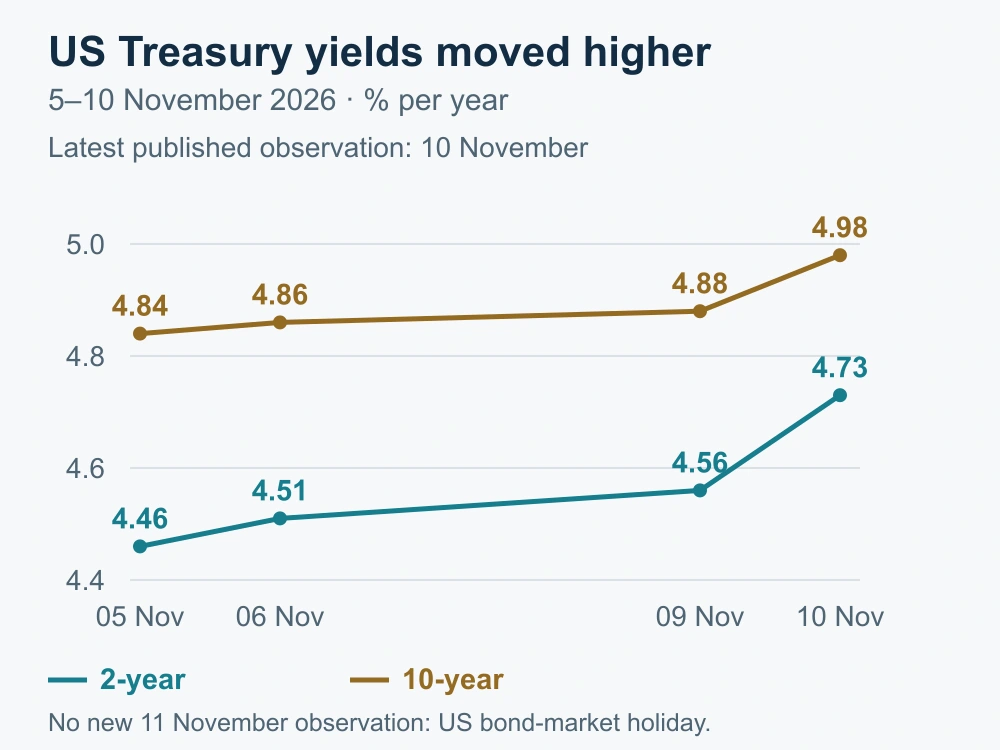
On 10 November, the two-year US Treasury yield rose from 4.56% to 4.73%, while the ten-year yield increased from 4.88% to 4.98%. This was a new development in financing conditions, although simultaneous equity and bond moves do not establish one explanation for all trading. There is no new official yield observation for 11 November because of Veterans Day.
Chip sales and cloud earnings answer different questions
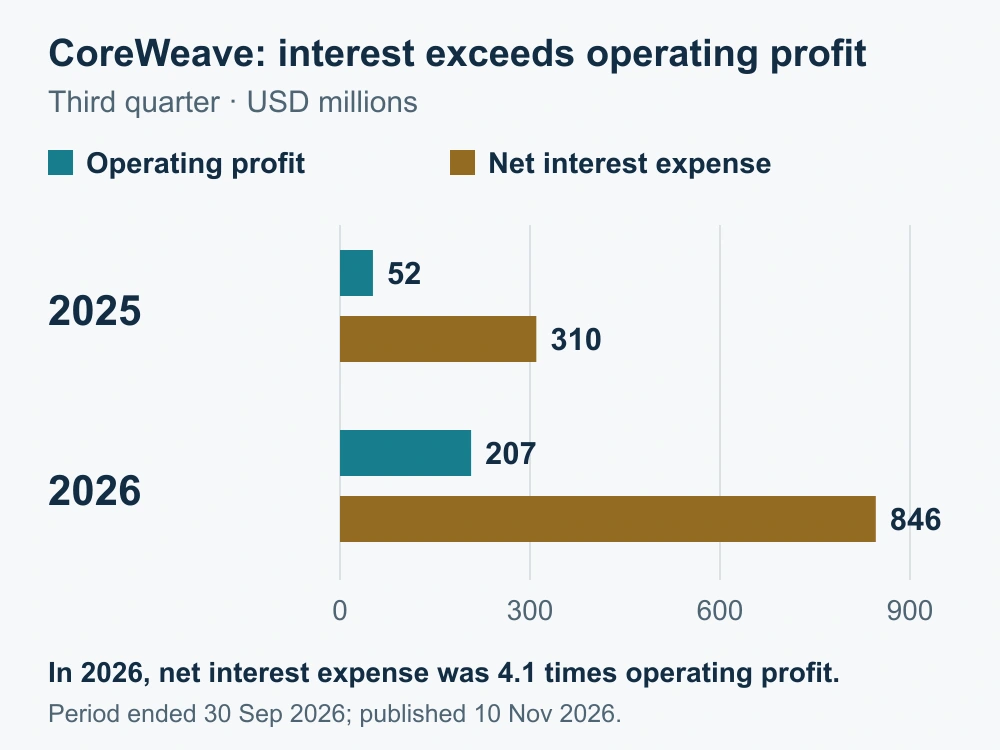
Taiwanese chip manufacturer TSMC reported October revenue of 586.89 billion New Taiwan dollars on 10 November, up 59.7% year on year. These are total company sales, not AI-only revenue or its customers’ profits. US AI computing provider CoreWeave reported another part of the chain on the same day: third-quarter revenue rose 168.2% to $3.661 billion, but operating income was only $207 million.
For your investments
Let’s discuss your portfolio
 FINANCIAL FREEDOM01 / 04
Investment results since 1999
Are you beating
global equities?

at the end of the period
Jan 1999–Jun 2026 · EUR · Cumulative return, %
Linear scale · * MSCI World → MSCI ACWI.
Past performance does not guarantee future returns.
FINANCIAL FREEDOM02 / 04Historical comparison
How far did it fall?
How long to recover?
Decline from the previous high

Longest recovery to the previous high

Jan 1999–Jun 2026 · EUR · Monthly data
* MSCI World → MSCI ACWI.
Past performance does not guarantee future returns.
FINANCIAL FREEDOM03 / 04Personal investment consultation
Already investing?
Let’s review your portfolio.
Yet to start
investing?
Let’s build your first
investment plan.
FINANCIAL FREEDOM04 / 04
Personal investment
consultation
Martynas
Juška
Investment manager
Managing a portfolio
of more than€100 million
CoreWeave’s quarterly net loss was $709 million. The gap explains why additional revenue alone does not establish that a project will pay for itself: equipment and electricity are needed before all customer payments arrive, while debt interest is due now. Suppliers’ order growth and operators’ financing risk can increase together.
Shares rebounded on 11 November, but Asia did not move uniformly on 12 November
The Nasdaq Composite closed 1.60% higher on 11 November than in the previous session. The New York Stock Exchange’s intraday commentary identified AI infrastructure companies after CoreWeave’s results as one source of strength. However, at 08:20 Lithuanian time on 12 November, Japan’s Nikkei 225 was 0.77% below its previous close. This was an intraday reading, not Japan’s final result; a US rebound does not describe every region.
The latest Japanese and German reports exposed different outcomes from expansion
In its updated 12 November slide, SoftBank showed $6.6 billion of equipment advances remaining as of 30 September after a $2.9 billion write-off. The group expects to recover $5.6 billion through the PORTS-Pike power-generation project: $3.4 billion in the near term and $2.2 billion by the end of 2027. Expected proceeds are not cash received; the underlying financial report was released on 10 November.
Germany’s Siemens reported on 12 November that July–September Smart Infrastructure orders increased 40% to €8.665 billion and profit rose from €1.166 billion to €1.468 billion compared with the same quarter of 2025. Data-centre orders in the United States and Europe were important, but US tariff refunds also supported profit. AI demand alone does not explain the entire change.
Meanwhile, the Bank of Japan reported on 12 November that producer goods prices increased 7.1% year on year in October, following 6.8% in September. That represents an additional cost risk for businesses unable to pass every increase on to customers. Producer goods prices are not Japan’s consumer inflation.
Week
What matters now
Separate the opportunity for growth from the responsibility for funding it
Expansion creates sales opportunities for chip and electrical-equipment suppliers. Data-centre operators and project investors also bear equipment depreciation, borrowing and customer-payment risks. Companies associated with the same AI theme will not necessarily earn similar returns. What matters is not just the size of an order but the contract’s profitability and when cash reaches the business.
A positive exception would be growth that a company can fund from internally generated cash without weakening its ability to service debt. A negative case would be rapidly expanding sales accompanied by even faster cost increases. For SoftBank, actual receipts would validate its recovery plan; for Siemens, assessing continuing profitability requires separating the effect of tariff refunds.
A higher bond yield is not simply good or bad news
Higher market yields put pressure on the prices of existing long-dated fixed-rate bonds, but newly invested money may earn more interest. Shorter-dated bonds generally fluctuate less, although their proceeds must be reinvested sooner. For debt-funded businesses and the property sector, the cost of new financing is the central issue.
? Yield and return: what is the difference?
Comparable US Treasury yields are derived from market prices and expressed as annual percentages. They are not a fund’s return over a period; a 0.10-percentage-point change is 10 basis points. Dollar exchange-rate movements also affect US-asset returns for a euro-based investor.
Week
What comes next
12 November: does economic activity remain resilient?
UK September and third-quarter economic data are scheduled for 09:00 Lithuanian time. The United States will publish weekly unemployment insurance claims at 15:30. The first event will test growth; the second will provide a more timely labour-market signal after the October employment report.
13 November: is price pressure reaching business selling prices?
The October US Producer Price Index is scheduled for 15:30 Lithuanian time. The question is whether slower headline consumer-price growth is accompanied by less pressure on producer prices. That would help assess profit margins, although the producer and consumer indexes measure different baskets.
17 November: where are goods-price increases coming from?
October US import and export prices are scheduled for 15:30 Lithuanian time. They will add to the picture of equipment and other goods costs. Easing pressure would support new-project budgets; the opposite would warrant more caution about the profitability of expansion plans announced today.
Important. This is general market analysis, not a personal recommendation to buy or sell. Historical data and company results do not guarantee future returns. Forecasts and conditional scenarios may not materialise.
How is the history preserved and updated?
All five periods in this edition share one information date. Week means the latest 7 days, quarter means 90 days, and year means the trailing 12 months. The next dated edition will have a separate URL. This text keeps its date and assessment; later events are not silently inserted into an older edition. Longer periods assess new evidence alongside earlier developments without repeating every headline.