
Today · Market review
South Korea raised rates as European shares rebounded
On 26 November the Bank of Korea raised its policy rate for the third time this year. European stocks recovered Wednesday’s losses that same Thursday. Strong chip demand helps manufacturers, but higher borrowing costs weigh on a different group of companies. Data cut-off: 23:59 Vilnius time.
Period covered: 2026-11-26Information as of 4 min read
South Korea made a fresh rate decision. The European Central Bank (ECB) published the account of its October meeting, showing how many members could already have supported a rise at that meeting.
The proposed US import tariffs still face public consultation. US stock exchanges were closed for Thanksgiving on 26 November, so there was no new cash-equity session.
Today
What happened
Stronger growth gave South Korea room to raise rates
On 26 November the Bank of Korea raised its policy interest rate from 3.00% to 3.25%. Five of seven members backed the move; two preferred to hold. Both headline and core annual inflation were 2.8% in October, above the bank’s 2% target. The bank also weighed rising household debt and housing-market risks.
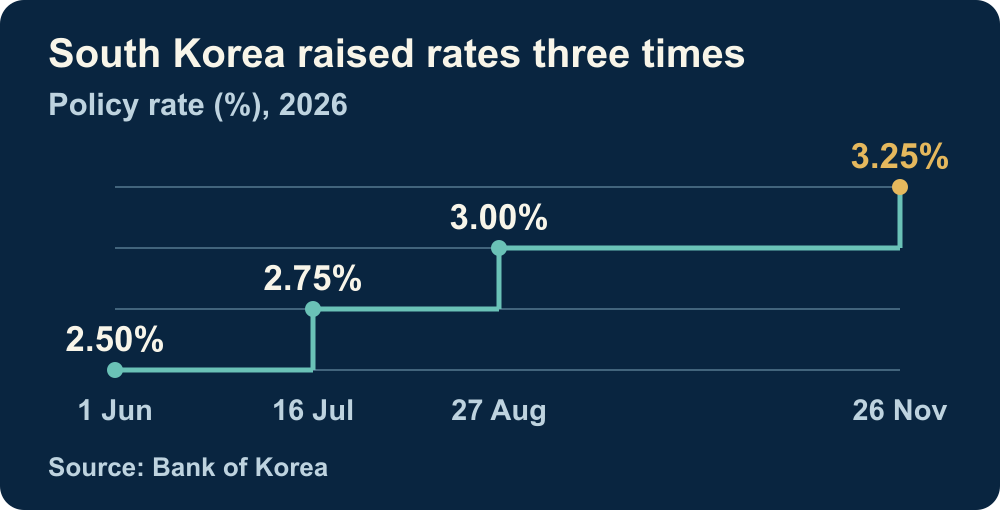
The bank raised its growth forecast for this year from 3.3% to 3.9%, and its 2027 forecast from 2.9% to 4.1%. These are forecasts, not final data. Strong chip exports gave the bank more room to address pressure on prices and housing, even though higher rates can make borrowing harder for some domestic companies and households.
Asian chip shares recovered only part of their losses
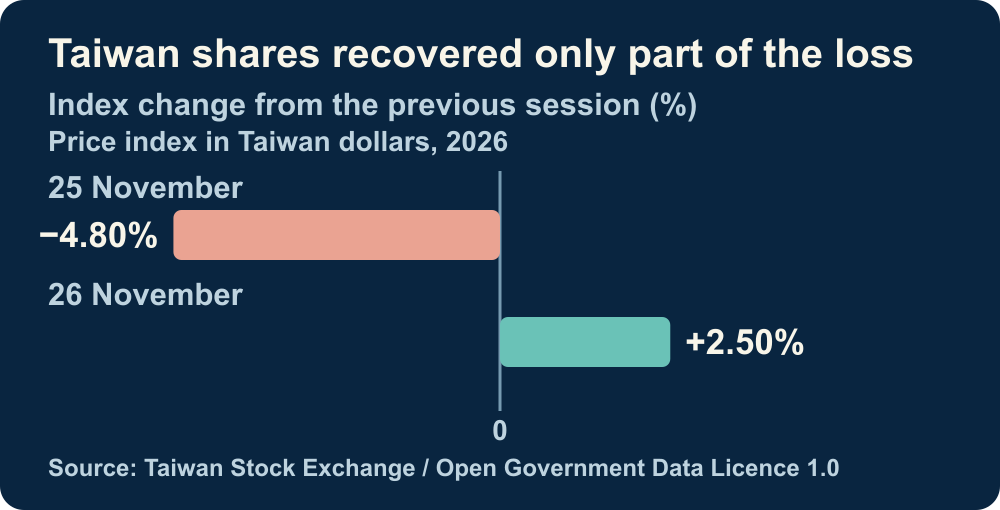
Japan’s semiconductor share index rose 4.03% on Thursday after falling 9.84% on Wednesday. A smaller gain from a lower starting point does not cancel a larger drop. Taiwan’s benchmark TAIEX rose 2.50% to 39,151.81 points, but stayed 2.42% below Tuesday’s close. Taiwan had not returned to its Tuesday level, whereas the broader European market had returned to its Monday level.
For your investments
Let’s discuss your portfolio
 FINANCIAL FREEDOM01 / 04
Investment results since 1999
Are you beating
global equities?

at the end of the period
Jan 1999–Jun 2026 · EUR · Cumulative return, %
Linear scale · * MSCI World → MSCI ACWI.
Past performance does not guarantee future returns.
FINANCIAL FREEDOM02 / 04Historical comparison
How far did it fall?
How long to recover?
Decline from the previous high

Longest recovery to the previous high

Jan 1999–Jun 2026 · EUR · Monthly data
* MSCI World → MSCI ACWI.
Past performance does not guarantee future returns.
FINANCIAL FREEDOM03 / 04Personal investment consultation
Already investing?
Let’s review your portfolio.
Yet to start
investing?
Let’s build your first
investment plan.
FINANCIAL FREEDOM04 / 04
Personal investment
consultation
Martynas
Juška
Investment manager
Managing a portfolio
of more than€100 million
European shares returned to Monday’s level
The STOXX Europe 600 rose 1.75% to 636.98 points, almost exactly Monday’s level of 636.97 points. That is a euro price index, not a fund return. The ECB account published that day covered its 28–29 October meeting: all members agreed to hold the deposit rate at 2.50%, although many could also have backed a rise after energy costs exceeded the adverse scenario. There was no new decision on Thursday.
Separately, the ECB reported that euro-area bank loans outstanding to companies, adjusted for certain technical changes, were 4.5% higher in October than a year earlier, after 4.3% in September. Household loan growth held at 3.1%. This helps show whether credit is slowing, but it cannot tell us whether a new business loan became cheaper.
China responded to the US proposal, not to new tariffs taking effect
China’s foreign ministry rejected the US allegation of industrial overcapacity on 26 November and called for talks. The US trade representative’s 25 November proposal concerns imports from China, the European Union and other economies; tariffs and exceptions vary by origin and product. China’s statement did not announce a retaliatory duty.
Today
What matters now
Stronger earnings and dearer borrowing can affect different holdings in one fund
If orders rise, South Korean and Taiwanese chipmakers could see revenues grow. If borrowing costs rise, some South Korean property companies and businesses that need to refinance soon face greater risk. Sector share prices can therefore rise at the same time as borrowing conditions tighten.
In the euro area, longer-dated fixed-rate bonds are especially exposed if higher energy prices push bond yields up. For energy-intensive manufacturers, the question is whether they can pass costs to customers. Thursday’s equity rebound did not settle either question.
Today
What comes next
27 November: Tokyo prices and a shortened US session
Preliminary November inflation in Tokyo will show whether price pressure is easing in the capital. It is not a nationwide figure. The main US equity session ends at 20:00 Vilnius time. It will show whether a broader US rally follows the rebound in Asia and Europe.
1 and 17 December: euro-area inflation and the ECB decision
Eurostat’s preliminary November release will help distinguish energy’s impact from rising prices for other goods and services. The ECB’s decision and fresh projections on 17 December will show whether the bank expects those pressures to persist.
Important. This is general market analysis, not a personal recommendation to buy or sell. Historical data and company results do not guarantee future returns. Forecasts and conditional scenarios may not materialise.
How is the history preserved and updated?
All five periods in this edition share one information date. Week means the latest 7 days, quarter means 90 days, and year means the trailing 12 months. The next dated edition will have a separate URL. This text keeps its date and assessment; later events are not silently inserted into an older edition. Longer periods assess new evidence alongside earlier developments without repeating every headline.