
30 days · Market review
30 days: Korea raised rates, the ECB explained its pause
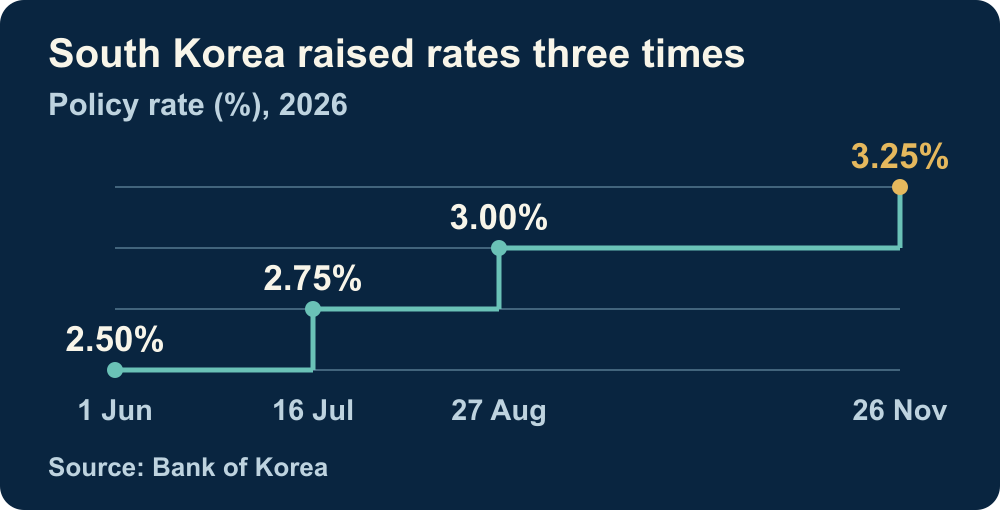
On 26 November, the Bank of Korea raised its base rate to 3.25%. On the same day the European Central Bank explained why it had kept its deposit rate at 2.50% in October, even as dearer energy raised inflation risks. The distinction matters for households with variable-rate loans and businesses that must refinance. Data cut-off: 26 November 2026, 23:59 Vilnius time.
Period covered: 2026-10-28 – 2026-11-26Information as of 9 min read
South Korea changed its policy rate; the euro area published an account of an earlier decision. In a separate ECB release, euro area company loans grew 4.5% from a year earlier.
The ECB’s 2.50% deposit rate retained on 29 October still applies. Dearer energy can still raise business costs even if companies are drawing more bank finance.
30 days
What happened
Interest rates took different directions at the end of October
On 28 October, the US Federal Reserve retained its 3.75–4.00% target range, while the Bank of Canada raised its rate by a quarter of a percentage point to 2.50%. The European Central Bank kept its deposit rate at 2.50% on 29 October. It also warned that a prolonged increase in energy costs could raise inflation and reduce growth.
The Bank of Japan retained its 1.25% policy rate on 30 October and announced that it would accelerate sales of its exchange-traded-fund holdings from January 2027. That was a future change in the pace of disposals, not additional sales already completed in November. Australia raised its rate to 4.85% on 3 November and the United Kingdom to 4.00% on 5 November; both increases were 0.25 percentage points.
The Bank of Korea kept its base rate at 3.00% on 22 October, before this 30-day window began. It stayed there until the November meeting. The central bank had already noted strong exports and the need to assess the effects of earlier increases.
Shares fell in early November, while employment provided a counterweight
On 5 November, the US S&P 500 price index declined 4.36% in one session, and Japan’s Nikkei 225 fell 5.96% on 6 November. These are separate daily price changes in US dollars and yen, not returns for this whole month. They showed that geographic equity diversification does not provide protection from broadly cautious investors.
The US October employment report released on 6 November also showed 165,000 additional non-farm payroll jobs and unemployment of 4.1%. The foundation for household income had not visibly collapsed. Falling share prices alone therefore did not establish that the central bank would need to cut interest rates urgently.
The 10 November price release left the interest-rate question open
US October monthly consumer-price growth was 0.4%, following 0.6% in September. However, prices excluding food and energy increased 0.3% for a third consecutive month. The headline pace slowed, but persistent price pressure had not disappeared. That matters for households’ purchasing power and businesses’ ability to pass increased expenses on to customers.
Equipment suppliers’ growth differed from their customers’ financing
On 10 November, US computing-infrastructure provider CoreWeave reported a striking third-quarter gap: operating profit was US$207 million, while net interest expense reached US$846 million.
German industrial-technology company Siemens reported on 12 November that July–September Smart Infrastructure orders rose 40% year on year and revenue increased 16%. Data-centre demand in the United States and Europe supported the business, although US tariff refunds also helped profit. This was strong demand at one stage of the supply chain, not uniform profitability across all projects.
Europe paid more for energy while Asian consumption lagged
Eurostat reported on 13 November that the euro area’s September goods-trade deficit was €10.3 billion, compared with a €13.5 billion surplus a year earlier. The energy-trade deficit widened from €20.7 billion to €33.0 billion. These are nominal amounts, not simply changes in imported quantities. A larger energy bill leaves less money for other purchases and investment.
China’s October figures released on 16 November showed industrial value added rising 4.8% year on year, but retail sales of consumer goods growing just 0.4%. The first measure is real and the second nominal. Japan’s third-quarter real GDP, published the same day, was almost unchanged from the previous quarter: consumption fell 0.3%, while private non-residential investment increased 1.6%.
At 23:20 Lithuanian time on 17 November, after the US market close, US chip designer NVIDIA reported revenue of US$115.8 billion for the quarter ended 25 October, 103% more than a year earlier. This is new confirmation that technology-infrastructure expansion is turning into supplier sales; the return on its customers’ investment remains a separate question.
The 18 November minutes explained why a rate pause is not a promise to cut
The Federal Reserve published minutes of its 27–28 October meeting. It had retained the 3.75–4.00% target range by ten votes to two; both dissenters wanted an increase. Almost all participants regarded a further increase as likely to be needed in their baseline scenario. This was an earlier discussion, not a new November decision: the December choice will also depend on subsequent data.
For your investments
Let’s discuss your portfolio
 FINANCIAL FREEDOM01 / 04
Investment results since 1999
Are you beating
global equities?

at the end of the period
Jan 1999–Jun 2026 · EUR · Cumulative return, %
Linear scale · * MSCI World → MSCI ACWI.
Past performance does not guarantee future returns.
FINANCIAL FREEDOM02 / 04Historical comparison
How far did it fall?
How long to recover?
Decline from the previous high

Longest recovery to the previous high

Jan 1999–Jun 2026 · EUR · Monthly data
* MSCI World → MSCI ACWI.
Past performance does not guarantee future returns.
FINANCIAL FREEDOM03 / 04Personal investment consultation
Already investing?
Let’s review your portfolio.
Yet to start
investing?
Let’s build your first
investment plan.
FINANCIAL FREEDOM04 / 04
Personal investment
consultation
Martynas
Juška
Investment manager
Managing a portfolio
of more than€100 million
On 18 November, Eurostat confirmed 4.0% inflation
Eurostat reported that annual euro-area inflation rose from 3.8% to 4.0% in October. Energy prices were 21.0% higher than a year earlier; this category made the largest contribution to the overall figure. Some households have less to spend elsewhere when more goes on energy, even if their earnings are unchanged.
A strong Monday did not undo the Friday sell-off
On 23 November, US chip supplier Nvidia announced that its board had reinstated Jensen Huang as chief executive. The Nasdaq Composite price index rose 6.51%, from Friday’s 22,617.73 to 24,089.56 points. It had closed at 25,136.27 on 13 November, so it was still 4.16% short of that level. After a large loss, it takes a larger percentage gain to recover the starting level because the gain is measured from the lower base.
Higher prices accounted for the rise in October spending
On 25 November, the US Bureau of Economic Analysis reported that its Personal Consumption Expenditures Price Index rose 3.8% in the year to October, or 3.3% excluding food and energy. The updated September annual rates were 3.7% and 3.1%, respectively. During October itself both indexes rose 0.3%.
After allowing for price changes, October real consumer spending fell by less than 0.1% from September. Meanwhile, income after taxes and inflation increased 0.5%, and households saved 4.1% of their after-tax income. Higher incomes did not translate into a greater volume of purchases that month.
Korea changed rates; the ECB explained an earlier pause
On 26 November, the Bank of Korea raised its base rate from 3.00% to 3.25%. In October, both overall consumer prices and prices excluding food and energy were 2.8% above a year earlier. The bank also considered faster growth in household loans. The decision does not raise every repayment: that depends on the type of interest rate in the contract and the next reset date.
The ECB released the account of its 28–29 October meeting on the same day. All members supported leaving the deposit rate at 2.50%, although many could have backed an increase. In October they had not yet seen clear evidence that the energy shock was feeding through materially to wages and broader price-setting. There was no new rate decision on 26 November.
Separately, the ECB reported that outstanding adjusted bank loans to non-financial companies grew 4.5% from a year earlier in October, following a revised 4.3% in September. Growth in loans to households held at 3.1%. These are loan balances for different borrowers, not the interest rates on contracts signed in October.
30 days
What matters now
Who feels the higher borrowing cost first?
In the euro area, loans are most exposed when their rates vary or they must be refinanced. Long-dated fixed-rate bond prices usually fall when market yields rise, but maturity also matters. For bank shares, the question is whether higher interest income will outweigh dearer deposits and losses on unpaid loans.
Exports may support revenue for Korea’s chipmakers, while domestic construction and retailers rely more on household spending and credit. A single-country equity fund can own both types of business, but its result will depend on their weights and whether the won rises or falls.
A small move in government bonds does not make every loan cheaper
The US Treasury reported that its ten-year government bond yield fell from 4.91% to 4.85% on 25 November. That eases pressure on long-dated Treasury prices, but companies still pay extra interest to compensate for their own credit risk. A corporate bond fund can therefore react differently from a Treasury fund.
When sales volumes stall, higher turnover does not necessarily mean higher profits. A retailer unable to pass on dearer equipment, deliveries or power keeps less from each sale. Sellers whose products customers cannot easily replace are better placed to withstand that pressure.
Which part of the expansion receives cash, and which spends it?
For technology and electrical-equipment manufacturers’ shares, order volumes and profitable delivery matter. For data-centre operators’ shares and bonds, service usage, customer payments and debt burdens are important. An opportunity emerges when demand grows faster than additional costs. Risk increases when extra revenue can only be achieved by borrowing still more.
Energy producers and energy-intensive industrial businesses also face different conditions. More expensive commodities can increase the former’s revenue but are a cost for transport or chemical companies. If a business cannot increase its selling price, the difference reduces profit. Long-term energy contracts may delay the effect without necessarily removing it.
Portfolio diversification needs to cover more than country names
Several equity funds can own the same technology suppliers or depend on the same investment in data centres. Bond maturity, the borrower’s ability to repay and currency help reveal additional risks. Longer-dated fixed-rate bonds generally react more strongly to changes in yields, while exchange rates also affect the value of dollar assets for a euro-based investor.
European banks’ capital provides an important counterweight to financing concerns. On 19 November, the ECB announced total capital requirements and guidance of 15.7% of risk-weighted assets for 2027, while the actual ratio using the same capital definition stood at 20.1% in the second quarter of 2026. This buffer can help absorb losses, but does not protect bank shares against falling prices or future bad loans.
30 days
What comes next
1 December: euro-area inflation
Eurostat’s flash November estimate will help show whether the effect of energy is fading, or whether price increases are spreading further across services.
8–9 December: US central bank meeting
The Federal Reserve will decide on interest rates and issue new projections. The question is whether slower orders outweigh continued price pressure.
17 December: ECB decision
The European Central Bank will announce its rate decision and new economic projections after its December meeting. The issue is whether energy costs are spreading to services and wages, and how much dearer loans are weakening demand.
23 December: US spending and growth
The US Bureau of Economic Analysis will publish November consumer spending prices and its third estimate of July–September growth. The releases will show whether the volume of spending picked up and whether newer information changes the view of the quarter.
Important. This is general market analysis, not a personal recommendation to buy or sell. Historical data and company results do not guarantee future returns. Forecasts and conditional scenarios may not materialise.
How is the history preserved and updated?
All five periods in this edition share one information date. Week means the latest 7 days, quarter means 90 days, and year means the trailing 12 months. The next dated edition will have a separate URL. This text keeps its date and assessment; later events are not silently inserted into an older edition. Longer periods assess new evidence alongside earlier developments without repeating every headline.