
Week · Market review
Chip shares swung while borrowing costs stayed in focus
From 20 to 26 November, chip shares reversed several times. Strong demand, potential trade barriers and high valuations all mattered for the same manufacturers. The Bank of Korea raised rates on 26 November, a reminder that stronger demand in one sector does not necessarily mean cheaper borrowing across the economy. Data cut-off: 23:59 Vilnius time.
Period covered: 2026-11-20 – 2026-11-26Information as of 4 min read
South Korea delivered a fresh rate rise on Thursday and Europe’s broad equity index returned to Monday’s level. Asian chip shares did not fully regain Wednesday’s losses.
New policy decisions in the US and euro area are due in December. The 25 November US tariff plan is still a proposal, so importers do not yet know which products would cost more.
Week
What happened
From Monday’s rebound to Wednesday’s selling
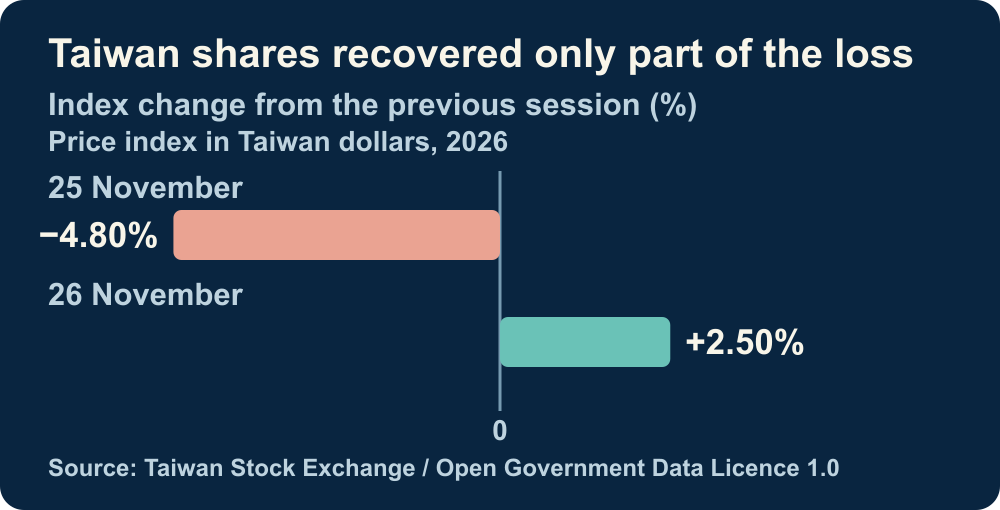
US chip shares rebounded on Monday 23 November and Asian stocks followed on Tuesday. Taiwan’s TAIEX closed at 40,122.35 points on Tuesday and fell 4.80% on Wednesday. It is a reminder that one session is a poor guide to the next few days. Thursday’s 2.50% rebound did not close the remaining gap.
Japan’s semiconductor share index fell 9.84% on 25 November and rose 4.03% the next day. On 25 November, the Korea Exchange paused only certain automated sell orders for five minutes after futures on its main share index dropped. It did not halt all trading. On Thursday, the broad STOXX Europe 600 recovered its losses from earlier sessions and finished close to Monday’s level.
Higher spending in dollars did not mean US households bought more
On 25 November the US Bureau of Economic Analysis reported that annual consumer spending inflation reached 3.8% in October, after a revised 3.7% in September. Spending in dollars rose 0.3% from September, but it fell by less than 0.1% after allowing for prices. Shoppers spent more without buying more in aggregate. The US ten-year Treasury yield fell to 4.85% on Wednesday despite the higher annual inflation reading.
US stock exchanges were closed on 26 November for Thanksgiving. The latest US equity closing price in this period therefore comes from Wednesday, not Thursday. Europe and Asia had another trading day on Thursday.
For your investments
Let’s discuss your portfolio
 FINANCIAL FREEDOM01 / 04
Investment results since 1999
Are you beating
global equities?

at the end of the period
Jan 1999–Jun 2026 · EUR · Cumulative return, %
Linear scale · * MSCI World → MSCI ACWI.
Past performance does not guarantee future returns.
FINANCIAL FREEDOM02 / 04Historical comparison
How far did it fall?
How long to recover?
Decline from the previous high

Longest recovery to the previous high

Jan 1999–Jun 2026 · EUR · Monthly data
* MSCI World → MSCI ACWI.
Past performance does not guarantee future returns.
FINANCIAL FREEDOM03 / 04Personal investment consultation
Already investing?
Let’s review your portfolio.
Yet to start
investing?
Let’s build your first
investment plan.
FINANCIAL FREEDOM04 / 04
Personal investment
consultation
Martynas
Juška
Investment manager
Managing a portfolio
of more than€100 million
Different forces shaped borrowing costs in Europe and South Korea
The Bank of Korea raised its policy interest rate from 3.00% to 3.25% on 26 November after annual inflation hit 2.8% in October. Two of seven members preferred to hold rates. Strong chip orders supported growth, while the bank also weighed house prices and household borrowing.
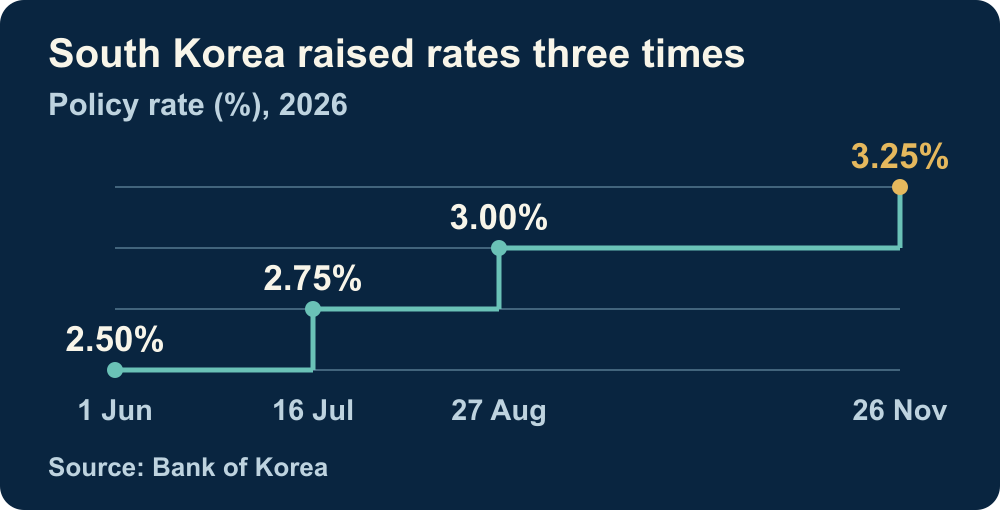
The ECB held its deposit rate at 2.50% at the 28–29 October meeting. The 26 November account showed that many members could have backed an increase because energy costs had risen beyond the adverse scenario. Even so, outstanding euro-area corporate loans, adjusted for certain technical changes, rose 4.5% year on year in October. This does not tell us the cost of a new loan.
Higher US import tariffs are still under discussion
On 25 November the US trade representative released proposals following investigations into excess production in 14 economies. For the European Union, it proposed a combined 15% tariff on covered goods, including existing ordinary and applicable additional duties, with exceptions. It is not another 15 percentage points on every product. On 26 November China’s foreign ministry rejected the US characterisation and called for talks, but did not announce a new tariff.
Week
What matters now
Separate sector concentration, debt maturity and the cost of imports
US, Japanese and Taiwanese technology funds may have different labels but rely on the same data-centre investment. More orders help chip revenues; delayed projects or disappointing earnings could hit funds in several regions at once. A broader fund offers diversification only to the extent it actually reduces that concentration.
Weak US spending volumes could reduce the quantities some retailers sell even if their dollar revenue rises. If yields fall, longer-dated US government bonds typically gain in price, but currency moves also affect the result in euros. The tariff risk for an individual company depends less on its head office than on where its products come from, what duties already apply and whether customers will pay a higher price.
Week
What comes next
27 November: Tokyo prices and a shortened US session
Preliminary November inflation in Tokyo will show whether price pressure is easing in the capital. It is not a nationwide figure. The main US equity session ends at 20:00 Vilnius time. It will show whether a broader US rally follows the rebound in Asia and Europe.
1 and 17 December: euro-area inflation and the ECB decision
Eurostat’s preliminary November release will help distinguish energy’s impact from rising prices for other goods and services. The ECB’s decision and fresh projections on 17 December will show whether the bank expects those pressures to persist.
Important. This is general market analysis, not a personal recommendation to buy or sell. Historical data and company results do not guarantee future returns. Forecasts and conditional scenarios may not materialise.
How is the history preserved and updated?
All five periods in this edition share one information date. Week means the latest 7 days, quarter means 90 days, and year means the trailing 12 months. The next dated edition will have a separate URL. This text keeps its date and assessment; later events are not silently inserted into an older edition. Longer periods assess new evidence alongside earlier developments without repeating every headline.