
Weekly market review · 28 September – 2 October
Jobs growth slows, but borrowing gets no cheaper
The US added far fewer jobs in September, while rising energy prices pushed euro-area inflation higher. Yet US consumers were still increasing their spending. Together, these developments explain the week’s central question: why do weaker jobs figures not yet promise cheaper loans?
The week at a glance
The week in numbers
US job growth slowed, yet long-term bond yields rose. Euro-area inflation accelerated, while Micron results showed strong demand for memory chips.
- S&P 500 price index−0.27%25 September–2 October closes; US dollars, excluding dividends and currency effects.
- Nasdaq Composite price index+0.45%25 September–2 October closes; US dollars, excluding dividends and currency effects.
- US ten-year Treasury yield5.28%2 October; up 0.11 percentage points over the week. Annual yield, not a weekly return.
- Euro against the US dollar−1.56%ECB reference rates, 25 September–2 October: 1.1403 → 1.1225 USD per EUR.
The week in brief: fewer new jobs, more expensive energy and higher borrowing costs
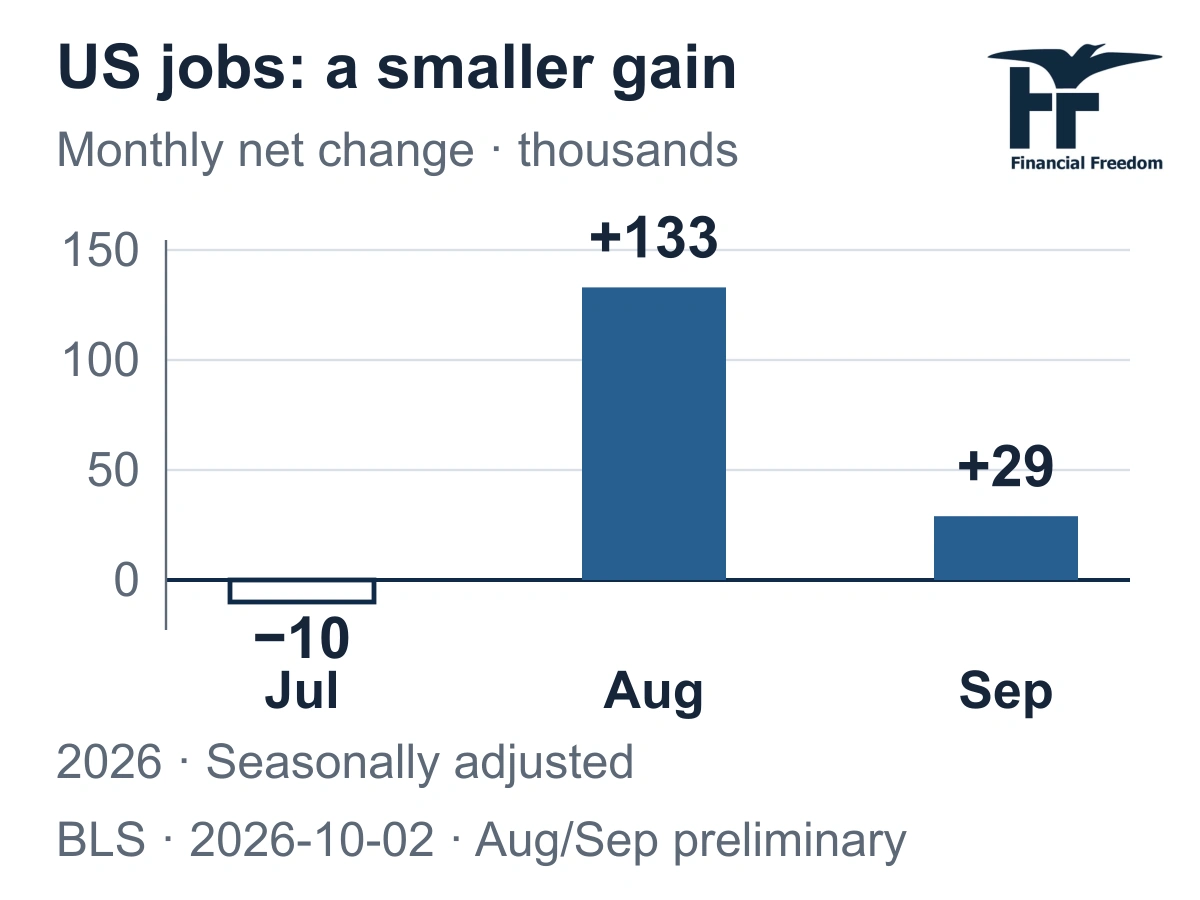
On Friday, 2 October, the US released weaker jobs figures: employment rose by 29,000 in September, compared with 133,000 in August. This matters beyond the workplace. When fewer jobs are created, household incomes may grow more slowly, making it harder for shops and service businesses to increase sales. But this report alone does not establish that the whole US economy is already shrinking.
August figures released on Wednesday provided a counterweight: US consumer spending, adjusted for price changes, rose 0.6% over the month. Thursday’s survey of manufacturers also showed an increase in new orders. The labour market is weakening, but demand for goods and services is holding up. That supports business revenue and gives the central bank no clear reason to rush into interest-rate cuts.
Europe’s figures on Friday highlighted another risk: September inflation accelerated, with energy prices rising much faster than the rest of the consumer basket. Long-term US bond yields also increased over the week. Anyone with loans or bonds therefore needs to watch prices and borrowing conditions, not just employment.
The two US stock indices moved in different directions: the S&P 500 price index fell 0.27% over the week, while the more technology-heavy Nasdaq Composite rose 0.45%. These are changes between the closing levels on 25 September and 2 October, in US dollars and excluding dividends. A stronger dollar also increased the euro value of US assets for Lithuanian investors.
Why does slower jobs growth not yet mean cheaper loans?
The slowdown in the US labour market is not just a September fluctuation. On 2 October, the Bureau of Labor Statistics revised the combined increase in jobs for July and August down by 60,000. The chart shows the latest monthly estimates, including those revisions .
The net change in nonfarm jobs, adjusted for seasonal patterns. It includes jobs lost as well as jobs added, not just new recruits. Earlier estimates are revised as more data arrive.
An investor buying a long-term bond considers not only employment but also how much inflation will reduce the purchasing power of future interest payments and the principal repaid. US consumer prices, measured by the personal consumption expenditures price index, were 3.4% higher in August than a year earlier. While spending is growing and price pressures persist, a weaker jobs report does not necessarily bring long-term interest rates down.
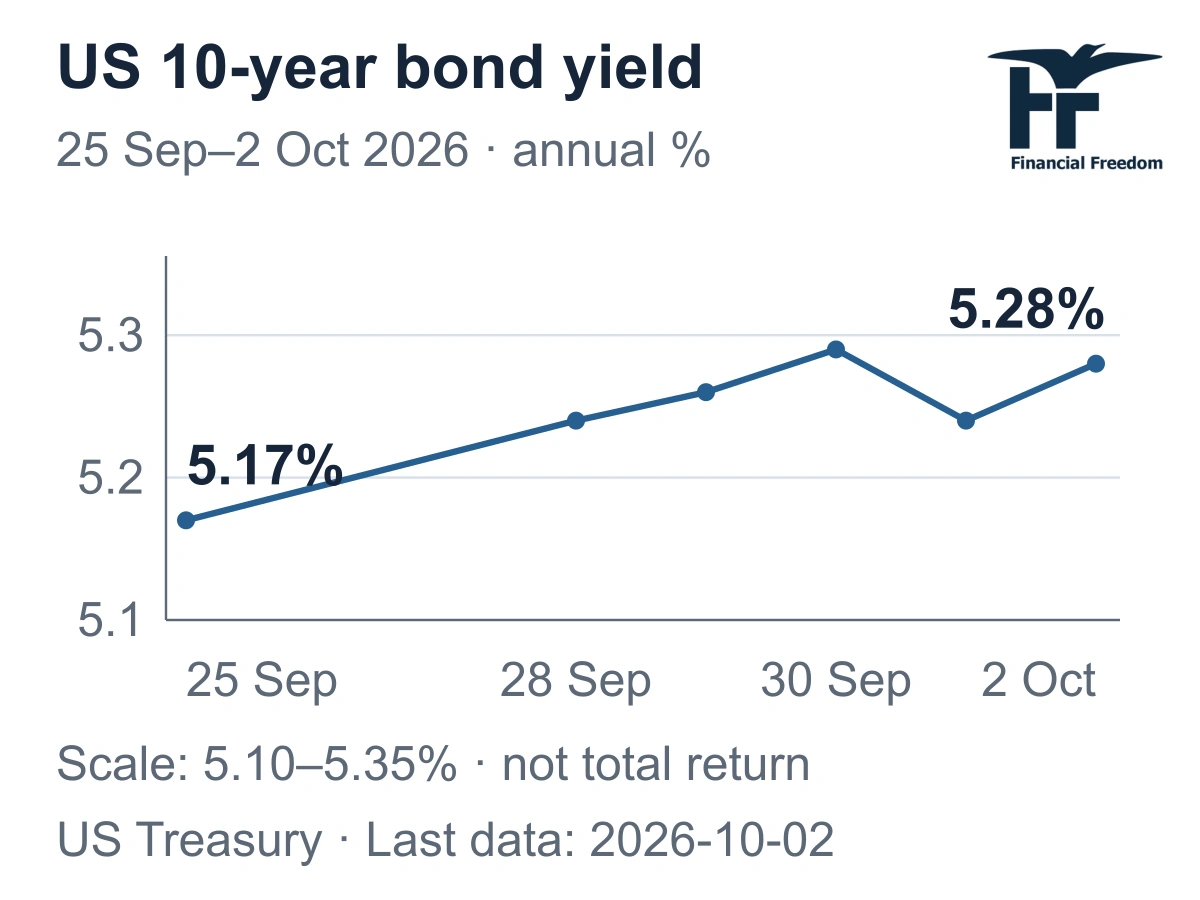
A bond’s yield can rise without its payments changing: when the price falls, a new buyer pays less for the same agreed payments. An existing holder sees the bond’s market value decline, but its fixed interest payments do not change. More expensive new borrowing can reduce profits at businesses that rely on debt to expand. If yields keep rising, longer-maturity bond funds and heavily indebted companies would face greater pressure.
Bond yield relates today’s price to the agreed payments and maturity. The chart shows annual yields, not weekly investment returns. Loan rates also depend on the borrower’s risk and contract.
For your investments
Let’s discuss your portfolio
 FINANCIAL FREEDOM01 / 04
Investment results since 1999
Are you beating
global equities?

at the end of the period
Jan 1999–Jun 2026 · EUR · Cumulative return, %
Linear scale · * MSCI World → MSCI ACWI.
Past performance does not guarantee future returns.
FINANCIAL FREEDOM02 / 04Historical comparison
How far did it fall?
How long to recover?
Decline from the previous high

Longest recovery to the previous high

Jan 1999–Jun 2026 · EUR · Monthly data
* MSCI World → MSCI ACWI.
Past performance does not guarantee future returns.
FINANCIAL FREEDOM03 / 04Personal investment consultation
Already investing?
Let’s review your portfolio.
Yet to start
investing?
Let’s build your first
investment plan.
FINANCIAL FREEDOM04 / 04
Personal investment
consultation
Martynas
Juška
Investment manager
Managing a portfolio
of more than€100 million

Professional portfolio management
Markets change every week. Your portfolio should not change with every headline.
Portfolio management turns market information into a consistent process: risk and concentration are monitored, while decisions follow your agreed strategy instead of the latest market move.
Energy is the main difference in Europe’s inflation figures
Eurostat’s preliminary estimate, released on 2 October, showed euro-area annual inflation rising from 3.2% to 3.8% in September. Excluding energy, food, alcohol and tobacco, however, the increase was small: from 2.4% to 2.5%. The distinction matters because prices are not all accelerating at the same pace.
Annual inflation compares a consumer basket’s prices with the same month a year earlier. Excluding energy, food, alcohol and tobacco helps separate more volatile prices. September’s preliminary estimate may change.
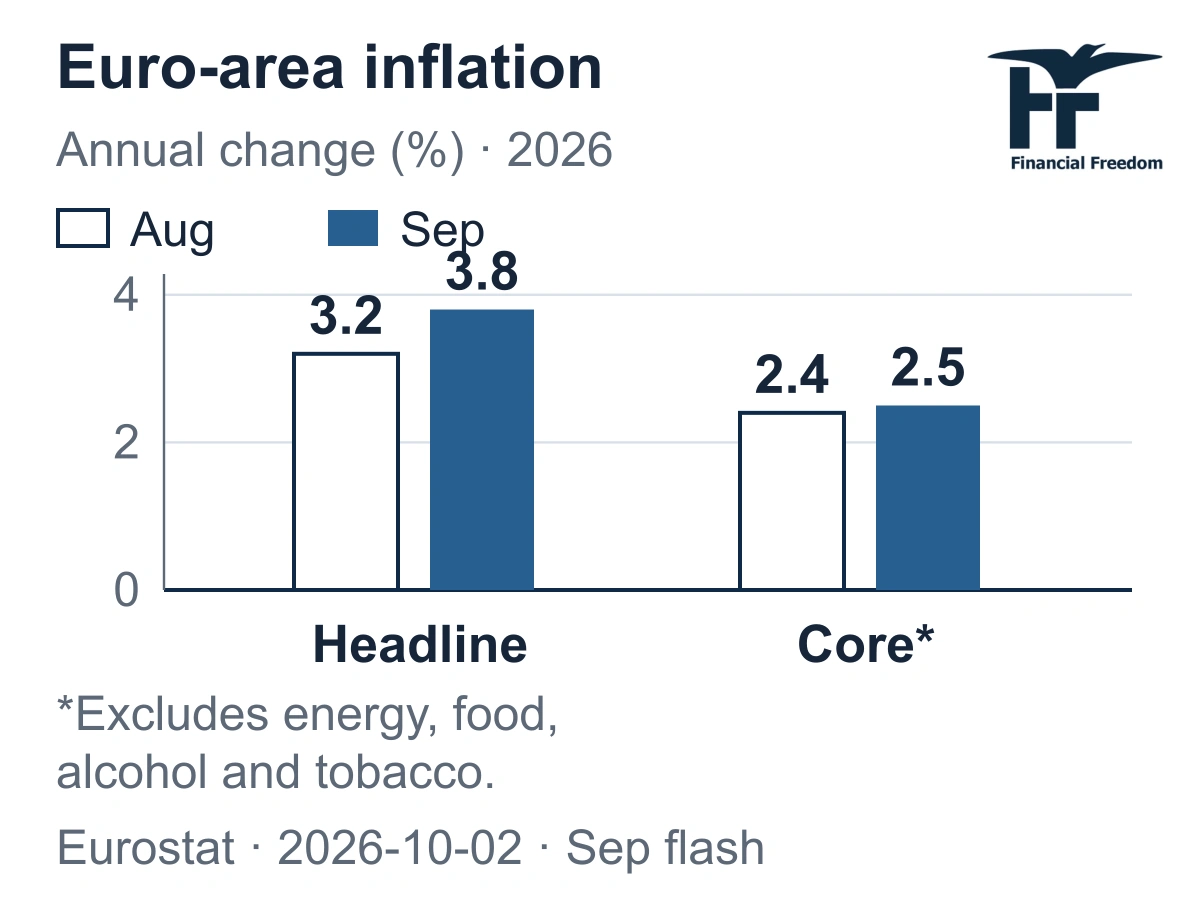
Energy was 18.8% more expensive in September than a year earlier, up from an annual increase of 14.3% in August. When households spend more on electricity, heating and fuel, less is left for restaurants or larger purchases. Energy-intensive manufacturers find it harder to protect profits. Higher prices may benefit energy producers, provided their own costs do not rise at the same pace.
The next question is whether higher energy costs spread to other goods and services. If they do, the European Central Bank will find it harder to cut interest rates. If energy becomes cheaper, headline inflation could fall without a sharp economic downturn. The headline figure alone is therefore not enough when assessing euro-denominated bonds or consumer stocks.
France shows how high interest rates can become a concrete expense. On 29 September, its debt agency announced a financing requirement of €339.7 billion for next year, compared with €311.7 billion this year. Repayments of existing debt account for most of the increase. If that debt has to be replaced with more expensive new bonds, more of the budget would go towards interest rather than other spending.
What offsets interest-rate risk: sales and a stronger dollar
Rising bond yields do not mean that every stock must fall. Companies with growing sales and profits may be better able to absorb higher financing costs. On 30 September, memory-chip manufacturer Micron reported quarterly revenue of $54.23 billion, compared with $41.46 billion in the previous quarter. Its reporting quarter ended on 3 September, not at the end of the calendar quarter.
Micron’s management links demand to artificial intelligence and data centres. This reveals an important distinction for investors: buying equipment generates revenue for the chip supplier but is an expense for the data-centre owner. The owner will need enough paying customers to earn back that investment. Growth in a supplier’s sales therefore does not prove that every artificial-intelligence business is profitable. Micron forecasts revenue of $60–63 billion for the next quarter; that is not yet an achieved result.
The dollar also helped euro-based investors this week. European Central Bank reference rates showed one euro buying $1.1403 on 25 September and $1.1225 on 2 October. Had an investment’s dollar price stayed completely unchanged, its value in euros would have risen by about 1.59%. This illustrates the currency effect without hedging, not the return of a particular fund.
A stronger dollar can help holders of US stocks and bonds. But for European businesses paying for equipment or raw materials priced in dollars, the same purchase becomes more expensive. A subsequent recovery in the euro could reverse the investor’s currency benefit. When assessing portfolio performance, it is worth separating the return on the investment itself from the contribution of exchange rates.
What matters next is why interest rates change
A more favourable combination would be slower price growth with consumer spending holding up: businesses could maintain revenue while borrowing eventually became cheaper. It would be a different story if rates fell because of a sharp economic downturn. Bonds might then rise in price, while weaker corporate profits weighed on stocks. That is why inflation, spending and profits need to be considered together, rather than watching the direction of interest rates alone.
What comes next
- 6 October: US export and import figures for August will add to the picture of the third-quarter economy. Is overseas demand supporting manufacturers?
- 8 October: The account of the European Central Bank’s September meeting will explain how it assessed energy prices and the risk of broader inflation. This is not a new interest-rate decision.
- 14 October, in the week after the coming one: US consumer-price figures for September will show whether inflation is slowing alongside jobs growth.
Important. This is general market commentary, not a personal investment recommendation. Investments can rise or fall in value, and past performance does not guarantee future returns. Consider the investment’s costs, risks, time horizon and your financial circumstances.