
Weekly market review · October 5–9
Consumers worry, but borrowing costs remain high
The University of Michigan survey released on October 9 showed weaker sentiment among US consumers. That raises risks to company sales, but rising household inflation expectations also make cheaper loans harder to count on. In Europe, improving energy supply still needs to be confirmed by deliveries, while Germany’s industrial figures show an uneven recovery.
The week at a glance
What moved markets before the detailed explanation
US consumer sentiment weakens, but price pressure persists. Energy-stock pledges still need to become deliveries, while construction largely supported Germany’s rise in output.
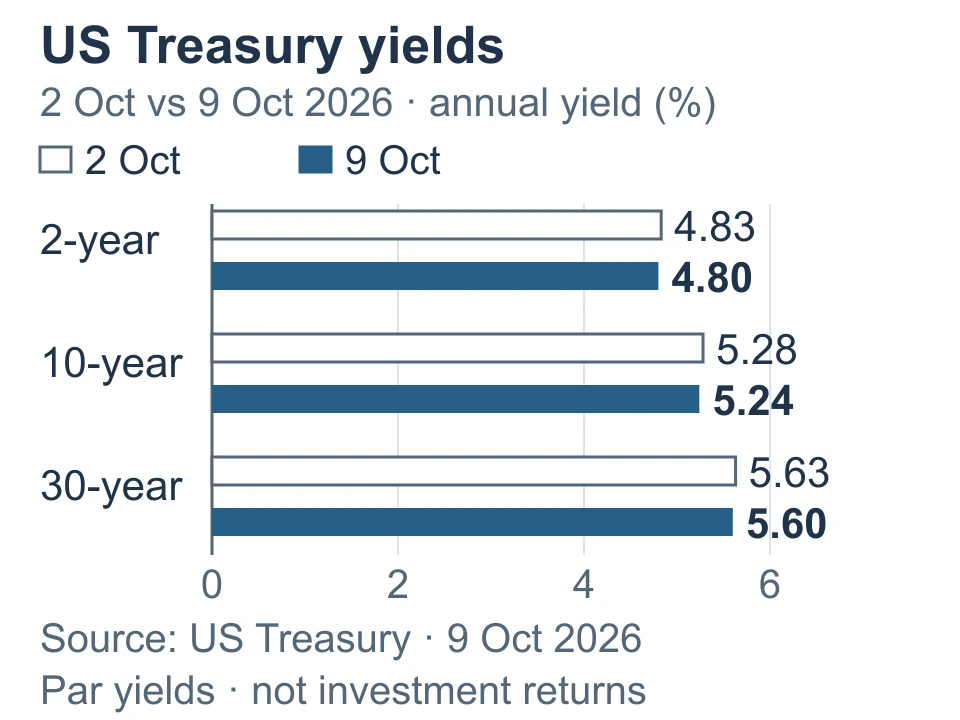
- US 10-year Treasury yield5.24%9 October; annual. Down 0.04 percentage points from 2 October.
- US 2-year Treasury yield4.80%9 October; annual. Down 0.03 percentage points from 2 October.
- Euro against the US dollar−0.17%European Central Bank reference-rate change from 2 to 9 October.
- US consumer sentiment46.3 pointsPreliminary October survey, released 9 October; not a spending change.
- German goods exports−0.8%August monthly change in nominal value; released 8 October.
Weaker demand does not yet mean lower prices
The week of October 5–9 revealed an uncomfortable combination for investors: the US services sector is still expanding, but consumers feel worse about their current circumstances. An economic slowdown alone is not enough to make loans cheaper quickly. If energy and other business costs remain high, central banks must weigh risks to both prices and growth.
Monday’s survey of US services companies showed expansion alongside stronger price pressures. Tuesday’s drop in German orders looked steep, but fluctuations in large contracts explained most of the monthly change. On Wednesday, construction accounted for much of the stronger headline production figure in Germany. That same day, the International Energy Agency called for faster delivery of oil reserves pledged earlier. A renewed call is not a new delivery.
German export figures published on Thursday showed a lower value of goods sold abroad. The account of the European Central Bank’s September meeting explained why the bank had raised interest rates, but was not another increase. Friday’s US consumer survey sharpened the week’s question: assessments of current conditions deteriorated, even as expectations for the future improved slightly.
Long-term US bond yields fell a little over the week, but rose again on Friday. The euro changed little against the dollar. This is not a single turning point that benefits every investment: longer-dated bonds depend on the direction of inflation, consumer businesses on their customers’ purchasing power, and European manufacturers and transport companies on the actual availability of energy. The key is still to distinguish a sign of weaker demand from evidence that price pressures have already eased.
US consumers grow more worried as inflation expectations rise
The preliminary University of Michigan consumer sentiment index released on October 9 fell from September’s final reading of 48.1 to 46.3 points. Its components moved in different directions, however: the assessment of current conditions fell from 50.9 to 44.7, while expectations for the future rose from 46.3 to 47.3. The survey therefore points to greater difficulties today, rather than uniformly greater pessimism about the future.
The index summarises US households’ answers about their personal finances and the economic outlook. A lower reading means weaker sentiment, not a fall in spending by the same percentage. October’s result is preliminary; the final reading will be released on October 23.
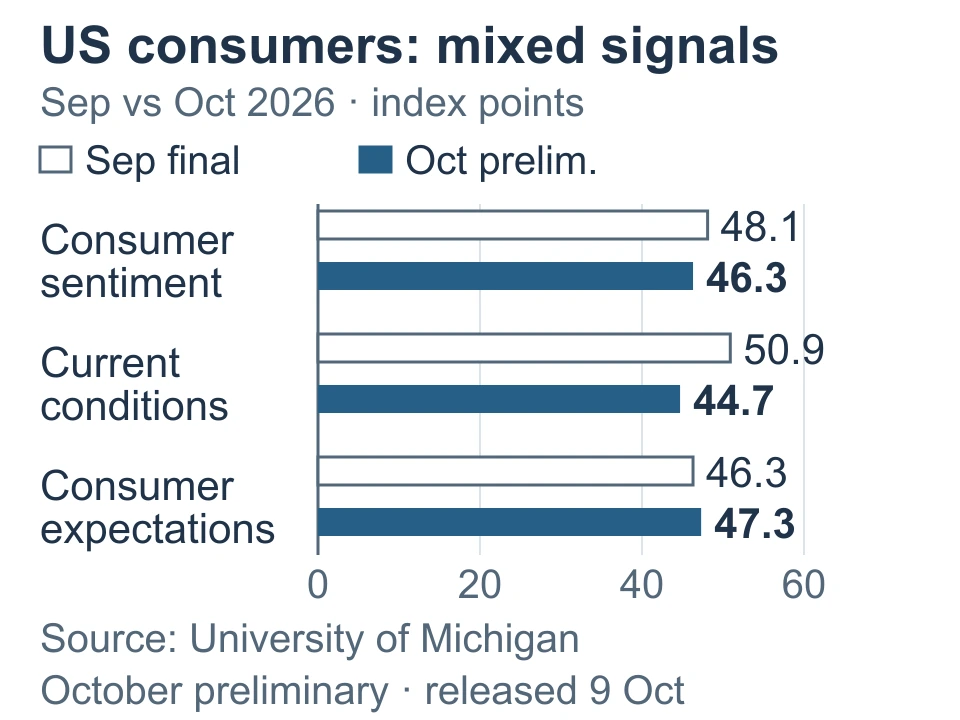
Households’ expected inflation over the coming year rose from 4.6 to 4.7 per cent. This is their view of future price increases, not inflation already measured. The September US services purchasing managers’ survey, released on October 5, also showed expansion: the overall index was 54.9 points, while the prices index rose from August’s 72.6 to September’s 74.0 points.
Purchasing Managers’ Indices summarise companies’ answers about the direction of change. An overall reading above 50 generally indicates sector expansion, while a prices reading above 50 indicates more widespread reports of price increases. A prices index of 74.0 does not mean inflation of 74.0 per cent.
A separate university analysis published on October 9 helps identify which customers’ spending may be more vulnerable. In interviews conducted from June 23–September 21, only 20 per cent of respondents in the lower-income third planned to keep buying goods with particularly large price increases as usual; the share was 42 per cent in the higher-income third. The question concerned those particular goods over the coming year, not all spending. It highlights different risks for consumer businesses serving different customers, rather than a confirmed decline in sales.
The yield on 10-year US government bonds fell from 5.28 to 5.24 per cent between October 2 and 9. On Friday, however, it rose compared with Thursday. The small weekly decline can help existing fixed-rate bonds, but borrowing costs remain an important obstacle for property financed with debt.
The US Treasury table gives an indicative annual bond yield for each maturity. It is not the investment return for that week or the central bank’s interest rate. When market yields fall, the prices of previously issued fixed-rate bonds generally rise; longer-dated bonds usually respond more strongly.
Federal Reserve Governor Christopher Waller spoke on October 8 about possible further interest rate increases if the data warranted them. This was one policymaker’s conditional position, not a new decision by the central bank. For bond investors, easing price pressures would be an opportunity, while a longer period of expensive borrowing remains the main risk. US inflation data for September, due on October 14, will help test which of these forces is stronger.
For your investments
Let’s discuss your portfolio
 FINANCIAL FREEDOM01 / 04
Investment results since 1999
Are you beating
global equities?

at the end of the period
Jan 1999–Jun 2026 · EUR · Cumulative return, %
Linear scale · * MSCI World → MSCI ACWI.
Past performance does not guarantee future returns.
FINANCIAL FREEDOM02 / 04Historical comparison
How far did it fall?
How long to recover?
Decline from the previous high

Longest recovery to the previous high

Jan 1999–Jun 2026 · EUR · Monthly data
* MSCI World → MSCI ACWI.
Past performance does not guarantee future returns.
FINANCIAL FREEDOM03 / 04Personal investment consultation
Already investing?
Let’s review your portfolio.
Yet to start
investing?
Let’s build your first
investment plan.
FINANCIAL FREEDOM04 / 04
Personal investment
consultation
Martynas
Juška
Investment manager
Managing a portfolio
of more than€100 million

Professional portfolio management
Markets change every week. Your portfolio should not change with every headline.
Portfolio management turns market information into a consistent process: risk and concentration are monitored, while decisions follow your agreed strategy instead of the latest market move.
Pledged energy reserves help only when supplies reach the market
On October 7, the International Energy Agency called for faster delivery of reserves agreed back in March. Around 325 million barrels had already reached the market, while roughly 100 million pledged barrels had not yet been delivered. This is the fulfilment of an existing commitment, not a new additional decision of the same size. For investors, physical deliveries therefore matter more than another headline repeating the pledge.
The US Energy Information Administration’s October 7 report for the week ending October 2 showed why total oil inventories alone do not answer transport companies’ concerns. Inventories of distillates, which include diesel and heating oil, stood at around 105.1 million barrels, or 12 per cent below the seasonal five-year average. Crude oil inventories were roughly 1 per cent above their own seasonal average. Crude still has to be refined and delivered to where the particular fuel is needed.
The seasonal comparison measures inventories against the average for a similar time of year over the previous five years. Distillates and crude oil have different averages, so these percentages cannot be added together. Lower inventories mean a smaller buffer against disruption, but do not by themselves prove a price increase of the same size.
Greater diesel supply would benefit transport companies and energy-intensive European manufacturers by reducing the risk of fuel becoming more expensive or scarce. Oil producers and refiners face a different effect. High prices can support their revenues, but weaker demand or faster restoration of supply could erode that advantage. Refiners’ profits also depend on crude prices and operating costs, not just the price of finished fuel.
The account of the European Central Bank’s September meeting, published on October 8, connected energy to the interest rate question. The bank raised its deposit facility rate to 2.50 per cent in September; it took effect on September 16. The October account was not a new increase. The bank assessed the risks from energy prices, but did not yet regard broader transmission to wages and other prices as established.
For borrowers with variable-rate euro loans, the question is whether price pressures will force the bank to keep interest rates higher for longer. Longer-dated euro bonds would benefit more from the opposite outcome. The International Energy Agency’s oil market report on October 14 and the US inventory report on October 15 will help test the distinction: are pledges becoming deliveries, and is the risk of shortages in the fuels actually needed declining?
Higher German production is not yet an industry-wide recovery
August data released by Germany’s statistics office on October 6–8 pointed in three different directions. Industrial orders fell 10.6 per cent month on month, but excluding large contracts the decline was just 0.1 per cent. This is an important qualification: the size of the headline drop does not represent the change in demand facing every German manufacturer.
Output rose 2.0 per cent in August. Construction grew 9.3 per cent, while industry excluding energy and construction increased 0.6 per cent. Output in energy-intensive industries fell 0.5 per cent. The overall result is more favourable for construction suppliers than for factories exposed to energy costs; there is no single conclusion that fits an entire portfolio of European industrial shares.
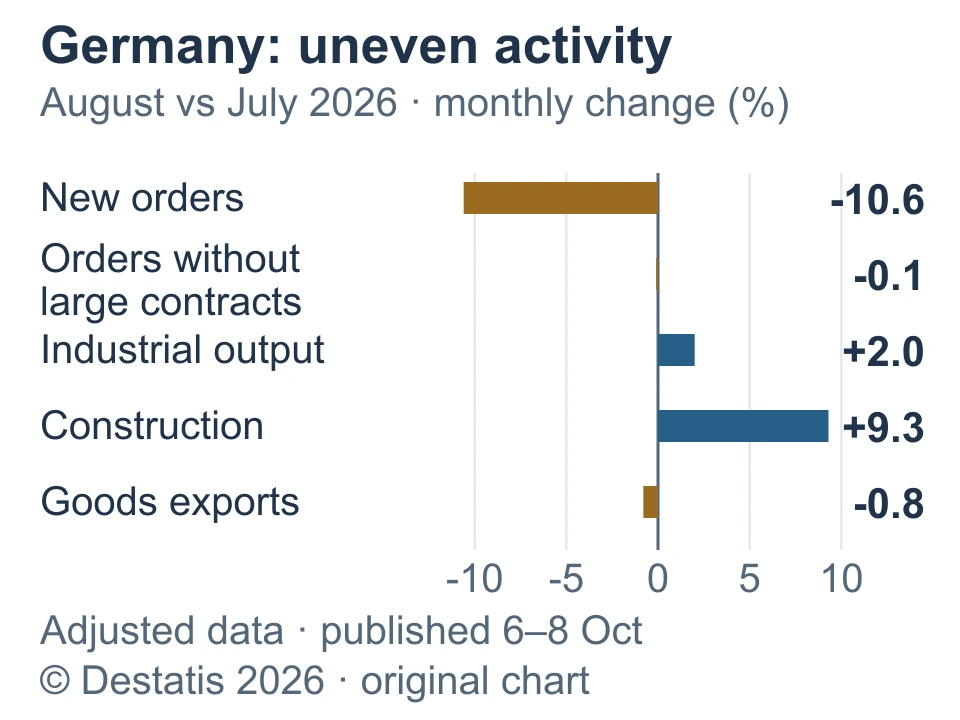
Goods exports were worth €137.6 billion in August. Their value was 0.8 per cent lower than in July, although 6.2 per cent higher than a year earlier. Exports to the US fell 6.3 per cent month on month, while exports to the euro area rose 0.8 per cent. These figures measure the value of goods, not just physical quantities, so they cannot directly be treated as the change in every exporter’s sales volumes.
When assessing European industrial shares and corporate bonds, it is useful to distinguish companies by where their customers are, their energy costs and the nature of their orders. Opportunities arise where construction activity and actual orders support revenue. Risks remain for manufacturers whose foreign customers are buying less, or whose profits are squeezed by energy costs. Germany’s final September inflation figures on October 13 will help assess the price environment; subsequent company results will show whether this economic data translated into revenue.
The currency effect was small this week, but remains a separate part of the result for Lithuanian investors. The European Central Bank’s reference rate changed from 1.1225 to 1.1206 US dollars per euro between October 2 and 9. The euro weakened by around 0.17 per cent. If the dollar price of an investment stayed unchanged, that exchange rate movement would increase its euro value slightly. This is a conditional currency effect, not the return of a particular fund or share.
A portfolio depends on different sources of revenue and costs, not one headline
Weaker consumer sentiment makes it more important to examine whom companies sell to. Businesses serving lower-income customers and those serving higher earners may face different pressures. Similarly, European construction suppliers and energy-intensive exporters do not share the same outlook. A broad equity fund reduces the risk from any single company, but does not remove the common effects of changes in interest rates, energy and demand.
Fixed-rate bonds can benefit if inflation pressures ease. Their prices can fall, however, if markets again have to anticipate higher interest rates; maturity matters especially. Near-term cash needs are worth separating from long-term investments, and the euro return on US assets from their price movement in dollars. This week’s signals call for examining diversification within a portfolio, rather than making the same decision for every holding.
What we are watching
- October 14 at 15.30 Lithuanian time: US consumer price data for September. Will measured inflation confirm the price pressures seen in surveys?
- The International Energy Agency’s oil market report on October 14 and the US fuel inventory report on October 15. Are deliveries reducing the risk of shortages in specific fuels?
- The Federal Reserve’s decision on October 28 and the European Central Bank’s decision on October 29. How will the banks weigh slowing growth against inflation risks?
Important information. This is a general market review, not a personalised recommendation to buy or sell. Investments can fall in value; changes in currencies, interest rates and company performance affect different parts of a portfolio in different ways.