
Weekly market review · 23–27 November
Shares rebounded, but US inflation picked up
US equities recovered part of the previous week’s losses over 23–27 November. Technology shares jumped on Monday after chipmaker Nvidia reinstated its former chief executive. But US inflation picked up in October, and the government’s borrowing cost was slightly higher on Friday than a week earlier. The equity rebound did not come with cheaper borrowing this time.
The week at a glance
What moved markets before the detailed explanation
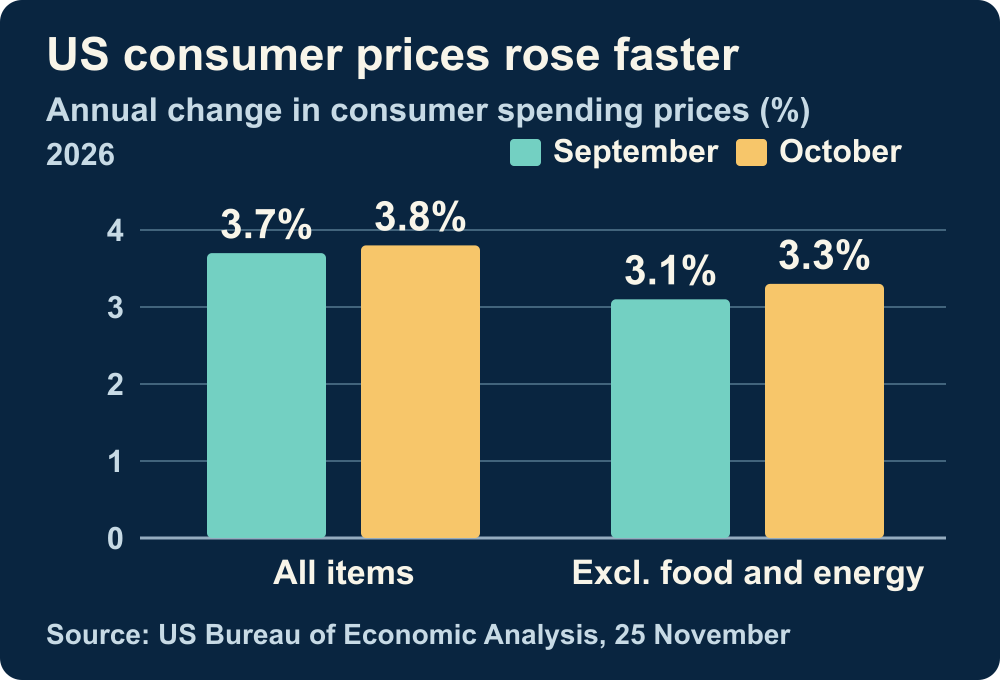
US and Taiwanese shares rebounded on 23–27 November even as US consumer spending inflation rose to 3.8%. South Korea lifted rates; the euro area’s next decision is still ahead.
- S&P 500+5.60%20–27 November · USD price index
- Nasdaq Composite+6.68%20–27 November · USD price index
- Taiwan shares (TAIEX)+9.09%20–27 November · TWD price index
- STOXX Europe 600+2.91%20–27 November · EUR price index
- US ten-year Treasury yield4.94%27 November · +0.02 percentage points on the week
- US dollars per euro1.095727 November ECB reference · −0.30% on the week
The rebound began on Monday, but it was not a quiet week
On 23 November US chipmaker Nvidia said its board had reinstated Jensen Huang as chief executive. The decision resolved uncertainty about who would lead the company. Its shares rose 31.48% that day, while the tech-heavy Nasdaq Composite gained 6.51% and the broad S&P 500 gained 4.73%. The move reached far beyond one share, although the change at the top alone cannot explain the entire rally.
The rebound reached Asia on Tuesday, and part of it unwound on Wednesday. Taiwan’s benchmark TAIEX gained 8.99%, then fell 4.80% the next day. The Korea Exchange paused some automated buy orders for five minutes on Tuesday and some automated sell orders for five minutes on Wednesday. It was responding to sharp moves in futures on its main equity index, not closing the whole exchange.
On Wednesday 25 November investors faced two new developments. The US Bureau of Economic Analysis reported faster annual consumer spending inflation, and the US trade representative proposed tariffs affecting 14 economies. Japan’s chip-share index had already fallen that day before the US release, so the US inflation news alone cannot explain Asia’s decline. The STOXX Europe 600 rebounded on Thursday while US stock exchanges were closed for Thanksgiving, and finished the week 2.91% higher on the index provider’s daily figures.
The Friday US equity session ended at 20:00 Vilnius time. Since the previous Friday’s close, the Nasdaq Composite gained 6.68% and the S&P 500 gained 5.60%. The Nasdaq recovered only about 60% of its previous week’s loss in index points, so it did not get back to the level of two weeks earlier. The European Central Bank’s Friday reference rate was 1.0957 US dollars per euro, about 0.30% below the previous week. For euro-area investors who had not hedged their dollar exposure, that currency move slightly lifted returns in euros.
Taiwan’s weekly gain looks large, but the starting point matters. The TAIEX closed at 39,308.08 points on Friday: above 20 November but 2.03% below Tuesday’s close. The weekly return and the distance from the week’s highest close answer different questions.
For your investments
Let’s discuss your portfolio
 FINANCIAL FREEDOM01 / 04
Investment results since 1999
Are you beating
global equities?

at the end of the period
Jan 1999–Jun 2026 · EUR · Cumulative return, %
Linear scale · * MSCI World → MSCI ACWI.
Past performance does not guarantee future returns.
FINANCIAL FREEDOM02 / 04Historical comparison
How far did it fall?
How long to recover?
Decline from the previous high

Longest recovery to the previous high

Jan 1999–Jun 2026 · EUR · Monthly data
* MSCI World → MSCI ACWI.
Past performance does not guarantee future returns.
FINANCIAL FREEDOM03 / 04Personal investment consultation
Already investing?
Let’s review your portfolio.
Yet to start
investing?
Let’s build your first
investment plan.
FINANCIAL FREEDOM04 / 04
Personal investment
consultation
Martynas
Juška
Investment manager
Managing a portfolio
of more than€100 million
Taiwan gained 9.09% but stayed below Tuesday’s close
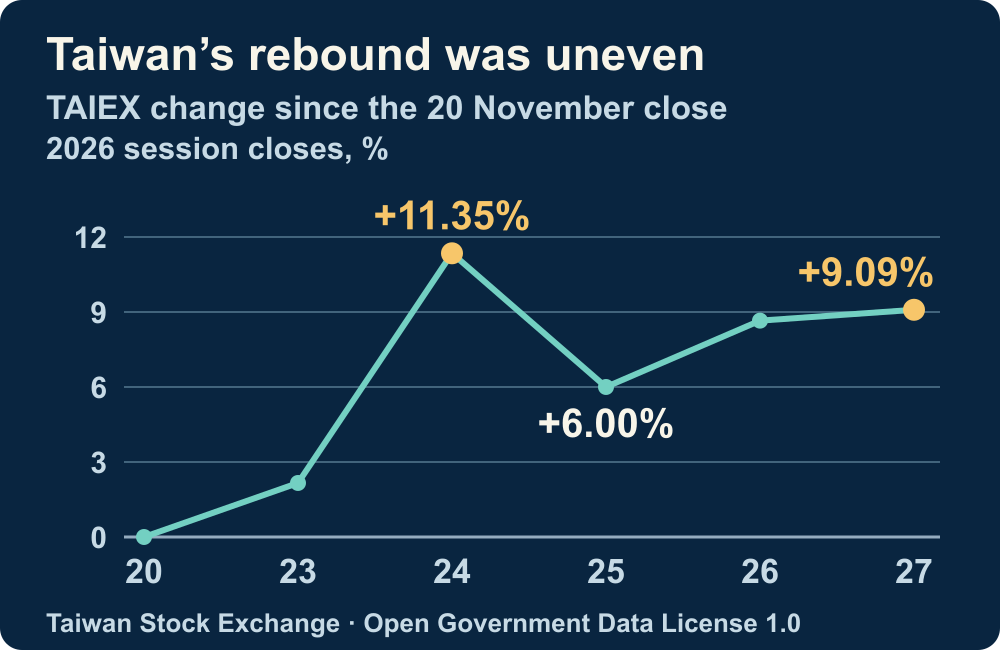
Taiwan’s financial regulator tightened conditions for some short sales from 23 November. On covered stocks, traders could not sell borrowed shares below the previous close, subject to exceptions. It was not a ban on all sellers. Technology funds in Taiwan, Japan and the US may be geographically separate yet depend on the same orders for chips. Faster expansion by data-centre customers can help several regions; delayed orders can hurt funds in several places at once.
US households spent more dollars without buying more
The US , published on 25 November, showed annual inflation of 3.8% in October, after a revised 3.7% in September. Higher bills did not mean more goods or services were bought. Dollar spending increased 0.3% from September, but consumption fell by less than 0.1% after adjusting for prices.
The personal consumption expenditures price index (PCE) tracks prices of the goods and services US households consume. The annual figure compares prices with the same month a year earlier. The Federal Reserve measures its 2% inflation target with this index.
The ten-year US Treasury yield rose from 4.92% to 4.94% from Friday to Friday. A small move, but the opposite of what a story about cheaper borrowing would imply. If prices start rising more slowly, longer-dated fixed-rate bonds already in circulation could gain. If yields rise again, those bonds would lose value and companies issuing new debt or taking out new loans could pay more.
Tariffs are still under discussion, but South Korea already raised rates
On 25 November the US trade representative proposed changes to duties on imports from China, the European Union, Japan, South Korea, Taiwan and other economies. For covered EU goods, the proposal sets a combined 15% rate including applicable duties already in force. It is not another 15 percentage points on every item; some goods subject to separate sectoral duties would be excluded from this measure. On 26 November China rejected the US argument about excess production and called for talks, but did not announce a new retaliatory duty. If costs do rise, where a product comes from, its supply contract and customers’ alternatives will determine how much importers absorb and how much they pass on.
On 26 November the Bank of Korea raised rates from 3.00% to 3.25%. Chip exports supported growth, while the central bank was also weighing household debt and housing-market risks. The European Central Bank published an account that day of its October meeting: all members agreed to keep the deposit rate at 2.50%, although many could have supported a rise. The Korean decision does not automatically change what a euro-area company pays for a loan in a different currency or of a different term. The country, contract and central bank all matter.
What to watch next
A rebound can ease pressure on technology funds, but it does not remove their reliance on the same companies. For bonds and variable-rate loans, the more important question is whether price growth actually slows.
- 1 December: Eurostat’s preliminary November inflation release will show whether energy prices are still pushing euro-area inflation up sharply.
- 4 December: the US employment report will show whether job growth is strong enough to support spending.
- 8–9 December: the Federal Reserve decision and projections will show how the central bank sees inflation that is still above target.
Important information. This review is for information, not personal investment advice. Investments can rise or fall in value, and past performance does not guarantee future results.