
Today · Market review
Monday map: rates are rising, but not everywhere for the same reason
By 07:00 on Monday, the new fact was China's short-term liquidity operation, not a cut in lending rates. Weekend and Friday information set the wider picture: Japan raised rates, shorter US Treasury yields rose more than longer ones during the week, and European price pressure persisted. Debt maturity, currency and the profit left after costs matter more than one headline.
Period covered: 2026-09-21Information as of 7 min read
What changed in the latest information? On 21 September the People's Bank of China supplied CNY165 billion of seven-day liquidity at 1.40%. Sunday's lending benchmarks remained 3.00% and 3.50%. On Friday the Bank of Japan raised its overnight guideline to about 1.25%, while two- and ten-year US Treasury yields ended the week at 4.76% and 5.01%.
What still holds? Resilient US demand and low unemployment-benefit claims are a counterweight, but dearer imports, energy and borrowing can reduce company profit. China's short liquidity provision is not proof of a consumer recovery. One yield-curve move is not an automatic economic forecast.
Today
What happened
On Monday morning China managed short-term liquidity without cutting its lending benchmarks
By the 07:00 Lithuanian cutoff, the genuinely new Monday fact was a CNY165 billion seven-day reverse-repurchase operation by the People’s Bank of China at 1.40%. This supplies short-term cash to the banking system; it is not a new cut in household or company lending rates. On Sunday, the one-year and five-year-plus Loan Prime Rates were left at 3.00% and 3.50%. The central bank also announced a CNY60 billion auction of 182-day central-bank bills in Hong Kong for 23 September. These instruments do different jobs, so they should not be compressed into the claim that China made loans cheaper.
The distinction matters because temporary liquidity can ease a cash shortage between banks without repairing weak consumer demand. August industrial output was 5.2% higher than a year earlier, while retail sales rose only 0.4%. Those figures were published on 15 September, not on Monday. Commodity suppliers and exporters need evidence that liquidity becomes real orders; European consumer companies need the Chinese buyer to recover.
? Reverse repo versus Loan Prime Rate: what is the difference?
A seven-day reverse repo supplies money to the financial system for a short period against collateral. The Loan Prime Rate is a separately published reference for bank loan pricing. A change in one does not automatically mean a change in the other.
Japan raised rates on Friday, but global central banks are not moving in one identical way
On 18 September the Bank of Japan voted 7–2 to lift its overnight-rate guideline from about 1.00% to about 1.25%, effective 24 September. This was a Friday decision, not Monday news. On 16 September the Federal Reserve raised its range to 3.75–4.00%, while the European Central Bank’s earlier decision to lift its deposit rate to 2.50% took effect during the same week. On 17 September the Bank of England kept its rate at 3.75%, although three of nine members wanted 4.00%.
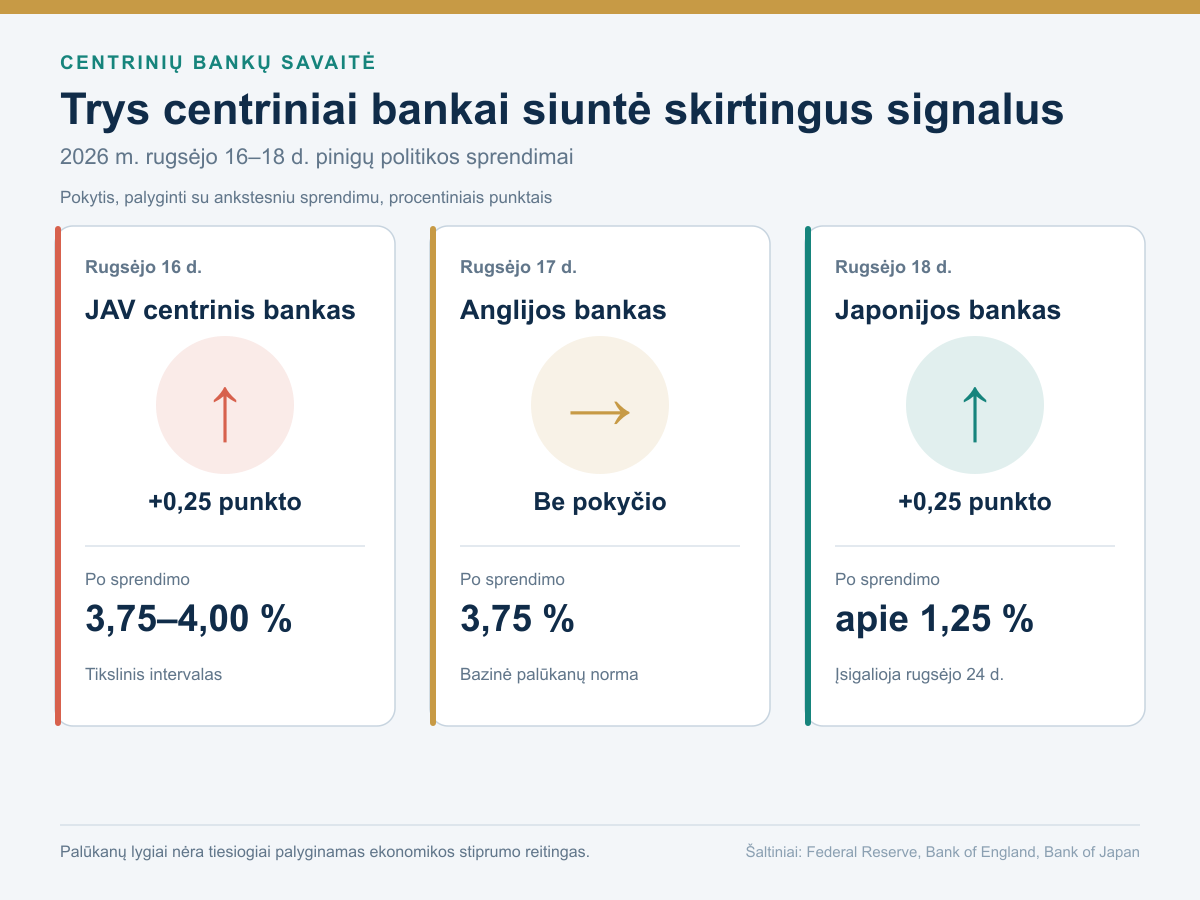
A higher Japanese rate can change the cost of yen-funded positions and the relative appeal of Japanese bonds. US and euro-area increases feed more directly into new dollar and euro borrowing costs. Banks may earn more interest income, but customers also face more repayment risk. Long-duration bonds and growth shares valued on distant future profits tend to be more sensitive when investors demand a higher return.
The US bond market ended the week with a narrower spread, not a general retreat in yields
US Treasury data for 18 September put the two-year yield at 4.76% and the ten-year yield at 5.01%. Compared with 11 September, the shorter yield rose 0.13 percentage points and the longer one 0.05 points. Their spread narrowed from 0.33 to 0.25 percentage points. Thursday’s decline was therefore not the week’s final result: both yields rose again on Friday.
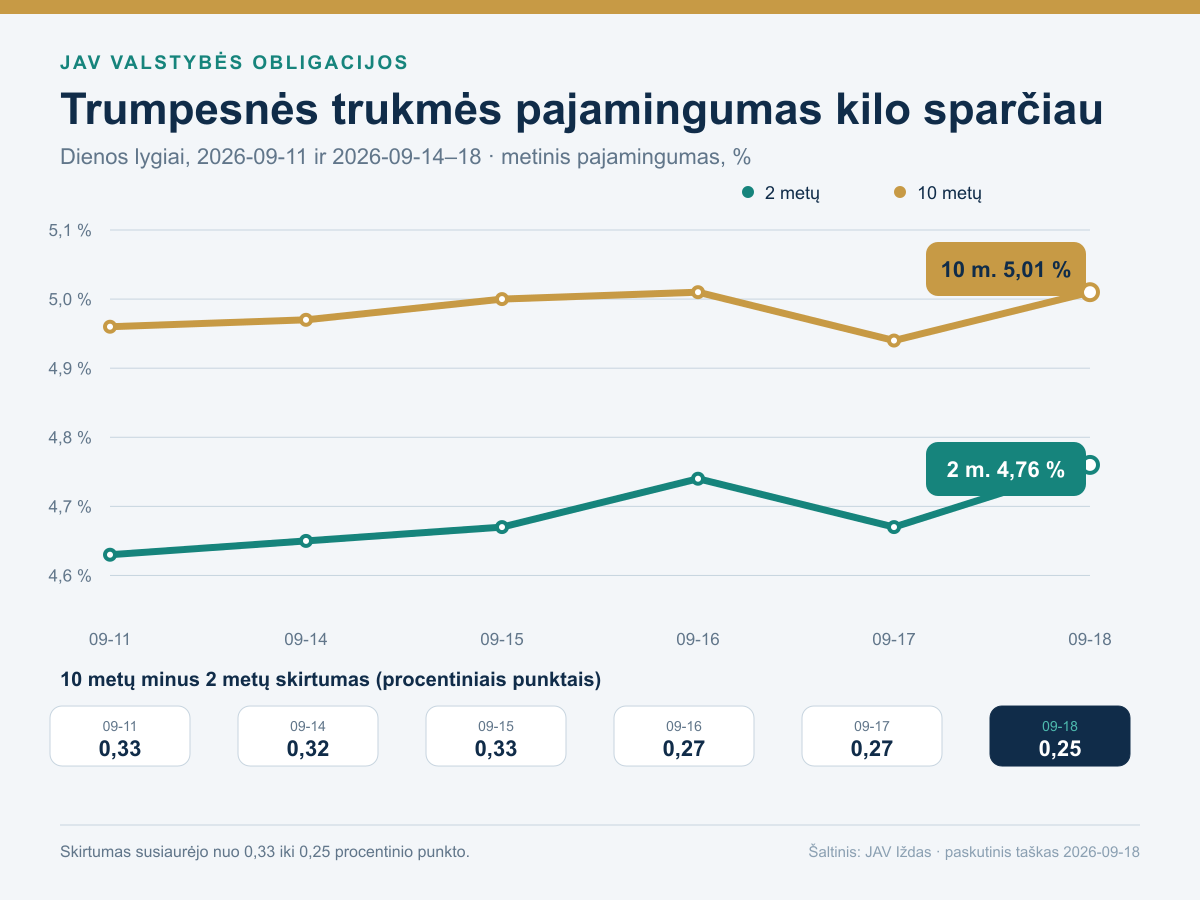
The spread is not an automatic recession signal. It shows the difference between the market yields on two- and ten-year government debt. A faster rise in the two-year yield can mean investors expect short rates to stay high for longer, or demand less additional return for the longer maturity. A company refinancing soon can face a higher bill; the market price of an existing fixed-rate bond generally moves in the opposite direction from its yield.
? What is the 10-year minus 2-year yield spread?
It is the ten-year US Treasury yield minus the two-year yield. A positive 0.25 percentage-point reading means the longer yield was 0.25 points higher. The number alone does not explain why the curve moved and does not forecast the economy without other evidence.
European inflation and US import prices show that cost pressure is broader than an oil headline
On 17 September Eurostat confirmed annual August inflation of 3.2% in the euro area, up from 2.9% in July. Energy prices rose 14.3% over the year and contributed 1.29 percentage points to the headline rate; services contributed another 1.43 points. Lithuania’s harmonised rate was 5.6%, 2.4 points above the euro-area average. These are August measurements released on Thursday, not current Monday prices.

US import prices rose 0.7% in August and 7.0% over the year. Non-fuel import prices were up 5.5% annually and capital-goods import prices 7.3%. These are border prices, not the consumer checkout bill. Still, a company that cannot pass the increase to customers loses margin. A firm with stronger pricing power may preserve profit, but the consumer then feels the pressure for longer and central banks have less room to reduce rates.
US demand is still holding up, while housing gives an uneven signal
US retail sales in August were 1.2% higher than in July and 6.0% higher than a year earlier. The series is not adjusted for inflation, so a larger dollar amount is not the same as more goods sold. Initial unemployment-benefit claims were 196,000 in the week ended 12 September, 10,000 fewer than a week earlier. This is a timely layoffs indicator, not a count of new jobs.
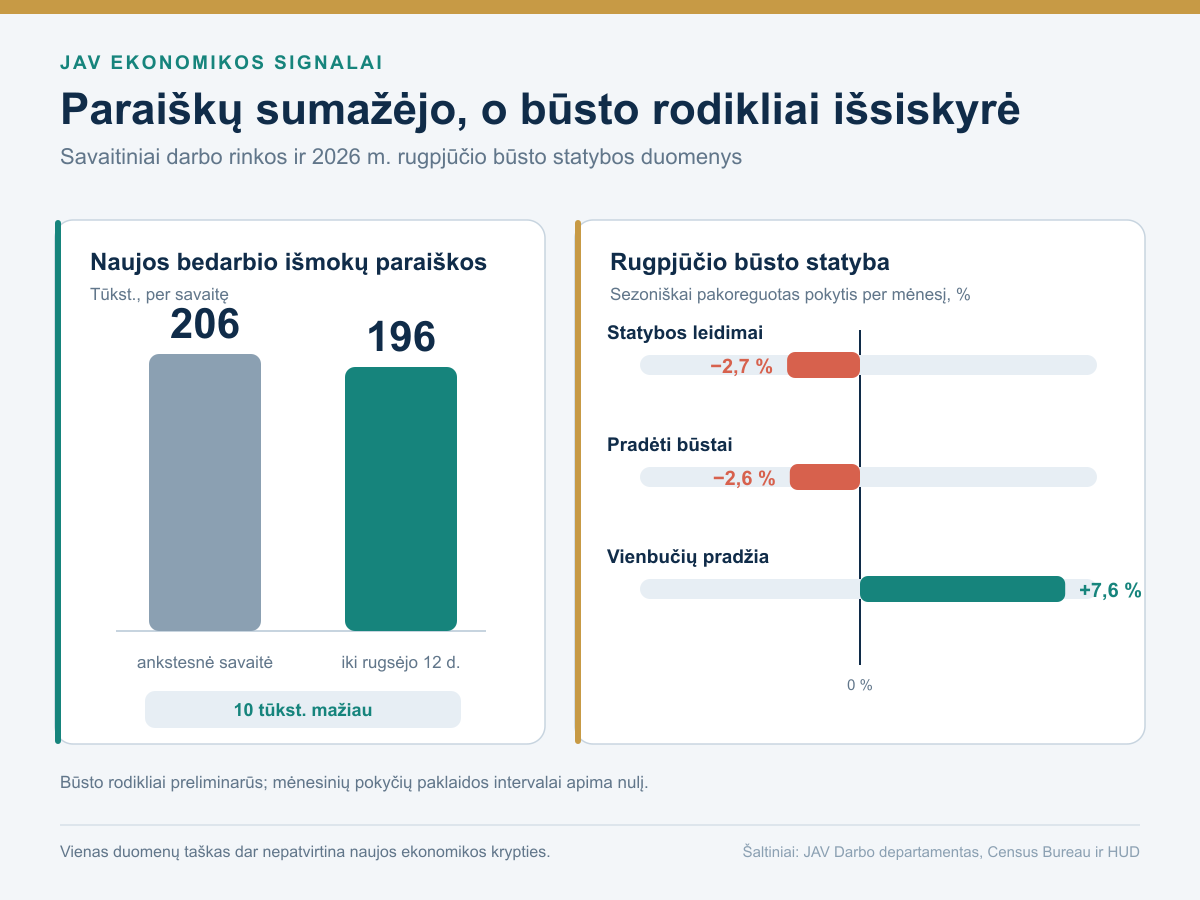
August building permits fell 2.7% and total housing starts 2.6%. Single-family starts rose 7.6%, but the monthly uncertainty range was ±14.0%, so the direction is not statistically secure. Banks and building-material suppliers need more than a permit count: mortgage costs, completed supply and household income all matter. Resilient demand offsets some rate pressure; the risk is that expensive credit takes longer to appear in activity.
? What is a seasonally adjusted annual rate?
A monthly housing estimate is adjusted for normal seasonal patterns and expressed as the annual total that would result if that pace continued for a year. It is not the number actually built in one month. A wide uncertainty range means the monthly change should be read cautiously.

Investment consultation
Do your investments work together?
Review where your money is invested, how much depends on a single market and whether your plan fits your goals. Leave with clearer next steps.
See the consultation process and terms on the registration page.
Today
What matters now
What matters now: different rate paths return attention to profit and debt maturity
The Monday 07:00 picture is not one simple risk-on or risk-off story. China supplied short-term liquidity without changing its main lending benchmarks. Japan raised rates on Friday, while the US two-year yield ended the week higher. Energy and services remained the largest contributors to euro-area inflation. Cash-rich companies and shorter-maturity bonds therefore face a different risk from highly indebted growth businesses or long-duration bonds.
In equities, revenue growth needs to be separated from profit growth: a 1.2% increase in US retail-sales dollars says nothing by itself about volumes or margins. In bonds, investors should compare the 5.01% ten-year yield with the 4.76% two-year yield and their different duration risk. Yen and dollar moves can further change the euro return for a Lithuanian investor. The opportunity is easing cost pressure without a collapse in demand; the risk is that higher input and borrowing costs hit profit together.
Today
What comes next
What comes after Monday morning?
- China’s transmission into the real economy. We will look for unchanged loan benchmarks and short liquidity to show up in orders, consumption and property financing.
- The Bank of Japan’s new rate taking effect on 24 September. The important evidence is not one currency minute but the response of banks, bonds and yen-funded positions after implementation.
- US labour data and the next euro-area inflation estimate on 2 October. They will help distinguish resilient demand from inflation that keeps rates high for longer.
No next-meeting Fed probability has been invented from memory. A current official CME table reading was not reliably captured before the cutoff, so no number is presented as a Federal Reserve forecast or promise.
Important. This is general market analysis, not a personal recommendation to buy or sell. Historical data and company results do not guarantee future returns. Forecasts and conditional scenarios may not materialise.
How is the history preserved and updated?
All five periods in this edition share one information date. Week means the latest 7 days, quarter means 90 days, and year means the trailing 12 months. The next dated edition will have a separate URL. This text keeps its date and assessment; later events are not silently inserted into an older edition. Longer periods assess new evidence alongside earlier developments without repeating every headline.