
Today · Market review
Oil and interest rates are squeezing markets. What can hold up?
Markets face more than expensive oil. It matters whether it can be delivered, whether companies can cover higher costs and whether customers will accept higher prices. Today’s China data show growing production but almost flat retail sales. Ahead of tomorrow’s US interest rate decision, this is a reminder: economic growth does not mean easier conditions for every business.
Period covered: 2026-09-15Information as of 7 min read
What has changed since yesterday? China’s August data, released today, showed faster industrial expansion but weak consumption. US long-term yields remained high on Monday, while France’s borrowing benchmark rose. The week’s question remains the same: will energy prices prevent interest rate cuts?
An interest rate decision alone cannot restore oil supply or reduce every company’s bills. Resilience means more than growing sales: it also means being able to cover costs without borrowing at ever-higher rates. Continuing production growth and sustained investor demand for bonds provide a counterweight to pessimism.
Today
What happened
Oil: even the alternative route can become a bottleneck
Supply disruptions matter even when the world needs less oil. On Monday, the AP news agency reported on repairs to Saudi Arabia’s East–West pipeline, which was closed after an attack. Regional officials interviewed by the agency estimated that repairs could take three to five weeks. That is not an operator-guaranteed reopening date. This pipeline allows some oil to reach the Red Sea without passing through the Strait of Hormuz.
Friday’s International Energy Agency forecast shows the broader scale: global supply could fall by 5.7 million barrels per day this year, to 100.7 million. That is about 5.4% below the previous year’s level implied by these figures. The projected demand decline is smaller, at 2.5 million barrels per day. A forecast is not a completed full-year result.
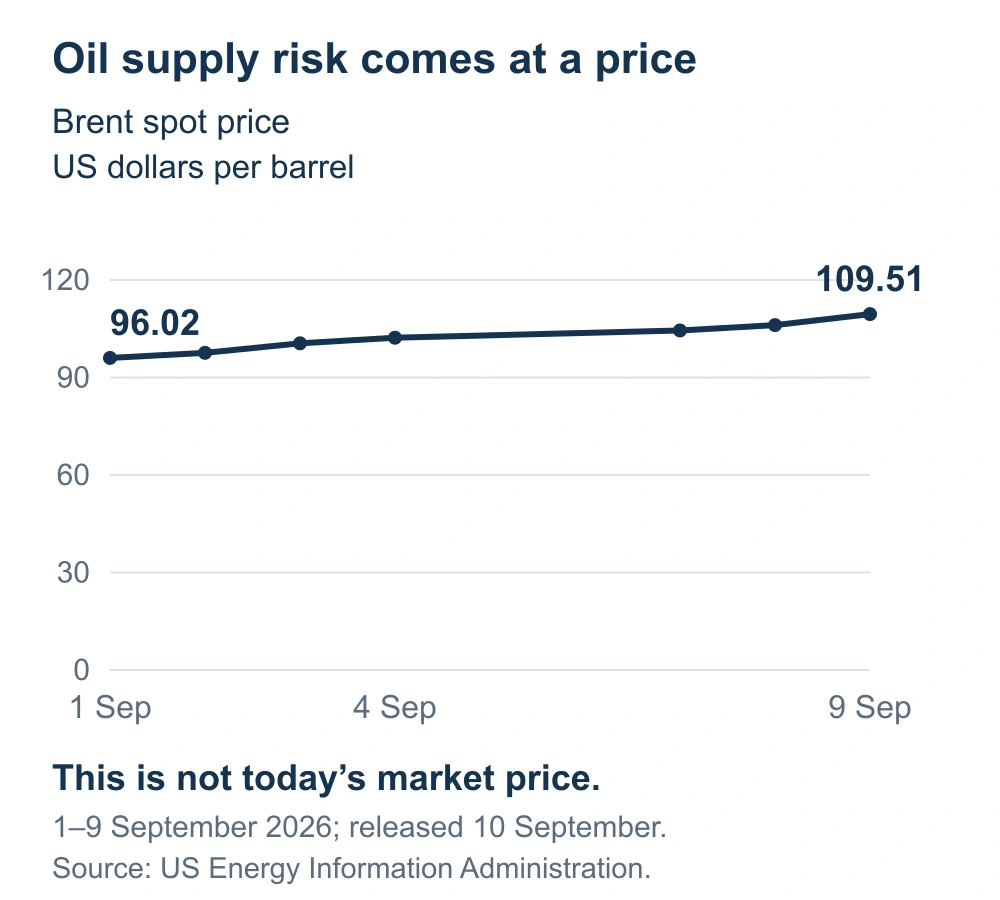
Weaker consumption therefore does not necessarily make fuel cheaper quickly: supply may be shrinking even faster. Airlines, hauliers and chemical producers face cost risks. Higher prices can help oil producers or refiners if they have feedstock and can deliver their products. The opportunity is a reliable restoration of supply; the risk is further disruption on other routes. The next dependable signal would be an operator announcement that throughput has been restored. We do not add the capacities of different routes together: the same barrel may travel through several segments.
The US rate decision is still ahead, but borrowing is already expensive
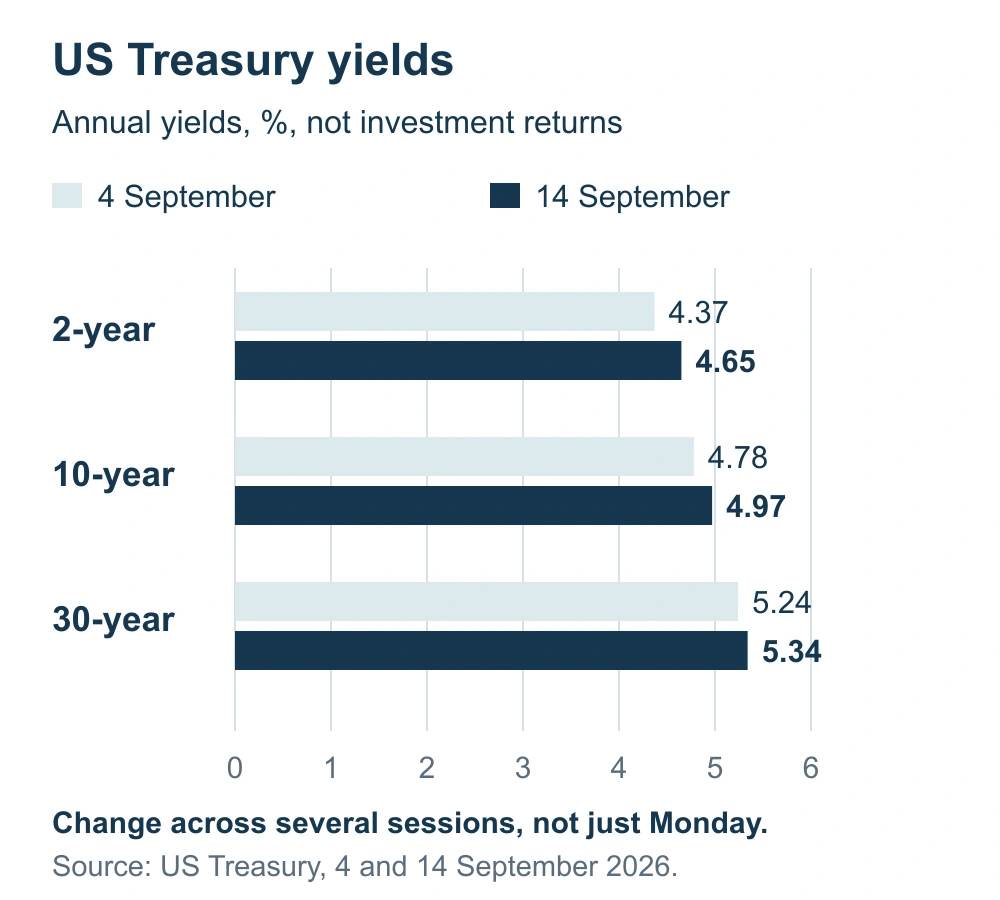
Tomorrow, what the Federal Reserve decides will matter, but so will its explanation of the next steps. The US Treasury’s Monday closing table put the ten-year yield at 4.97%, compared with 4.78% on 4 September. The two-year yield rose from 4.37% to 4.65% over the same interval. Monday’s changes alone were small, however: 0.01 and 0.02 percentage points respectively. The pressure accumulated over several days is not a fresh, single-session jump.
Higher interest rates benefit an investor making a new loan, but make life harder for a business that will soon need to refinance. They also reduce the appeal of previously issued fixed-rate bonds, typically putting pressure on their market prices. For equities, the question is whether profits can grow enough to offset more expensive borrowing and a more cautious valuation of future earnings.
? Bond yield: why is it not a return already earned?
A bond’s yield connects its market price with its expected interest and redemption payments. The US Treasury’s constant-maturity estimates are not a particular investor’s transaction. A higher yield generally involves paying less for the same fixed payments. A move from 4.78% to 4.97% is 0.19 percentage points. The final investment return also depends on the selling price, holding period and currency.
The opportunity would be easing inflation concerns and stabilising interest rates; the main risk is that higher energy prices spread to other prices. Until tomorrow’s decision, the US policy rate target range remains 3.50–3.75%. A yield chart alone does not prove what the central bank will decide.
China’s factories are growing faster, but consumers are in no hurry
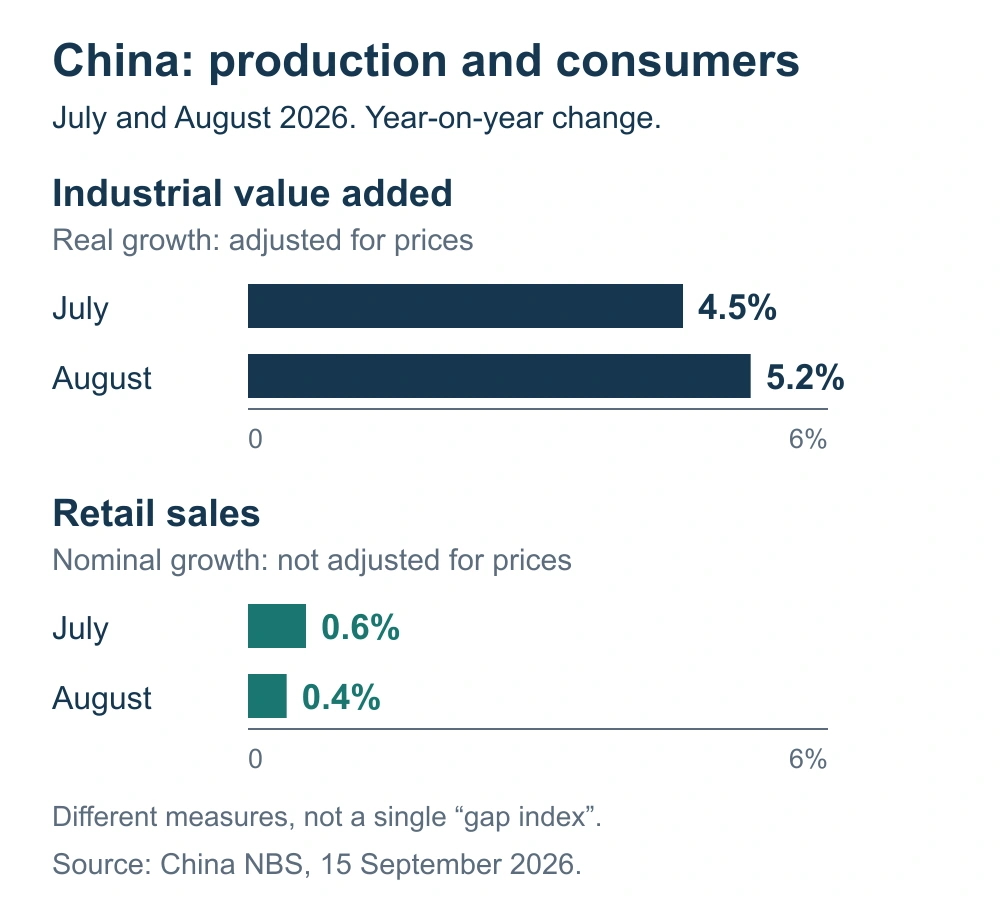
The August data released today resist a one-word description of China’s economy. Industrial value added rose 5.2% year on year in real terms, compared with 4.5% growth in July. Retail sales increased by just 0.4% year on year in nominal terms. These are different measures, but together they show why stronger production cannot automatically be taken as evidence of stronger consumption.
Higher factory output can help equipment, automation and export suppliers. Weak consumer spending calls for more caution towards consumer-goods and housing-related businesses. This matters to Europe in both directions: some companies sell equipment to China, while others depend on its consumers. The same regional weight in a portfolio can conceal very different businesses.
? Industry and retail sales: why do we not subtract one from the other?
Industrial value added measures the value created by industry, with the effect of prices removed in this release. Total retail sales of consumer goods cover the value of goods and catering sales at current prices. Their coverage and price adjustments differ. The difference between 5.2% and 0.4% is therefore not a precise measure of the gap between production and consumption. Both figures here compare with August 2025.
An opportunity would emerge if production growth were accompanied by a broader recovery in consumption. The risk is greater output without enough demand, squeezing selling prices and profitability. The next checkpoints are new stimulus measures, companies’ assessments of orders and September business surveys. These are still future signals, not an already confirmed turning point.

Check your saving plan
Are your monthly contributions enough?
Compare your monthly contribution with your target future income. Adjust the time horizon to see how the amount you need changes.
This compares scenarios; it does not promise a future outcome.
Today
What matters now
Mini-analysis: expensive government debt does not mean nobody is buying it
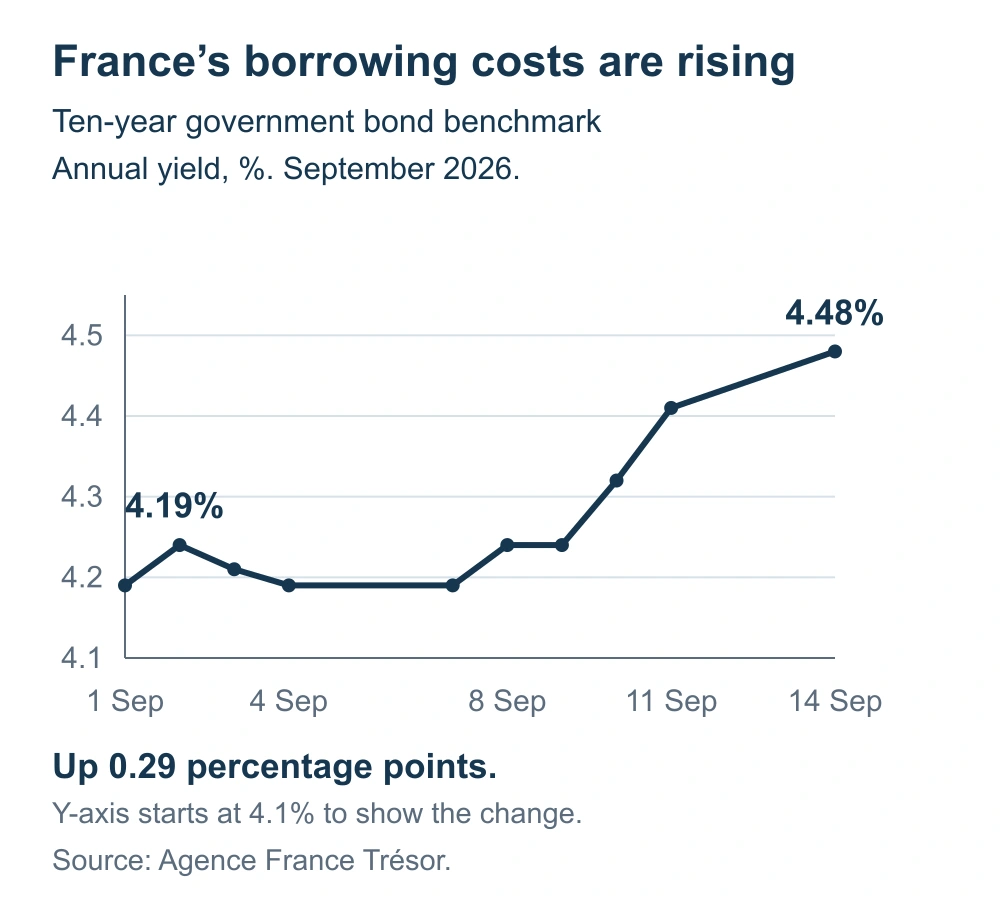
France illustrates the difference between a higher price for risk and demand disappearing entirely. Its ten-year government bond yield benchmark reached 4.48% on 14 September, up from 4.19% on 1 September. Yet the bids submitted at Monday’s short-term securities auctions were 2.78–4.26 times the amount allocated. A long-term benchmark and a short-term auction are not the same instrument, but both help avoid an overly simplistic crisis conclusion.
Higher interest rates increase a government’s future debt-servicing costs when it borrows again. They are unfavourable for the prices of existing longer-term bonds, while offering new buyers higher yields. For French banks and companies, the question is how much of this increase will feed through to their financing costs. We do not attribute the entire trend to domestic politics: euro-area interest rates and inflation expectations are changing too.
? What does France’s ten-year benchmark measure?
France’s ten-year constant-maturity Treasury rate, TEC 10, summarises the market yield at a standard ten-year maturity. It is not a central bank policy rate. The auction bid-to-cover ratio compares the volume of bids with the amount issued. It does not prove that the prices offered were favourable to the seller or that market risk has disappeared.
The opportunity is higher-yielding, high-quality debt, provided its maturity and price fluctuations suit the investor. Risk remains: if yields keep rising, a security bought earlier can fall in price. The 17 September auction will provide a test of both demand and price. A strong short-term bill auction alone does not guarantee equally strong demand for long-term bonds.
Portfolio takeaway: who can cover the bigger bills?
Oil supply, high interest rates and uneven Chinese demand meet on companies’ profit lines. An energy-buying, heavily indebted business depends on different conditions from an equipment supplier with cash reserves. Continuing production growth and bond buyers who have not disappeared provide a counterweight. This is not a one-way story of inevitable decline. For an investor using euros, the dollar also matters: the European Central Bank’s reference rate on 14 September was 1.1551 dollars per euro, compared with 1.1592 on Friday. The dollar’s strengthening over this interval supports the euro value of unhedged US assets, but does not remove equity or bond price risk.
Today
What comes next
What comes next: decisions matter, and so do their explanations
- 16 September, United States. Retail sales data will show the direction of consumer spending, and the Federal Reserve will announce its interest rate decision in the evening. Its assessment of energy prices and further progress on inflation will be crucial.
- 16–17 September, Europe. The already approved increase in the European Central Bank’s deposit rate to 2.50% takes effect on Wednesday. On Thursday, France’s bond auction and the Bank of England decision will provide fresh signals about financing costs.
- The coming days: energy supply. Confirmed updates on pipeline repairs, actual cargo flows and inventories matter. A reliable restoration of supply would weaken this week’s cost-risk thesis; fresh disruptions would strengthen it.
Interest rate and supply scenarios can still change. This review separates data already published from forecasts and future decisions. It provides general information, not a personal instruction to buy or sell.
Important. This is general market analysis, not a personal recommendation to buy or sell. Historical data and company results do not guarantee future returns. Forecasts and conditional scenarios may not materialise.
How is the history preserved and updated?
All five periods in this edition share one information date. Week means the latest 7 days, quarter means 90 days, and year means the trailing 12 months. The next dated edition will have a separate URL. This text keeps its date and assessment; later events are not silently inserted into an older edition. Longer periods assess new evidence alongside earlier developments without repeating every headline.