
Week · Market review
11–17 September: higher rates test company profits
Across seven calendar days, energy bills and interest rates became a clearer test of corporate profit. The US raised rates yesterday; sales grew, but imported inputs became more expensive. Fuel stocks are uneven. This window covers seven calendar days, not just a completed five-session trading week.
Period covered: 2026-09-11 – 2026-09-17Information as of 6 min read
On 16 September, the Federal Reserve raised its target range to 3.75–4.00%. August US sales and import-price figures, weekly fuel inventories and July European industrial volumes were also released that day. At this morning’s cutoff, these were completed developments, not upcoming announcements.
Across every time horizon, the test is how much of stronger sales survives after a business pays more for loans, imported products and fuel. A single revenue figure does not show real quantities or profit margins. Policymakers’ longer-term projections do not guarantee the outcome of future meetings.
Week
What happened
The starting backdrop before 11 September: energy volumes and forecast dates
Unreliable energy supply continued to shape the backdrop at the start of the week. A company needs to know more than the price of oil: will the cargo arrive on time, and how much will delivery cost? Bigger fuel bills squeeze transport and industry, leaving households less money for other goods. A disruption announcement alone is not enough to calculate the volume of oil lost or the change in a particular company’s profits.
The outlook published by the US Energy Information Administration on 9 September added a longer-term perspective. Its model inputs, however, had been collected by 3 September. Events announced later therefore cannot be described as the reason for that forecast revision. Nor is a forecast average price for a future period today’s exchange price. For an investor, this distinction separates a possible scenario from a price move that has already happened.
10 September: Europe approved a decision taking effect on 16 September
The European Central Bank decided to raise all three key interest rates by 0.25 percentage points. The deposit facility rate rose from 2.25% to 2.50% on 16 September. This is the rate paid on banks’ overnight deposits at the central bank, not a household deposit or mortgage offer.
The decision matters because higher rates can help restrain price growth while making new investments harder to finance. Companies that must soon refinance debt need to assess the terms of their next loan. A variable-rate loan payment changes according to its specific contract and reset date, not automatically alongside the central bank. Higher rates can help banks’ income, but they do not erase the risk that some customers will find repayment harder.
11 September: US headline price growth accelerated, but not every measure worsened
US consumer prices rose 0.4% in August from the previous month after adjustment for normal seasonal patterns, compared with 0.1% in July. Annual inflation remained at 3.4%. At the same time, annual inflation excluding food and energy slowed from 2.5% to 2.4%. One release therefore offered both a warning about faster price growth in the latest month and a counterbalancing signal of slower core inflation.
What is the Consumer Price Index?
The Consumer Price Index summarises the prices of a basket of goods and services bought by households, using consumption weights. The monthly change shows the latest pace, while the annual change compares with the same month of the previous year. It is not each family’s personal change in spending. Removing food and energy helps track a more stable price trend, but does not mean households avoid these costs.
11 September: new wealth data explained another side of economic resilience
Federal Reserve statistics showed that the net worth of US households and nonprofit organisations reached 195.9 trillion US dollars in the second quarter, up about 7% from the previous quarter. Equities held directly and through funds and other vehicles were worth 74.0 trillion dollars, while owner-occupied housing was worth 49.8 trillion. These are end-June asset balances, not September trading results or cash in bank accounts.
11 September: supply problems remained larger than demand weakness
The International Energy Agency’s 11 September forecast projected a larger fall in oil supply than in demand this year. This is a forecast, not the final annual result.
Lower demand does not automatically mean cheaper oil. If the volume reaching buyers falls faster, fuel bills can remain high even as the economy slows. This can help an energy producer only if it can deliver its output. For a haulier or an energy-buying factory, the same situation raises costs.
14 September: more expensive government debt did not mean a shortage of buyers
France’s ten-year market yield indicator, published by its Treasury, stood at 4.48% on Monday, compared with 4.19% on 1 September. At the short-term Treasury bill auctions on the same day, 14 September, bids were 2.78–4.26 times the amount issued. These are instruments of different maturities: the auction does not prove equally strong demand for ten-year debt.
These facts help distinguish two situations. Borrowing can cost more even when there is no shortage of willing lenders. The price of new borrowing matters to the government budget, while fluctuations in market value matter to an existing holder of a longer-term bond. A higher yield is neither proof of insolvency nor a promise of risk-free returns.

Professional portfolio management
A plan for your portfolio. No rush.
Let’s discuss your goals, risk tolerance and time horizon. Find out how your portfolio would be built and managed.
The first conversation is free, with no obligation.
Week
What matters now
The 16 September decision recast the rate-versus-profit story
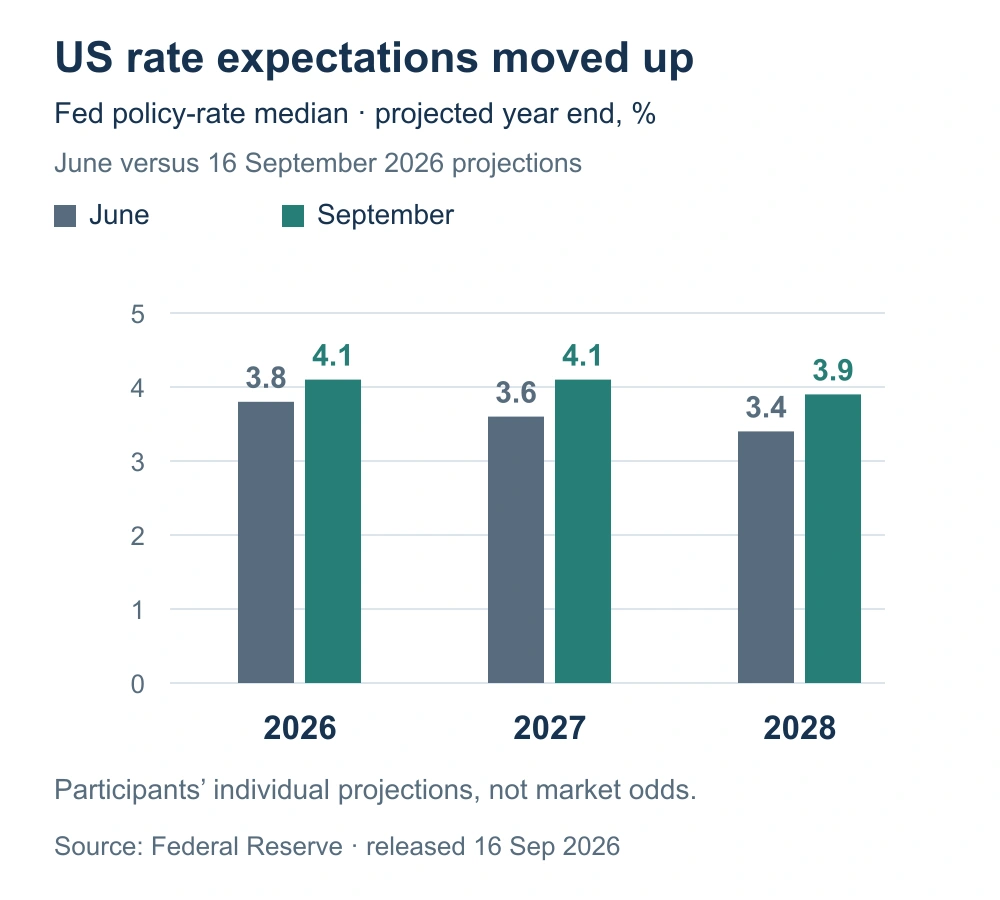
Yesterday, the Federal Reserve raised its target range to 3.75–4.00%. Policymakers’ median end-2026 rate projection moved from 3.8% in June to 4.1%, and the end-2027 figure from 3.6% to 4.1%. These are neither guaranteed meeting outcomes nor market-implied probabilities. Across the longer investment horizon, the turn matters because companies financing growth with fresh borrowing face a higher interest bill. Owners of existing fixed-rate bonds also need to watch their market value.
There is a genuine counterweight from demand. US retail and food-services sales for August, reported yesterday, rose 1.2% on the month to $773.9 billion. But those are nominal dollars; import prices rose 0.7% in the same month, so higher revenue does not ensure better margins. When sales grow while goods and borrowing become more expensive, the outcome differs across sectors. Investors need to distinguish quantity sold, profit and the need for debt.
Fuel stocks show that energy risk depends on the product
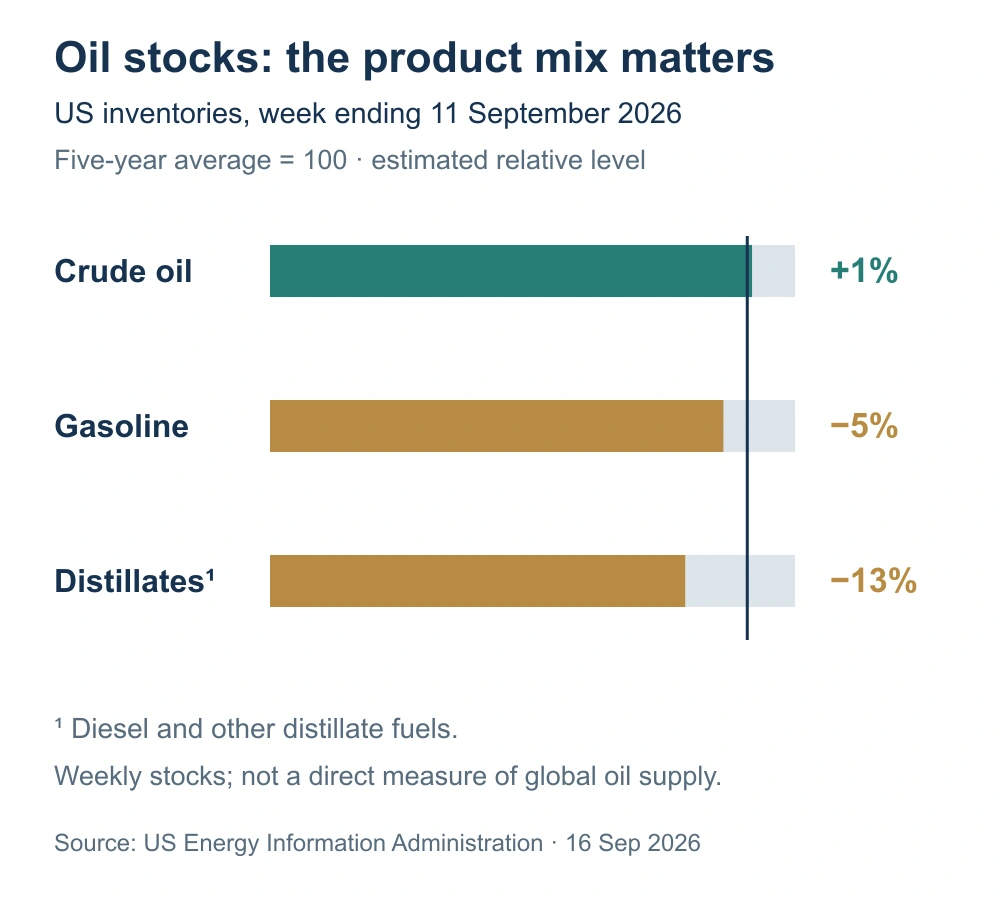
In yesterday’s US weekly report, crude inventories stood 1% above their five-year seasonal norm. Gasoline was 5% below it, while distillates, including diesel, were 13% below. Crude volume alone therefore cannot answer how much the fuel needed by a haulier or factory will cost. These are US inventories, not a global production measure or a price forecast. An oil producer and a fuel-buying airline may sit on opposite sides of the same portfolio exposure.
In Europe, July industrial production slipped 0.1% on the month, although capital goods rose 0.5% while non-durable consumer goods fell 1.6%. The figures, published yesterday, do not describe every factory as equally weak. The European Central Bank’s deposit facility rate increase to 2.50% took effect on 16 September. More expensive new loans could later impede investment, but the July production figure cannot prove that outcome. The opportunity is sustained orders with stabilising costs; the risk is a narrowing margin if bills rise faster than sales.
Week
What comes next
What will test the main thesis for this period?
The next signals are Eurostat’s detailed August inflation figures planned for 17 September, the next US weekly fuel-stock report and the US employment release on 2 October. The Federal Reserve meeting on 27–28 October will bring another decision, but its outcome is not known in advance. If volumes sold and corporate margins hold up, today’s cost pressures will be easier to absorb. If prices and interest bills keep rising faster than profit, indebted companies and longer-term bonds will remain under pressure.
Important. This is general market analysis, not a personal recommendation to buy or sell. Historical data and company results do not guarantee future returns. Forecasts and conditional scenarios may not materialise.
How is the history preserved and updated?
All five periods in this edition share one information date. Week means the latest 7 days, quarter means 90 days, and year means the trailing 12 months. The next dated edition will have a separate URL. This text keeps its date and assessment; later events are not silently inserted into an older edition. Longer periods assess new evidence alongside earlier developments without repeating every headline.