
Weekly market review · 2–6 November
Stocks fall as UK interest rates rise: the weekly review
The fall in US equities on 5 November and Japan’s sharp decline the following day showed that better economic data do not automatically protect investment values. The Bank of England also raised interest rates that week: pressure from energy costs meant cheaper borrowing could not be taken for granted.
The week at a glance
What moved markets before the detailed explanation
US and Japanese equities fell while US employment and productivity improved. Energy costs nevertheless prompted a Bank of England rate increase.
- Nasdaq Composite−3.37%Price-index change, 30 October–6 November, USD basis
- Nikkei 225−9.25%Price-index change, 30 October–6 November, JPY basis
- US 2-year yield4.51%6 November; down 5 basis points from 30 October
- US 10-year yield4.86%6 November; down 8 basis points from 30 October
- US 30-year yield5.26%6 November; down 5 basis points from 30 October
A more resilient economy did not prevent stocks from falling
The week of 2–6 November ended with a clear distinction between how businesses are performing and the price investors are willing to pay for their shares. The US Nasdaq Composite was still rising in the middle of the week. Thursday’s broad sell-off changed the picture, while Friday’s Japanese session showed that the risk was not confined to one country. Comparing Friday with Thursday alone would miss the point: the partial US recovery did not erase the week’s loss.
The economic news did not describe a uniform deterioration. Thursday’s preliminary US productivity figures for the third quarter suggested that businesses could produce more without increasing working hours at the same rate. Friday’s employment report added job growth and favourable revisions to earlier months. That matters for household incomes and company sales, but it does not guarantee that share prices already reflect every risk.
Europe faced another problem: higher energy prices are still feeding into business and household costs. On 5 November the Bank of England responded with higher interest rates. Eurostat’s September producer-price figures, released on the same day, showed how different the energy sector’s price changes were from those across the rest of industry. Falling equities and the prospect of lower interest rates are therefore not automatically the same story.
Bonds sent a different signal: longer-term US government yields finished the week below the previous Friday’s levels. This helps explain why equity performance alone does not describe a mixed portfolio. However, the euro value of dollar-denominated assets also depends on exchange rates, while the burden of energy costs varies across businesses. The next tests will be US inflation and demand for new government bonds: can economic resilience coexist with less pressure on prices?
The sell-off was broad, and one better session was not enough
The US decline on 5 November extended beyond technology companies: the Nasdaq Composite fell 5.52% and the broader S&P 500 lost 4.36%. In Japan, the Nikkei 225 dropped 5.96% on 6 November, with 222 of its 225 constituents declining. Such breadth matters even to investors who do not own individual technology shares but hold broad-market funds.
The full-week result remained negative. Between the closes on 30 October and 6 November, the Nasdaq Composite fell 3.37% and the Nikkei 225 lost 9.25%. The US index rose 1.09% on Friday but recovered only part of Thursday’s loss. These are price-index changes excluding dividends, calculated on a yen basis for Japan and a dollar basis for the US, not in euros.
A share that has fallen is not automatically cheaply valued: if expected earnings fall by as much or more, its price-to-earnings ratio may not improve. A lower price offers a better starting valuation only if revenues and profits remain sufficiently robust, not simply because the index has declined. US growth stocks and Japanese equities can fall together despite their different businesses. The next inflation figures and company order updates will help distinguish a reduced appetite for risk from weakening future revenues.
Political uncertainty also matters for data-centre development. On 5 November US Senate Democratic Leader Chuck Schumer set out an intention to protect household electricity bills from costs shifted by data centres. He promised more detail later and acknowledged the possibility of a presidential veto: this was an intention, not an enacted construction ban. If developers and tenants had to shoulder more infrastructure costs, projects could become more expensive and equipment orders could be delayed. The speech and the sell-off occurring on the same day do not, by themselves, establish the cause of the entire move.
For your investments
Let’s discuss your portfolio
 FINANCIAL FREEDOM01 / 04
Investment results since 1999
Are you beating
global equities?

at the end of the period
Jan 1999–Jun 2026 · EUR · Cumulative return, %
Linear scale · * MSCI World → MSCI ACWI.
Past performance does not guarantee future returns.
FINANCIAL FREEDOM02 / 04Historical comparison
How far did it fall?
How long to recover?
Decline from the previous high

Longest recovery to the previous high

Jan 1999–Jun 2026 · EUR · Monthly data
* MSCI World → MSCI ACWI.
Past performance does not guarantee future returns.
FINANCIAL FREEDOM03 / 04Personal investment consultation
Already investing?
Let’s review your portfolio.
Yet to start
investing?
Let’s build your first
investment plan.
FINANCIAL FREEDOM04 / 04
Personal investment
consultation
Martynas
Juška
Investment manager
Managing a portfolio
of more than€100 million
US employment and productivity counterbalanced the equity weakness
On 6 November the US Bureau of Labor Statistics reported an increase of 165,000 nonfarm payroll jobs in October. September’s gain was revised to 60,000 and August’s to 186,000, an upward revision of 84,000 across the two months. The previous picture for September was therefore weaker than the latest data now indicate. Unemployment eased from 4.2% to 4.1% of the labour force, although the agency described the change as small.
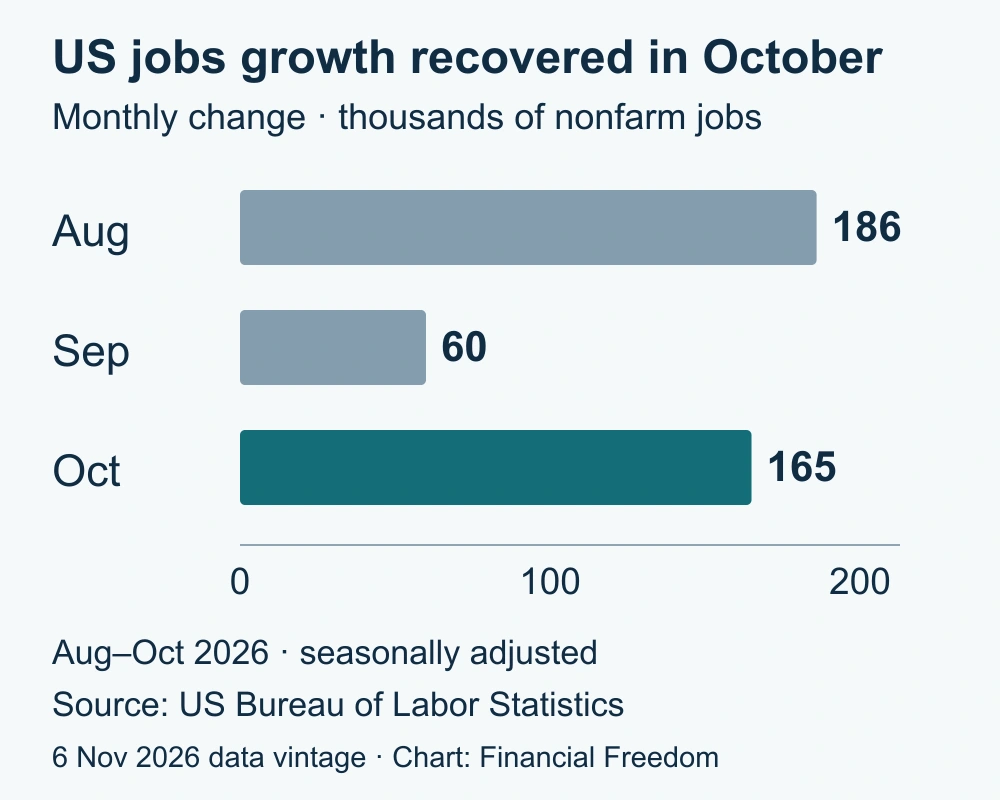
Private-sector average hourly earnings rose 3.1% over the year, potentially supporting consumer businesses’ sales. For bonds and debt-financed property, however, a more resilient labour market reduces the need for urgent rate cuts to support demand.
Productivity can help reconcile rising pay with company profitability. Preliminary figures released on 5 November showed US nonfarm-business productivity increasing by 3.6% in the third quarter while unit labour costs fell by 0.7%. Both are quarterly rates expressed at an annualised pace. This does not mean wages fell: hourly pay and other compensation increased.
Unit labour costs compare employee compensation with the quantity of output produced. An annualised quarterly rate shows the change that would occur if the same quarterly pace continued for a year; it is not the actual year-on-year change.
This favourable combination did not apply automatically to every sector: manufacturing unit labour costs increased by 2.7% at the same annualised quarterly pace. The relevant question is whether a particular company is genuinely becoming more productive or simply facing higher costs. US consumer-price data on 10 November will help show how much pay growth translates into real purchasing power.

Professional portfolio management
Markets change every week. Your portfolio should not change with every headline.
Portfolio management turns market information into a consistent process: risk and concentration are monitored, while decisions follow your agreed strategy instead of the latest market move.
Energy costs raised both bills and interest rates in Europe
On 5 November the Bank of England raised Bank Rate from 3.75% to 4.00%. Eight committee members voted for the quarter-percentage-point increase; one wanted a larger move. The decision matters for UK businesses and households taking out or refinancing loans: lower share prices do not automatically mean cheaper financing.
The Bank forecasts that energy costs will lift annual inflation from September’s 3.5% to around 5% by mid-2027. Evidence of pressures spreading to other prices and pay remains limited, so it makes no commitment to a future rate path.
Euro-area September producer-price figures, published on 5 November, highlighted the energy sector’s exceptional move. Industrial selling prices increased by 2.5% over the month, energy prices by 7.8%, and prices across industry excluding energy by just 0.1%. The headline figure therefore does not describe every sector equally.
The producer-price index measures changes in industrial companies’ selling prices on the domestic market. It is not the household consumption basket and cannot directly establish consumer inflation or a company’s profit margin.
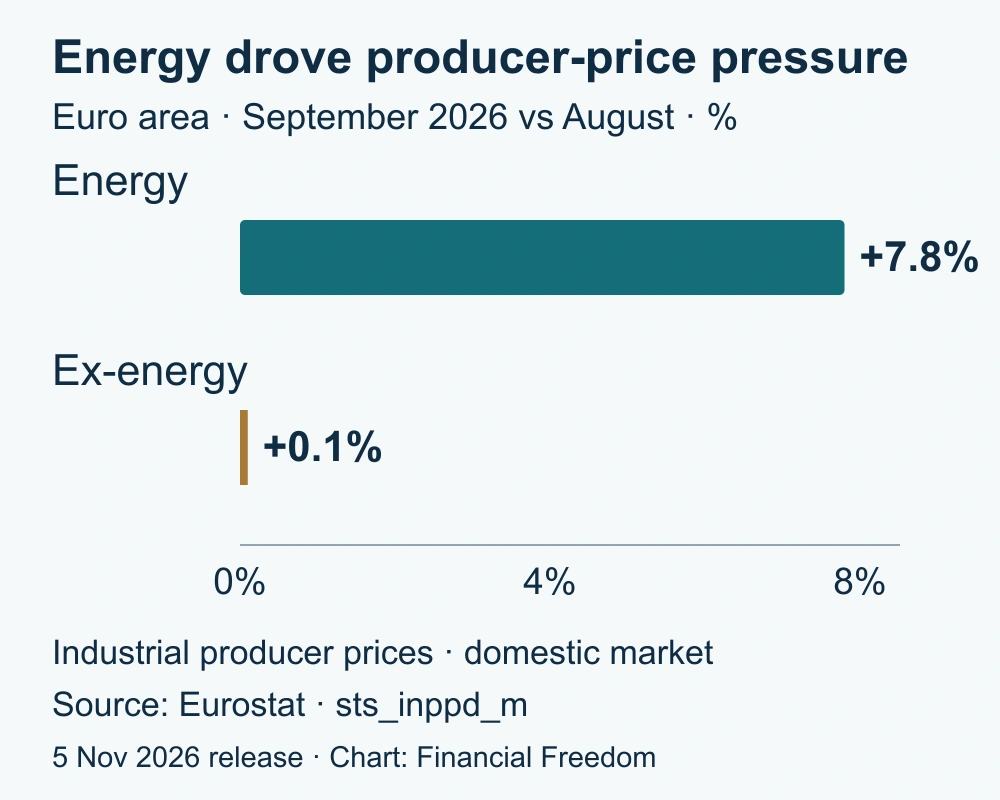
Higher prices can support energy suppliers’ revenues but squeeze energy-intensive manufacturers’ profits if costs cannot be passed on to customers. UK bonds and property companies also face interest-rate risk. Easing energy pressures would create an opportunity; their spread into pay and services is the risk. The next euro-area producer-price release is scheduled for 3 December.
US bonds showed that portfolio components need not move together
US government bond yields ended the week below the previous Friday’s levels. The ten-year measure declined from 4.94% on 30 October to 4.86% on 6 November, a fall of eight basis points. The two-year yield eased from 4.56% to 4.51%, and the thirty-year yield from 5.31% to 5.26%. These changes are not the percentage investment returns on those bonds.
Yield relates a bond’s price to its future payments; a decline in market yields generally increases the price of an existing fixed-rate bond. The figures here are the US Treasury’s modelled fixed-maturity nominal par yields. One basis point is 0.01 percentage point.
Lower yields can help government bonds offset equity losses, but a longer maturity increases price sensitivity to the opposite move too. Corporate bonds also depend on the issuer’s ability to repay, so they are not an identical counterweight.
On 4 November the Treasury announced a $125 billion refunding offering: approximately $97 billion will replace maturing privately held debt and about $28 billion will raise new cash. Three-year, ten-year and thirty-year auctions are scheduled for 9, 10 and 12 November respectively. Demand will help show whether investors are willing to finance the US at these yields. These are forthcoming events, not results from last week’s auctions.
The next question: can lower price pressure validate economic resilience?
Falling equities do not show that US household incomes are already shrinking, while higher productivity does not guarantee cheaper energy. This distinction means a portfolio requires separate assessments of company profits, share prices and borrowing conditions. Labour-market resilience counterbalances the risk of an economic downturn but does not protect investment values from fluctuating.
US consumer prices on 10 November, producer prices on 13 November and Treasury auctions on 9, 10 and 12 November will test the next question: can the economy stay resilient without raising the cost of financing? The next scheduled Federal Reserve meeting is on 8–9 December. The 3.75–4.00% policy range left unchanged on 28 October is not a promise about the next decision.
Important. This is general market analysis, not a personal investment recommendation. Investment values can fall, and past performance does not guarantee future results.