
30 days · Market review
Over 30 days, earnings growth could not settle energy and rate risks
The broad US equity sell-off on 5 November showed that growing technology-company revenue alone was not enough to sustain market confidence. From 11 October to 9 November, investors had to reconcile strong demand for equipment and chips with energy and financing costs that made future investment more expensive. Japan’s rebound on 9 November had not resolved that tension.
Period covered: 2026-10-11 – 2026-11-09Information as of 7 min read
A new wave of broad US and Asian equity selling emerged towards the end of the period. Meanwhile, US payroll figures improved and China reported faster producer-price inflation but slower consumer-price inflation.
October’s chip-company results remain evidence of revenue already earned, but their next-quarter forecasts have not yet been fulfilled. The pass-through of energy costs and the eventual returns on investment remain open questions.
30 days
What happened
By mid-October, higher energy costs had reached consumer prices
The US Bureau of Labor Statistics release on 14 October showed why oil matters beyond energy shares. Annual consumer-price inflation accelerated from 3.4% to 3.7% in September. Petrol prices rose 9.1% over the month and accounted for more than half of the overall monthly price increase. This left households with less money for other purchases while making the case for rapid interest-rate cuts more difficult.
Also on 14 October, the International Energy Agency reported that world oil supply had increased by 2.5 million barrels a day to 102.3 million in September. Recovering supply was an important counterweight, but the agency still described diesel markets as strained. More crude production does not necessarily mean that the right fuels are available everywhere: refining, logistics and regional supply disruptions also affect their prices.
? Consumer and producer prices: why can they diverge?
The consumer price index measures a basket of household goods and services, while the producer index measures businesses’ selling prices. Higher energy costs may reach customers later or only partly, so producer inflation is not a copy of future consumer inflation.
Strong chip-sector results did not stop every market setback
Dutch chipmaking-equipment supplier ASML reported third-quarter revenue of €11.662 billion on 14 October, compared with €9.326 billion in the second quarter. The company described strong customer demand, but interest in equipment for later years does not yet represent a complete flow of final orders and paid sales. This distinction matters to the equipment manufacturer and its suppliers as they plan additional capacity.
Taiwanese chip manufacturer TSMC reported third-quarter revenue of US$46.72 billion on 15 October. It forecast US$52.3–54.3 billion for the fourth quarter. These figures show a substantial existing business and an ambitious further sales plan, but forecast revenue has not yet been earned. A chip foundry’s revenue also does not prove that all its customers’ data centres are already generating a return on their investment.
On 15 October, market stress in South Korea triggered an automatic safeguard: after the broad KOSPI index fell at least 8% and remained there for a minute, trading was halted for 20 minutes at 12:38 local time. This describes a specific October session, not a November trading halt. A suspension temporarily pauses transactions but does not guarantee that prices will rise when trading resumes.
Chinese growth concealed a large gap between industry and construction
On 19 October, China reported that its real economy grew 4.5% year on year in the third quarter, compared with 4.3% in the second. However, property-development investment during the first nine months of the year was 20.6% below the preceding year’s level. The headline growth figure was therefore not equally favourable for industrial-equipment exporters, construction-material suppliers and property developers.
Central banks took different paths at the end of October
On 28 October, the US Federal Reserve retained its 3.75–4.00% target range, while the Bank of Canada raised its policy rate by 0.25 percentage points to 2.50%. The European Central Bank kept its deposit rate at 2.50% on 29 October. These were different decisions for different economies, not a single worldwide phase of cheaper borrowing.
The Bank of Japan retained its 1.25% policy rate on 30 October. It also announced that it would increase the pace of disposals of its exchange-traded-fund holdings from January 2027. This was a future plan, not additional selling already completed in November. Australia subsequently raised its rate to 4.85% on 3 November and the Bank of England to 4.00% on 5 November, each by 0.25 percentage points.
For your investments
Let’s discuss your portfolio
 FINANCIAL FREEDOM01 / 04
Investment results since 1999
Are you beating
global equities?

at the end of the period
Jan 1999–Jun 2026 · EUR · Cumulative return, %
Linear scale · * MSCI World → MSCI ACWI.
Past performance does not guarantee future returns.
FINANCIAL FREEDOM02 / 04Historical comparison
How far did it fall?
How long to recover?
Decline from the previous high

Longest recovery to the previous high

Jan 1999–Jun 2026 · EUR · Monthly data
* MSCI World → MSCI ACWI.
Past performance does not guarantee future returns.
FINANCIAL FREEDOM03 / 04Personal investment consultation
Already investing?
Let’s review your portfolio.
Yet to start
investing?
Let’s build your first
investment plan.
FINANCIAL FREEDOM04 / 04
Personal investment
consultation
Martynas
Juška
Investment manager
Managing a portfolio
of more than€100 million
November’s equity decline extended beyond technology
On 5 November, the US S&P 500 price index fell 4.36% and the Nasdaq Composite lost 5.52%. Japan’s Nikkei 225 dropped 5.96% on 6 November. These are specific session price changes, not returns for this entire 30-day period. Declines in the broader US index and Japan matter to an investor expecting to reduce risk merely by spreading money across several equity funds.
New political intentions also followed the US election on 3 November: on 5 November, Senate Democratic leader Chuck Schumer listed stopping tariffs and protecting households from electricity-infrastructure costs shifted onto them because of concessions to data centres. These were not enacted laws. A possible redistribution of expenses could change data-centre investment returns, but it does not establish a single cause for the broad equity sell-off.
The US Nasdaq recovered 1.09% on 6 November, while at 07:50 Lithuanian time on 9 November Japan’s Nikkei was up 2.41% from Friday’s close. The Japanese session was still in progress. These partial rebounds did not erase the preceding losses, but they show why a few days of selling cannot, without new evidence, be turned into either a permanent-decline scenario or a guaranteed recovery.
The latest economic releases did not point in one direction
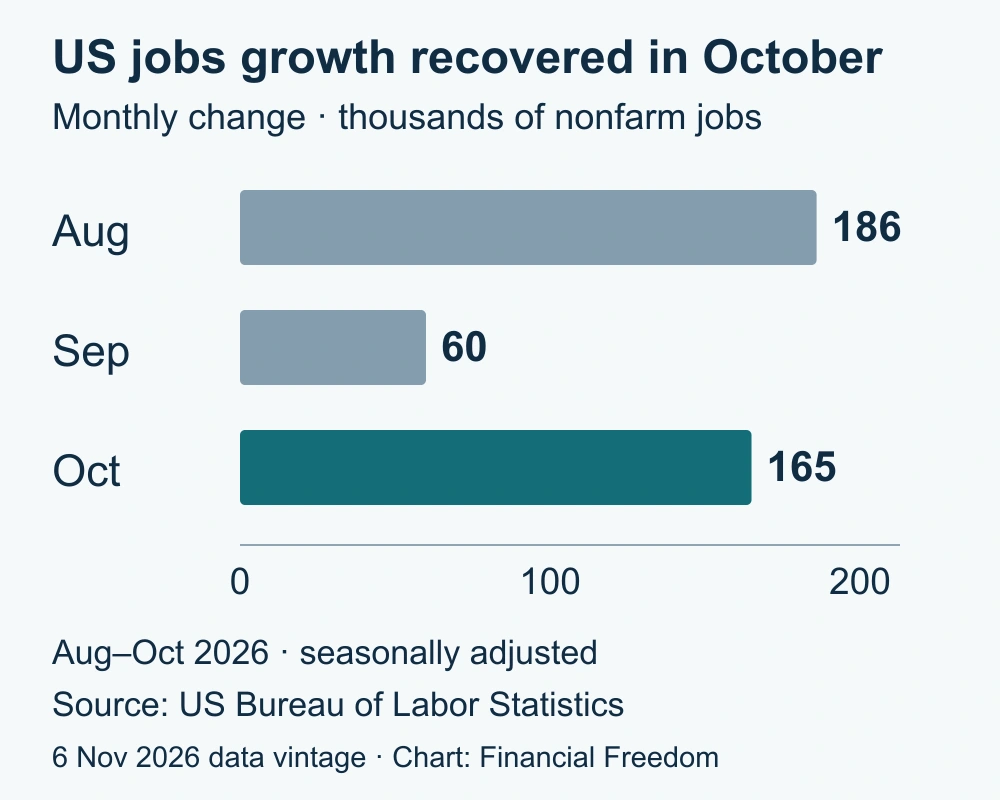
US October figures released on 6 November showed 165,000 additional non-farm payroll jobs and unemployment of 4.1%. The combined August and September payroll increases were revised upwards by 84,000. This is an important counterweight to the assumption that household incomes are already weakening sharply, but it also prevents rate cuts from being treated as an automatic response to falling shares.
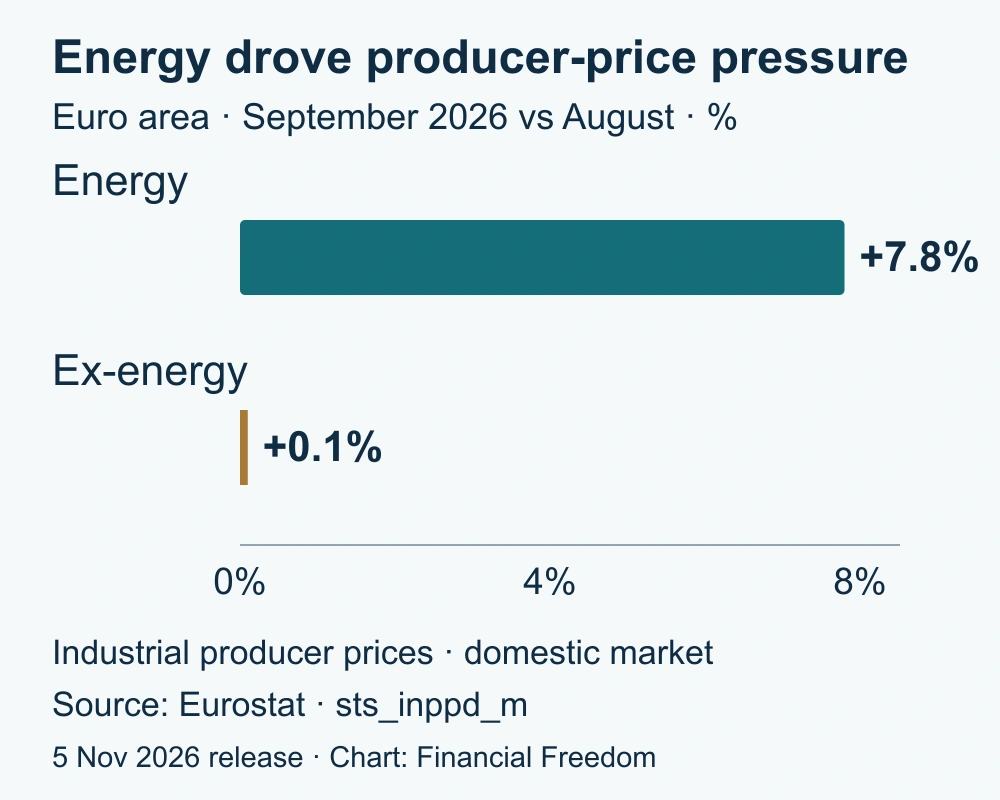
China’s October price release on 9 November added another divergence: annual consumer-price inflation slowed from 0.9% to 0.7%, while producer-price inflation accelerated from 5.0% to 5.7%. September figures released in Europe on 5 November had already shown a 30.8% annual increase in producer energy prices. Resilient demand therefore had to be assessed alongside business costs that were unevenly distributed.
30 days
What matters now
Sales growth matters alongside what the business retains
The technology story over this period requires a distinction between three things: an equipment supplier’s sales, orders received by the factory buying that equipment, and the eventual data centre’s earnings. The first may already appear in revenue while the third still requires years and further investment. Equipment and chip suppliers can therefore grow while their customers have less cash available. This is an economic relationship, not a finding about every individual company’s current cash flow.
An opportunity would arise if strong demand persisted while construction, electricity and financing costs remained manageable. The opposing risk is that weaker final usage or additional expenses reduce the future profits underpinning share prices. Semiconductor manufacturers, software suppliers and data-centre owners should therefore not be treated as completely interchangeable investments.
Energy and interest rates affect several portfolio exposures at once
More expensive fuel can support some energy producers’ revenue while making profitability harder for airlines, logistics companies and chemical manufacturers. Cheaper commodities could reverse that direction. A company’s ability to pass expenses on to customers matters: a long-term fixed-price sales contract and flexible pricing create different risks even within the same industry.
For bonds, maturity matters. The comparable US Treasury ten-year yield was 4.86% on 6 November, against 4.94% on 30 October. This comparison covers the last completed week, not all 30 days. A falling yield generally raises the price of existing fixed-rate bonds, but renewed inflation could undo that benefit.
? Bond yields: why can a decline be helpful?
When similar new bonds offer less interest, older fixed-rate bonds generally become more valuable. Longer maturities are usually more price-sensitive; a yield change is not an equivalent-sized fund return.
Currency remains a separate risk for a euro investor: the euro–dollar exchange rate can increase or reduce a dollar-denominated result. Several different global equity funds may also hold the same large technology companies. Portfolio diversification is therefore better assessed through actual companies, industries, currencies and debt maturities than through the number of funds owned.
30 days
What comes next
10 November: do new sales and prices support the earnings outlook?
TSMC plans to report October revenue on 10 November at 07:30 Lithuanian time. This is the first monthly check on whether actual sales in the new quarter support its guidance. One month’s revenue will not confirm the whole quarter’s profit, but it will help distinguish continuing demand from a repetition of earlier results.
The US October consumer price index follows that day at 15:30. The central question is whether September’s energy-driven inflation is easing and how much pricing pressure remains in other goods and services. US producer-price figures on 13 November will add evidence from businesses’ selling prices.
9–12 November debt auctions and the 8–9 December US decision
The US Treasury’s three-year, ten-year and thirty-year auctions take place on 9, 10 and 12 November respectively. They will show what interest investors require for different maturities. The next scheduled Federal Reserve meeting is on 8–9 December, not in November. Until then, new inflation and activity data will matter more, while political intentions should be assessed through specific proposals and enacted decisions.
Important. This is general market analysis, not a personal recommendation to buy or sell. Historical data and company results do not guarantee future returns. Forecasts and conditional scenarios may not materialise.
How is the history preserved and updated?
All five periods in this edition share one information date. Week means the latest 7 days, quarter means 90 days, and year means the trailing 12 months. The next dated edition will have a separate URL. This text keeps its date and assessment; later events are not silently inserted into an older edition. Longer periods assess new evidence alongside earlier developments without repeating every headline.